Changing the food paradigm, one person at a time
 Local cheesemaker takes home state fair’s top prize for cheese curds


June 8, 2026
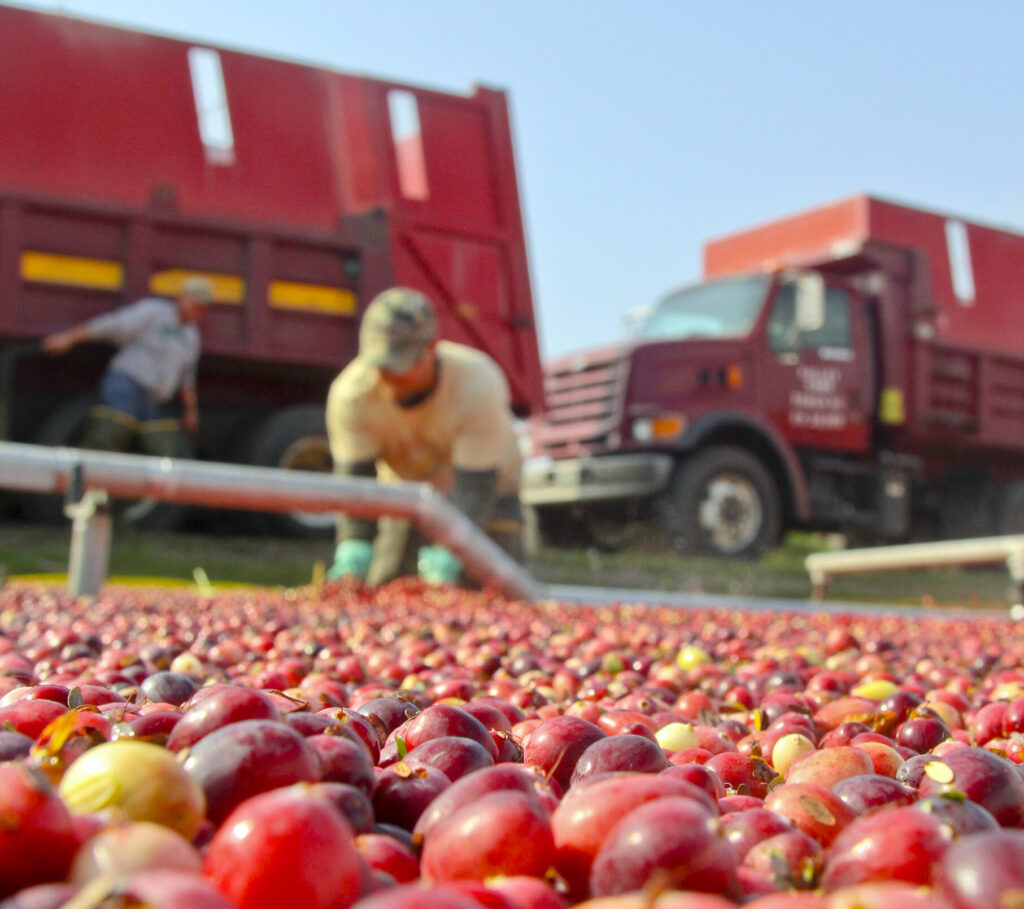
NORTH CENTRAL WISCONSIN – Even in what can be considered a down year, Wisconsin is continuing its cranberry conquest.
Per the Wisconsin Cranberry Board (WCB), the state produced 4.8 million barrels of cranberries in 2025, extending its streak atop all other states to 31 years running.
Though this represents an overall dip in production compared to the previous year’s 6.01 million barrels – covered in the June 9, 2025 issue of The Business News – the USDA National Agricultural Statistics Service reports Wisconsin’s overall production still represented more than 60% of the country’s cranberries.
For 2025, the state’s top five counties for cranberry production, according to the WCB were:
- Wood County – 1.38 million barrels (approximately 28.9% of Wisconsin’s total output)
- Monroe County – 989,333 barrels (20.6%)
- Jackson County – 765,135 barrels (15.9%)
- Juneau County – 626,493 barrels (13.1%)
- Vilas County – 278,980 barrels (5.8%)
Grant Holley – executive director of the Wisconsin State Cranberry Growers Association (WSCGA) – said the state’s prominence as a producer never gets old, nor is it taken for granted.
“Every year that we add to this [streak] is a new testament to how well Wisconsin is poised to be the cranberry leader,” he said. “And it’s not even just the United States, but within the world.”
Riding high with hybrids
Though Holley said Wisconsin’s climate deserves credit for being amenable to cranberry growth, two groups of people are responsible for the state’s production prosperity: farmers and scientists.
The latter, he said, endlessly study and experiment with ways to make cranberry vines highly durable and productive by cross-pollinating different species.
“The University of Wisconsin-Madison researchers are one of the greatest assets we have for our industry…,” he said, adding that they work in conjunction with the USDA. “They’re the ones who help us work through and develop the hybrids, and I hope they don’t ever stop.”
In an industry of ceaseless change – “sooner or later, there’s a new bug, there’s an invasive species, it gets warmer, colder, wetter, drier, etc.” – Holley said the WSCGA board supports the researchers’ ongoing efforts.
“Whenever you have a hybrid, you mix one species with another species, and we do it the old-fashioned way – we’re absolutely not genetically modifying anything,” he said. “We’re just ‘Tinder for cranberries,’ if you will.”
Holley – who began his career as a biology teacher – said the researchers’ ingenuity is invaluable to the state’s cranberry success.
“The unwillingness to change in a changing environment – that is the textbook definition of extinction,” he said. “If you do not evolve, if you do not change with your changing environment, you are bound for extinction. So, I hope [the UW researchers] never stop tinkering.”
Even the best need a rest
Holley said all healthy perennial plants – including the most advanced cranberry hybrids – take an occasional year to put their proverbial feet up.
“They can have banner years – a banner year one, banner year two, banner year three – and then they do get to the point where [it’s as if they decide], ‘You know what? I kind of want to sit on the couch and watch “Jeopardy” tonight’ – and you have a little bit of a lower[-yield] year,” he said.
For Wisconsin’s collective cranberry marshes, Holley said 2025 was one of those years.
However, whereas in most industries a 20% decline in annual production would be cause for alarm, he said the past year’s drop was “actually a really good thing.”
Holley said due to the experimental nature of hybrids, there’s potential concern as to the long-term viability of the new cranberry vines.
“Our vines can currently live 90-100 years, no problem,” he said. “When we make the hybrids, are we worried we could be making something that’s only going to last 20 or 30 years?”
Holley said when a perennial plant has its period of respite, “that’s always a good sign” it’s “practicing good self-help.”
If the plants weren’t taking that “Friday night off to watch ‘Jeopardy,’” Holley said there would be questions about their viability.
“Just like [people], if we push ourselves too hard, we’re reducing our life expectancy,” he said.
Holley said these concepts are well understood by cranberry growers, many of whom are able to draw upon generational industry wisdom.
“They’ve been on their same land for, [in some cases], 150 years, so they all know this is just sort of [how it goes] – ‘Yep, going to be the low year, can’t wait for next year’ – and that’s all it is,” he said. “There’s no stress with our folks. We all get it.”
A plant’s low year, Holley said, isn’t its equivalent of “hibernation,” as it will still produce “maybe half of the berries it normally does.”
Since the climate of a given year can trigger certain plants’ low years, and plants of the same age are apt to undergo cycles of productivity somewhat concurrently, Holley said cranberry farmers opt to stagger their plantings as well as vary the cranberry species they plant across their marsh beds.
Without this strategy, he said, a low year in 2025 could have yielded just three million barrels.
“[Yields] are going to average out, is what they’re going to wind up doing…,” he said. “[Farmers] would rather have years that are predictable than those highs and lows.”
Time ‘marshes’ on
Holley said cranberry farmers share the same enthusiasm as UW researchers when it comes to fine-tuning their craft.
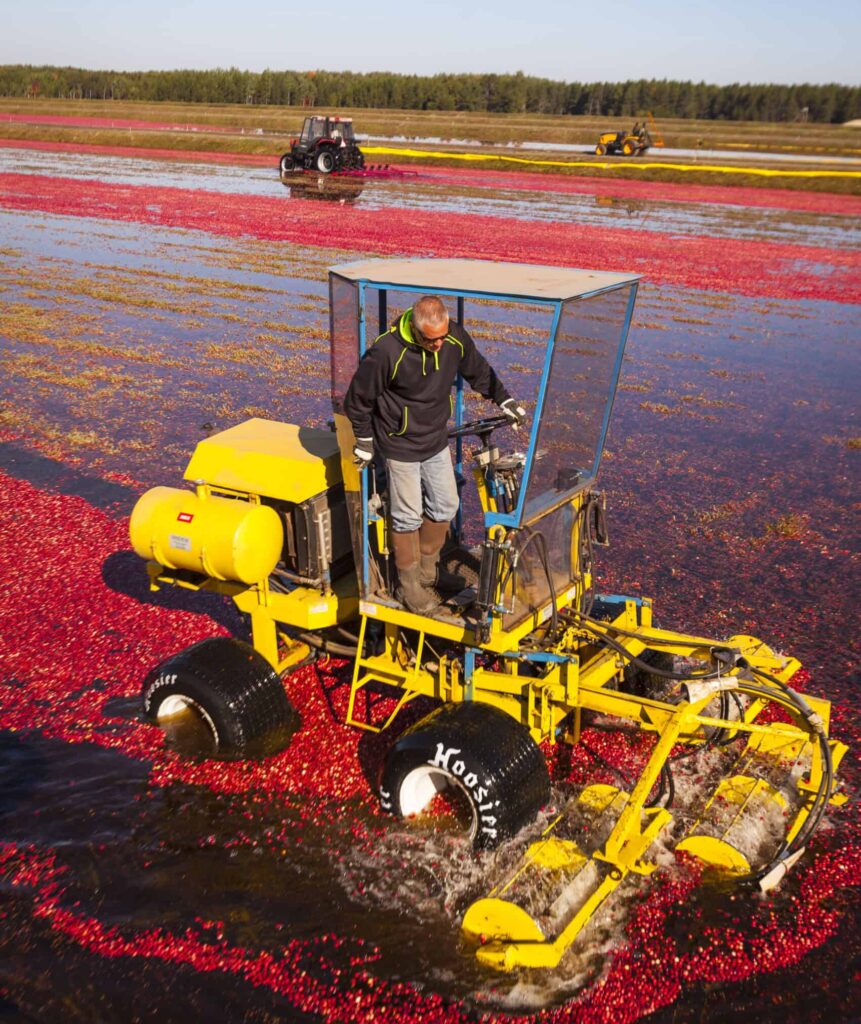
“Cranberry growers are nerds and engineers at heart,” he said. “They make a lot of their own equipment. They love tinkering with things – they’re really good at it.”
Holley said growers – who can represent up to eight generations of cranberry lineage – revere those who came before them and established their marshes, while finding their own passion for the industry.
“Really, this is their lives,” he said. “I know some of our growers who do social hours together and… try to make the rule that, ‘Tonight, we’re not going to talk about cranberries…’ It lasts 15-20 minutes. And it’s not out of burden – it’s because they just love what they do.”
Holley said the positivity for the industry only seems to amplify with each generation, painting an idyllic picture of childhood on the marshes.
“It takes a lot of water for cranberries, but that also means you’ve got a swimming hole,” he said. “You have all this land to be able to play, and you get to meet all of these other kids who are growing up exactly the same way, with the same values.”
Through his regular conversations with growers, Holley said many encourage their children to pursue careers outside cranberry farming, though most ultimately remain connected to the industry.
When farmers have multiple children, he said those who don’t end up running or working the cranberry farms will work adjacently, citing agricultural law, agribusiness and agritourism as common paths.
For those who exit the industry altogether, Holley said there often remains an unbreakable bond to berry life.
“So many of the folks who do leave the marshes will take their annual vacations to come back for harvest, not because ‘Ma and Pa Kettle’ need them – they’re going to make do [and] can get help if they wanted to – but this is how they grew up, and this is part of their holidays,” he said.
As succession plans play out across Wisconsin’s cranberry industry, Holley said generations honor the past while/by embracing futuristic tech.
One of the regional marshes he visits regularly, he said, serves as a vivid example of the dichotomy.
Holley said this particular marsh still utilizes cranberry-sorting equipment he estimates to be 120 years old, built of “the most beautiful oak and brass.”
“They’re functional, and they look like they should be in the Smithsonian,” he said. “They’re spotless, but it’s just that old-world-wood-meets-metal that gives you the shivers that Mark Twain is right around the corner. But, as the cranberries go through those [sorters] for size, they then go under a three-quarters-of-a-million-dollar infrared scanner that’s sitting right beside it.”
The image, Holley said, embodies the mindset of the state’s cranberry growers.
“If [modern equipment] helps their marshes, and it does it in a way that doesn’t negatively affect their marsh, then they’re all over it,” he said. “They will adopt it as quickly as can be.”
Holley said there are “a lot of hopes and dreams for AI” throughout the industry.
Presently, he said, technology has not been able to successfully comprehend the highly individualistic traits of cranberry marshes.
“We’re helping some research folks look into it, but we have adopted the philosophy that the AI boom isn’t quite here for us yet,” he said. “But we’re not going to ignore it – we’re just going to explore it slowly.”
‘It kind of goes against human nature’
Having grown up in West Virginia, Holley said what’s always struck him about Wisconsin’s cranberry industry isn’t the technology, but the character of its contributors.
Their honesty, reliability and eagerness to help, he said, are tough to fathom for the uninitiated.
“It’s a little bit like a cult,” he joked, “but it’s one of the most positive cults you’re ever going to get. The ‘cranberry Kool-Aid’ won’t have anything negative in it – it’s incredibly wholesome.”
Perhaps most impressive, Holley said, is the collective mentality of “it’s not about you – it’s about us.”
“As long as you can take ‘you’ out of the picture, you’re going to be incredibly successful, because you’re embracing the other entities you’re with, the diversity of ideas, the number of minds that come together for a common problem,” he said. “And whereas the concept is very easy to understand, it is the performance/execution of that concept that is difficult for most people. It kind of goes against human nature.”
For even a self-described “Pollyanna” – someone unyieldingly optimistic even in difficult situations – Holley said it never fails to amaze him when he witnesses board members make decisions not entirely in their own best interest.
“You know they want to vote against something, but they also look at it from the community standard and [decide], ‘I’ll suck it up – this is what is best for our entire community,’” he said.
It’s this mentality above all, Holley said, that bodes well for Wisconsin’s cranberry industry. “‘What is best for all of us’ – it’s that simple,” he said.