Waseda Farms: ‘Trust where your food comes from’
 Mold resistant, pest resistant, rot resistant, fire resistant



October 12, 2026
PLOVER – As the manufacturing industry continually changes and technology relentlessly improves, Pointe Precision’s tenured youth apprenticeship program is helping the company and its employees stay one step ahead of the competition.
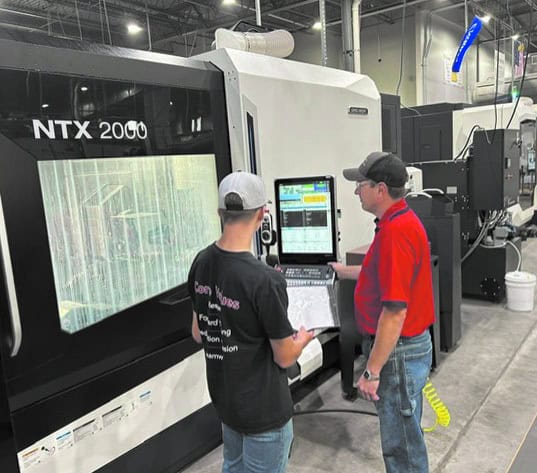
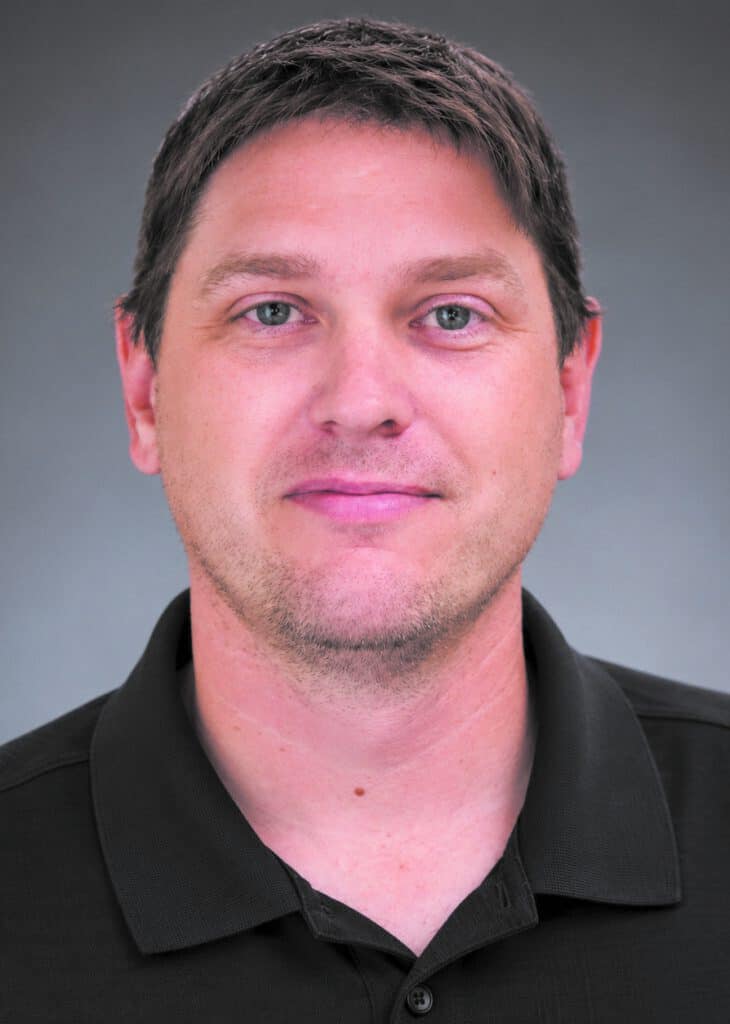
“We feel youth apprenticeship is probably one of the greatest ways for students to actually get their foot in the door, look behind the curtain and see how manufacturing has evolved,” Brad Cisewski, a continuous improvement engineer who has worked for Pointe Precision for nearly 30 years, said. “The machines are million-dollar pieces of equipment, computers [are] everywhere, lots of technology, lots of automation, high-end manufacturing and a great career.”
Nick Blaskey said he was the very first student to benefit from Pointe Precision’s early adoption of the youth apprenticeship model in 1997 – only two years after the company’s founding in ’95 – after the Wisconsin Department of Workforce Development’s (DWD) Bureau of Apprenticeship Standards expanded its scope to include practices such as Tool & Die casting and CNC machining.
However, from the time he started at Pointe Precision, Blaskey said the industry has “evolved quite a bit,” making it difficult for high school shop programs to keep up with the technological demands of modern manufacturing.
“As a student through high school, you’re used to seeing the machines you see in the machine shop – these old South Bend lathes, Bridgeport mills – and you come into a facility like this, and everything is all of a sudden foreign to you because all the machines look so different,” he said. “It’s still that way today. Schools can’t keep up with the cost of technology.”
Nearly a decade later, another former youth apprentice turned full-time employee, Kyle Koback, said when he toured the Pointe Precision facility in 2006, he shared the same feelings as Blaskey.
“I remember coming through here, and during my interview process for the youth apprenticeship, [I was thinking], ‘This is a little overwhelming – I don’t know if I can really do this,’” he said. “And then, you get really good mentors, and they show you all the training you need and everything to be successful, so it’s very neat to see the technology and even the growth in the last five years.”
According to its website, pointeprecision.com, Pointe Precision got its start manufacturing “high-tolerance components” for the aerospace and industrial markets, later expanding into the medical and recreational industries – industries Cisewski said the company continues to serve today.
“We’re a lockdown facility,” he said. “We run aerospace, medical, fuel engine, jet parts and missile parts.”

Due to the sensitive nature of the parts they manufacture, Cisewski said respect for the company’s reputation and its customers is paramount among Pointe Precision’s youth apprentices.
“It gets real,” he said. “They can’t take pictures, they can’t be on their phone [or talk about] what they see inside of our walls…, [but] I think most of the apprentices are great with it.”
Complicated machines, simpler process
Despite the equipment being “more complicated” to master, Blaskey said the advanced CNC technology is designed to make the overall process of machining more simplistic for the operator.
“It’s nice to get the kids in to learn more of this stuff because it is more complicated, but a lot of times we’re using more complicated machines to make a simpler process, to help make it easier on the person running the machine,” he said.
In tandem with the technology, Cisewski said the skill sets of green apprentices have evolved and become more advanced.
“I feel like a lot of the students are tech-savvy enough that they grasp onto things [quicker],” he said. “When they hit the floor, they’re sometimes more comfortable than I think they should be, but it’s interesting to see how, as Nick said, the machines are drifting more toward app-based [controls and] smartphone-looking type of equipment. So, some of them pick it up really, really fast.”
Blaskey said a student’s courage and curiosity is directed and harnessed by another member of Pointe Precision’s workforce in the form of one-on-one mentorship – something, he added, that hasn’t changed about the apprenticeship program since he started.
“They’re not afraid to go, ‘What does this button do?’” he laughed. “[But] the students are still with mentors – [who are] more of our long-term, tenured employees – to help teach them the rights and wrongs of machining.”
However, despite their experience and skill at their craft, Blaskey said even Pointe Precision’s most-tenured employees have had to learn new technology and adjust to the advancements.
“There are certain aspects of the business that I [trained] through that are no longer here in the company anymore,” he said. “Some of the tool grinding and stuff I was taught in one of the first summers I was here doesn’t exist in our building anymore.”


By nature of these evolutions, Blaskey said the program has changed in what students are taught and will continue to change as industry technology progresses.
For Pointe Precision’s existing workforce, Koback said the company will arrange for team members to train on new, incoming technology prior to including it in their process.
“We either send them to training, or have training through the manufacturer of the machine come here and do on-site training, so they’re prepared,” he said.
Beyond the technical skills, Koback said another important learning curve apprentices tackle is that of their conduct.
“They’re really here to learn all their soft skills, [like] how to be professional [and] how to be accountable for showing up to a job,” he said. “Most of these students, it’s probably their first job, and they’re a real employee. They are held accountable for their quality, and they’re held accountable for their attendance. So, it’s a lot [of developing their] soft-skill set that we really [focus on during] the apprenticeship program.”
Putting students through the same training as their full-time employees is an intentional practice Cisewski said helps best set them up for success.
“We’re trying to put every chip in their corner to be successful, and try to make sure they understand they’re out there making real parts,” he said. “For some of them, I think it’s shocking, like Kyle said, and then some of them pick it up and run with it really well.”
Koback, Blaskey and Cisewski said they believe affording students the opportunity to shoulder that kind of responsibility throughout their time with Pointe Precision puts them on a fast track ahead of their peers.
“Especially when a student starts, and they go through the first- [and] second-year program, we can see how different they are when they graduate,” Koback said. “Even outside of here, whether it works for them in our facility or they want to try to shift gears into a different apprenticeship, we still work pretty closely with some of them who used to be apprentices here…, so it’s cool to see them grow even outside of this building as well.”
Regardless, and perhaps especially because of their exceptional growth, Cisewski said Pointe Precision encourages the students to balance their work, school and social lives.
“We want them to still be in sports, we want them to still attend prom, and Pointe Precision runs a three-shift shop, so we have a lot of nights covered,” he said. “So, they can go to school – they can even make it to football practice and then come work at Pointe Precision for a couple hours every other night… They get to go to all the school events and still be kids, yet get to see what a long-term career might look like.”
Mutual support, student benefit
In 1997, when he first applied to be an apprentice at Pointe Precision, Blaskey said he was one of “five or six” students vying for a single spot available in the program.
“Back in 1996, [the DWD] did not have anybody taking apprentices for machining programs, so 1997 was the very first year machining was even offered in the program,” he said. “Pointe Precision was the one to get it started with the Stevens Point School District, [but] it was totally different back then because there was one spot available.”
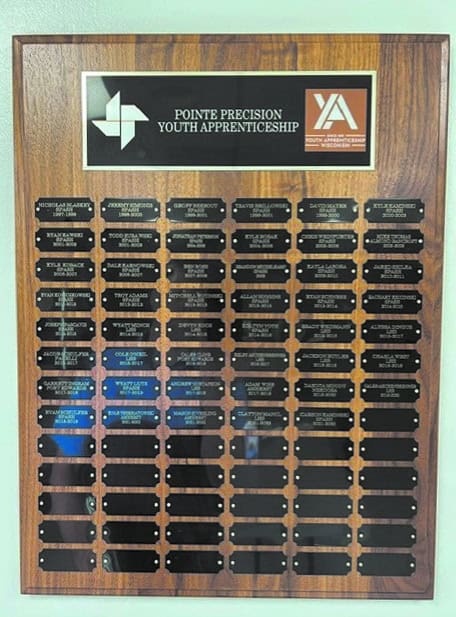
Over the next nearly 30 years, Cisewski said Pointe Precision would go on to accept and train 47 youth apprentices, calling on the company’s partnership with the Stevens Point Area High School.
“Pointe Precision has an active working relationship with the high school,” he said. “We all graduated from this high school, [and] this high school has a department that the company helps support.”
As a young high school student, Koback said he saw the Pointe Precision program as an opportunity to jump-start his career.
“It was definitely one of the companies in town that everyone talked about,” he said. “This is a place people knock on the door to try to get into, and to have that opportunity as a junior in high school, I needed to pursue that because I had invested interest in machining and working hands-on, and maybe not necessarily ever going to pursue any college degrees.”
Similarly, Blaskey said his innate love for manufacturing led him to pursue the sole position in the program’s inaugural year.
“It was quite an honor to win that position against [my] other schoolmates,” he said. “I have always had an interest in machining. I took a lot of shop classes and growing up, we had a lathe in the basement. We grew up on a farm [and] did a lot of custom machine work…, so it was a natural fit for me.”
Beyond their alma mater, Cisewski said Pointe Precision also supports a handful of other area high schools with shop classes in need of support.
“We support probably up to six local high schools in our area,” he said. “We go talk to the classes, we go to mentor the students, we bring them in for tours, [etc.]. Having that close relationship has always been a benefit of how the program started.”
Once accepted into the youth apprenticeship program, Cisewski said interested students can work their way to becoming a registered apprentice – an additional four-year, work-and-learn program – with the key word being “interested.”
“See if you like it – that’s what youth apprentices are for,” he said. “We’re not trying to trick them into a career they wouldn’t want to do. So, in some instances, the youth apprentices are very honest with us and say, ‘Hey, I want to try cart construction,’ and we say, ‘Hey, we know some construction owners – let us put you in touch, [because] you’re a good worker [and] a good student.’ We’re very supportive of them [to keep] trying.”
The program, however, is “just the beginning,” Blaskey said, as there are opportunities for career advancement from the shop floor up through Pointe Precision’s operations
“The youth apprenticeship program… [gets] these kids into a machine shop, [but] you can [progress] into whatever department in the building by getting your foot in the door of machining,” he said. “Just because you come in as a youth apprentice doesn’t mean you’re going to be running a machine forever. You can start there, you can build your skillset, but you can also move on to bigger, better things – whatever you’d like to learn on your career path.”
For more information on Pointe Precision and its service offerings, visit its aforementioned website.