We’ve really come a long way’ with cataract surgery techniques
 The Aissen Tree Farm celebrates 35 years in business



April 13, 2026
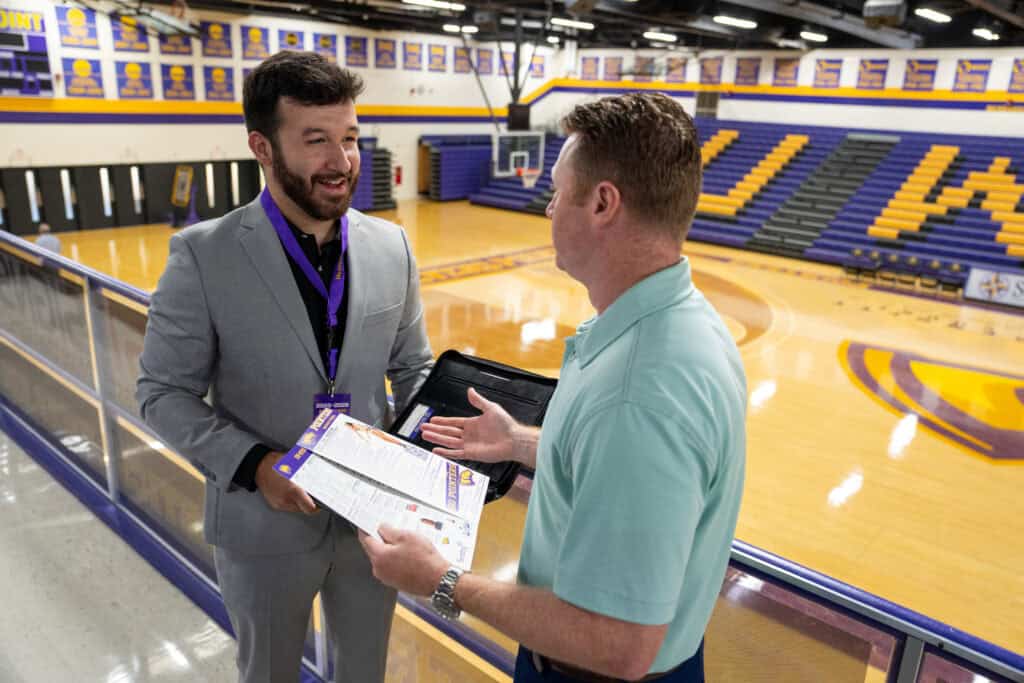
STEVENS POINT – As athletics across all competition and skill levels continue to permeate culture beyond the court, Kevin Neuman said the University of Wisconsin-Stevens Point (UWSP) is tackling sports business education both on and off the field.
Following its announcement earlier this year, Neuman – head of the Sentry School of Business and Economics – said this fall, UWSP is set to welcome its first cohort of students pursuing its new sport business major.
“I think in higher education, if you’re not looking [for] new ways to expand operations, pivot toward new markets [and] serve students, you’re going to struggle,” he said. “I feel the higher-ed landscape changes so quickly that you really need to be a lot more responsive to student trends and industry demands.”
Neuman said every level of athletics – “from youth sports to, obviously, the professional sports to recreational facilities, like Sentry World, indoor soccer facilities or tennis clubs” – and their operations would all fall within the “industry of sport” and, therefore, the business of sport.
“It’s an enormous industry – one that has been growing in size and popularity and one that’s underserved in terms of programs that are dedicated more explicitly towards those types of occupations,” he said.
Roughly three to four years ago, Neuman said UWSP and the Sentry School began exploring the idea of introducing the new sports business major.
Part of the work, he said, involved evaluating potential curricula and determining if pursuing them aligns with current strategic goals.
“Sometimes, the time’s not right, but we got really serious about it, I’d say, spring of ’25,” he said.
Utilizing the talents of an internal team dedicated to researching things like industry demands and competitor programs, Neuman said sports business was identified as an area of opportunity for higher education in Wisconsin.

“We looked around, and there are a few sport management programs in the Universities of Wisconsin System, which are similar, but they have grown out of the kinesiology, athletic training or coaching side of the academic world – more out of the health side,” he said. “Then they started teaching some business topics.”
Through its incoming sports business major, Neuman said UWSP is positioned to be the only public AACSB (Association to Advance Collegiate Schools of Business) school with a sports business program in the Upper Midwest.
“We’re really excited about that,” he said. “The only other program [like ours] is at DePaul [University]… in Chicago. So, different school, different price point.”
After receiving the necessary approval in January to officially introduce the program this coming fall, Neuman said UWSP began recruiting both students and faculty from across the U.S.
“Our final approvals came in early January, so we didn’t really start recruiting until [then], and demand has been really strong already, which is good to see,” he said.
Student, faculty recruitment
By announcing the new program in January, Neuman said incoming high school seniors and their families have plenty of time to discover UWSP and plan their summer visits.
“It is this perpetual cycle – you’re always looking out almost a year in advance,” he said. “The bulk of [our] applications come in the fall, and potential students… typically have at least [the] group of schools they’re considering determined… They may not know where they’re going in January, February [or] March, but they’re typically not looking to add completely new schools.”
At the time of his interview with The Business News, Neuman said roughly half of the students who had enrolled in the program for the fall 2026 semester “are brand new to UWSP.”
“They had not been admitted for other majors, so it’s a completely new consideration, which is pretty remarkable for this stage,” he said.
On the faculty side, Neuman said the Sentry School welcomed two new tenured or tenure-track educators from top sports programs across the country.
“We’re really excited to bring people [in] with that expertise to lead our program,” he said. “It shows we’re diving into this by making big hires of notable researchers and teachers well known nationally in the field, to come and help us get this program moving.”
However, prior to recruiting students and faculty, Neuman said the Sentry School and UWSP had to obtain approval from the Universities of Wisconsin Board of Regents.
“We had strong anecdotal evidence, but within the [Universities of Wisconsin], they ask you to do a lot more in terms of formal market research if they’re going to approve a program,” he said. “So, we started that process in the spring of ’25, and then [there are] a few different steps with the UW Regents for the approval process.”
Neuman said the program was approved by the UW Regents in December 2025 and then again by the “Higher Learning Commission – a regional university accrediting body” – in January 2026.
But he said its approval didn’t happen without some convincing.
“We’re not a for-profit entity…, [so] if you’re going to put valuable, scarce resources toward something, you need to make sure you’re serving a large enough student population to make it worthwhile,” he said. “Otherwise, I should take my resources and go find a greater student population to serve, [because] that’s the mission of the Universities of Wisconsin System, and we’re not sitting on hundreds of billions of dollars of endowments, so we have to make smart choices.”
Neuman said the Sentry School’s AACSB accreditation – which, according to aacsb.edu, is held by just 6% of business schools worldwide – is a major selling point for the program as it helps graduates secure jobs after completing the program.
“AACSB is huge, because at the end of the day, if [students] decide… not to go into the sports world, they still have an accredited business degree,” he said. “It’s a much nicer backstop, and it’s a much more robust business education than some of the sport management degrees out there.”
With the University of Wisconsin-La Crosse and -Parkside already offering sport management programs, Neuman said UWSP also had to demonstrate its major wasn’t redundant within the Universities of Wisconsin System.
“We cover not just the management and operation side, but also the finance, the marketing, the analytics side – your breadth of business content [is] much broader and deeper,” he said. “We go particularly deep in the marketing analytics and then the management as well. So, that clearly differentiated us from other programs within the system.”
Program scope, professional applicability
Rather than preparing students to adapt a general business degree to sports, Neuman said the program targets the distinct characteristics of the industry.
“There are a lot of nuances there right now, particularly in terms of college sports, with the Name, Image and Likeness (NIL) [policy] changes,” he said. “You’re looking at management, at public relations, brand management and brand development techniques that are [intended more for] actresses or performers.”
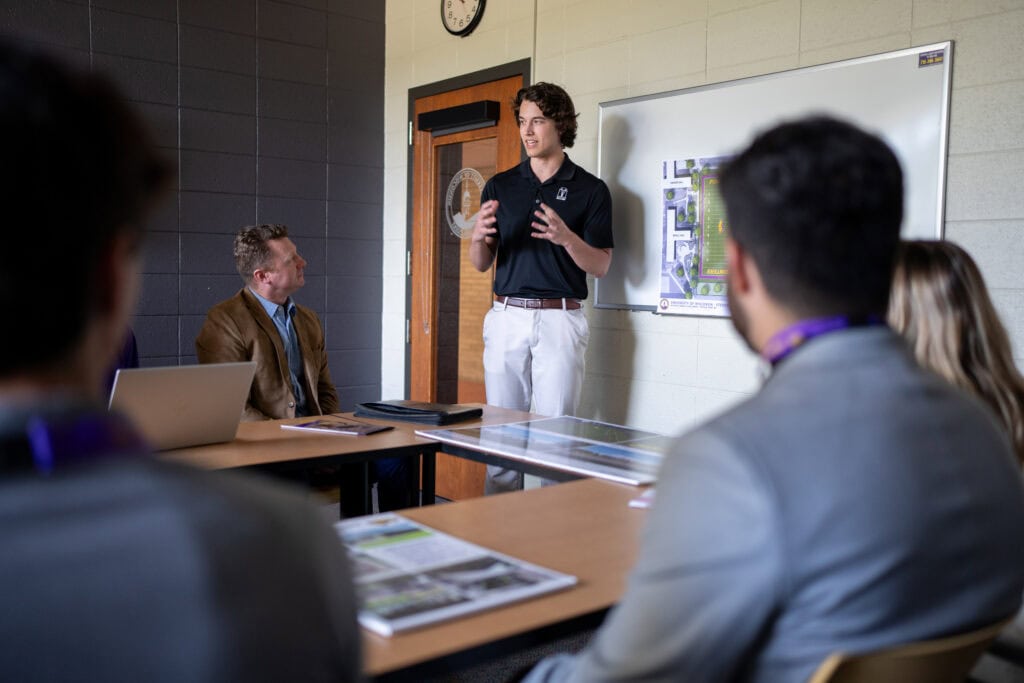
Neuman said the program also considers the operations of large sports facilities, which host not only professional teams but local-level organizations as well.
“On the finance side, I look at the mix between public and private stadium financing deals, the economic impact of that and that partnership with construction, public utilities – all those things that you need to build a new stadium,” he said. “It’s not like you can never break into the sports world with a regular business or communications degree, but there are some advantages to really focusing [in on] the content.”
At the end of the day, Neuman said sports has evolved into a cross-sectional industry rooted not only in player talent, but business, operational management and entertainment as well – leaving room for a wide breadth of professional opportunities for interested and motivated students.
“It is such a diverse industry,” he said. “There’s the entrepreneurial aspect, the community rec programs, [and] this type of training can prepare you for [jobs like] being a high school athletic director [or] a University of Wisconsin-Green Bay Division I athletic director [for] college and high school sports – there are a lot of occupations.”
In an industry of increasing advertising opportunities, Neuman said UWSP’s sports business major is also applicable in the corporate world.
“This is why this area is a little bit unique,” he said. “You’ll have large organizations who will have partner activation [staff] who will work with sports entities for that partnership because of the visibility the teams bring.”
Neuman said Sentry World, for example, has a chief marketing and golf partnerships position.
“Other companies will have the same thing, because [they’re] trying to look for specific partners that [their] company can leverage for visibility,” he said. “So, you can work in the sports industry and still work for an everyday corporation, but it’s because of the partnership opportunities that exist.”
With a recent shift toward experiential consumerism – “particularly among the younger population” – Neuman said more and more local leagues are being created to serve the amateur athlete population in conjunction with sports organizations propping up their games with additional entertainment offerings.
“All of a sudden, there’s a league because people want to be part of that experience,” he said. “It’s not just the event. It’s everything around it.”
“Experiential learning,” Neuman said, is also a point of difference for UWSP and the Sentry School – helping students prepare for the workforce through “team-based assignments and exercises” as well as for-credit internships required by its programs’ curricula.
“I think the Sentry School has set itself apart, and we’ve been booming,” he said. “We’re up more than 50% in headcount since fall 2019… A $10 million gift from Sentry Insurance in December 2022 was huge in terms of giving us more resources, but the momentum had started before then. So, in a lot of ways, the gift, the size of it and the willingness of Sentry to tie their reputation to us was really a validation of all of the things we had done for years up to that point.”
For more information, head to uwsp.edu.