Former military dog trainer provides service dogs to veterans
 Inthewoods Sugar Bush gets ‘sappy’ with maple syrup



March 23, 2026
NORTHEAST WISCONSIN – Global accelerator gener8tor and the University of Wisconsin-Green Bay (UWGB) are set to bring dozens of new entrepreneurs and start-ups to campus through the Cheese Wedge Consortium, which Chancellor Mike Alexander said is a new initiative launched in partnership with New North, Inc.
gener8tor Founder and Owner Joe Kirgues said he first connected with UWGB last year through the launch of its gBETA program – which gener8tor.com describes as “an accelerator for early-stage companies with local roots in UWGB.”
Kirgues said this new consortium offers another pipeline for start-ups to apply and benefit both from resources and potential funding provided by a $1 million grant.
“It’s sort of an extension building on our initial work together last year,” he said. “But in its own way, it’s also a fresh partnership we can use to do more things like [investment accelerators].”
Last fall, Alexander said UWGB and New North co-hosted an event for the Wisconsin Economic Development Corporation (WEDC) where they learned of a grant opportunity provided by Gov. Tony Evers’ Ignite Wisconsin initiative – which, according to UWGB’s consortium press release, was established to invest millions of dollars across four statewide consortiums to “strengthen high-growth start-up sectors.”
“At that event, we learned about it and thought this would be a really interesting collaboration,” he said. “The idea was, ‘How do we continue to drive economic development in Northeast Wisconsin, and what role does higher education play in that?’”
After discussions ensued, President/CEO Patti Habeck said a partnership between New North – the organization stewarding the Ignite grant – and UWGB “seemed like a natural fit.”
“UWGB, particularly, has been really wanting their Phoenix Innovation Park to take on something like this,” she said. “They were really excited about developing something like this, [and] it is well within New North’s goals and interests in strengthening our entrepreneurial ecosystem.”
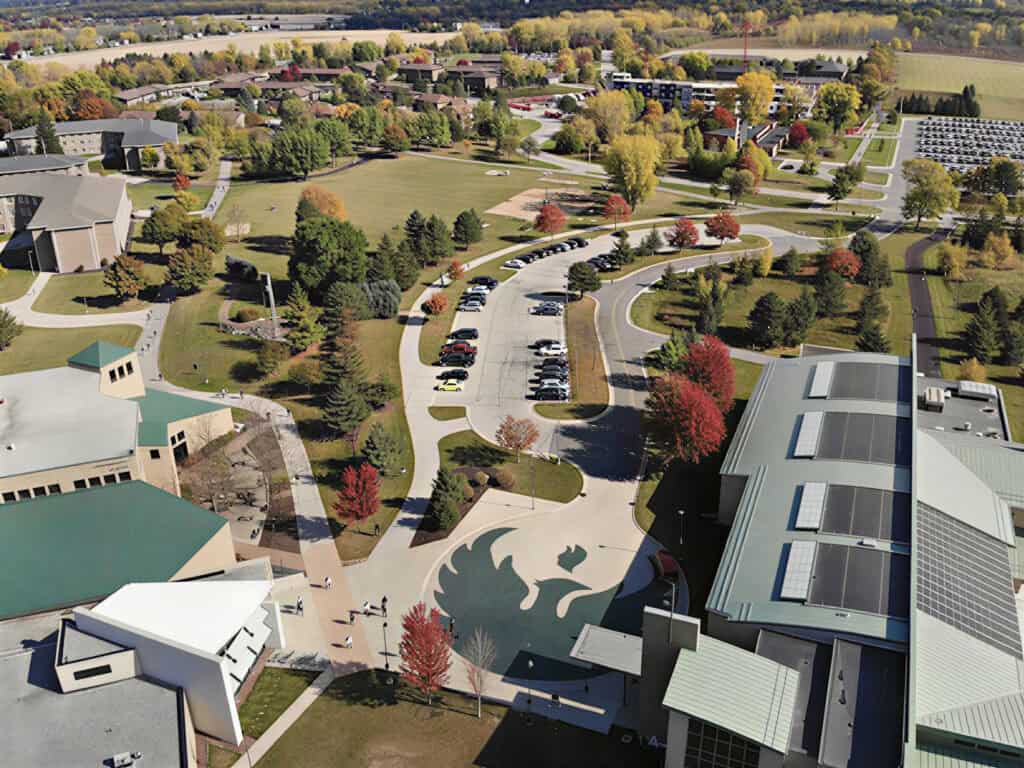
Announced in 2024 by UWGB and Brown County, the Phoenix Innovation Park – a total of 64 acres on the Northwest side of campus, per the university’s website – is set to welcome “new academic buildings for research and development along with a hotel, restaurant, commercial buildings and mixed-use housing.”

In establishing the park and new accelerator programming, such as the Cheese Wedge Consortium, Kirgues said the hope is to encourage new businesses to plant and grow their organizations in Northeast Wisconsin.
“The goal is to work with them to come onto the UWGB campus, to be a part of the community and to create local jobs and new leaders,” he said.
‘A concierge resource’
Similar to its gBETA initiative – first covered by The Business News in its Oct. 20, 2025 issue – Kirgues said interested start-ups will apply for and be admitted to the consortium in cohorts, with the first expected to commence this fall.
“We’re hoping to help bring in start-ups that can be a good fit [for the region],” he said. “Some of those are going to be local, some national and even some, we hope, could be international businesses that are choosing to expand into the United States by relocating to Green Bay.”
As part of its mission to provide regionally specific programming, Alexander said consortium leadership chose to focus its first cohort on food and agri-tech start-ups.
“[UWGB’s] role here, partly, is to see how [the consortium] can intersect with our strengths as an institution, and how we could connect it to the community at large,” he said. “We know there’s a huge industry in Northeast Wisconsin around food and agriculture technology…, so we have a lot of strengths there.”
Located within one of the “largest” manufacturing and agricultural regions in the country, Kirgues said gener8tor is especially excited to recruit businesses in search of a place to establish roots and grow – benefiting both the start-up and Northeast Wisconsin.
“With an emphasis [on] agri-tech and food, you’re naturally looking for start-ups that are curious about what advantages they might gain by becoming a part of the community – [be it] through the corporate network, investors or mentors that the program is making available,” he said. “It’s good for the start-up, but good for the community.”
In its first year, per UWGB, the consortium is “projected to support” 21 start-ups and directly fund 18 companies through investments and relocation stipends by way of its Ignite Wisconsin grant funds – which Kirgues said is gener8tor’s responsibility to utilize and disseminate.
“We’re really grateful to the Wisconsin Economic Development Corporation, to New North and UWGB for inviting us to take the role… as a catalyst for translating a lot of those resources in the grant directly to the benefit of those participating founders,” he said.
Kirgues said start-ups and their founders often go on to use those “critical investments” to build their team and hire local employees.
“When a start-up comes in, we meet them and, oftentimes, the founders are the only employees,” he said. “Years later, they’re up to 20 or 40 or 80 employees, and we have to ask for an appointment when we come in to meet with them – so they grow, and that’s what we’re trying to facilitate and encourage.”



Per UWGB, the consortium is also projected to create 46 new jobs and generate $3.4 million in regional revenue – demonstrating the impact Kirgues said start-ups can make on a local economy.
“They get to come in with an idea they’re just building from scratch, and you see it become this product that people use and employees go out and sell,” he said. “We’re trying to be a concierge resource for them through that process.”
Recruit and maintain
On campus, Alexander said UWGB students and faculty are excited to collaborate with start-ups coming through the Cheese Wedge Consortium.
“We have an incredible nutrition program, [and] we have people who are doing research in these areas,” he said. “There are all kinds of synergies that can result.”
Habeck said bringing UWGB, gener8tor and New North together to drive economic impact is an innovative way to strengthen the region’s existing industries by injecting new ideas.
“We have a whole supply chain that has been built up around the food industry – it’s pretty unique, and it’s very, very strong,” she said. “For us to build more of these consortiums and these shared opportunities where we can really pull together our strengths in this space is very, very exciting.”
At the time of his interview with The Business News, Kirgues said dates for the consortium’s fall cohort weren’t yet announced, but encouraged any interested parties – “whether it be applicants or people to help the participants” – to visit gener8tor’s website for information on the initiative, eligibility criteria and to apply.
“Our job is to help build that applicant pool, and then to invite our partners to come in as we’re doing the interviews,” he said. “Not just because they’re helping evaluate, but oftentimes, they see how they can contribute as they’re listening to these founders – and we think through not just which founders are the best fit for the community, but where is the community the best fit for a founder?”
In all, Kirgues said gener8tor, UWGB and New North each play a distinct yet important role in not only recruiting, but in retaining talented entrepreneurs and innovative businesses in Northeast Wisconsin.
“We’re creating opportunities for students and graduates to continue engaging not just as founders, but as employees and interns and other ways to be a stakeholder with those start-ups,” he said.