Mid-State Technical College takes tailored roadshow to employers, adults
 Celebrating 20 years of ‘growth, talent and impact


March 9, 2026
APPLETON – Over the next decade, the U.S. Bureau of Labor Statistics projects 34% job growth in data science.
Lawrence University is responding by launching a Data Science & Statistics major this fall.
Building on the success of its popular minor – established in 2020 – Andrew Sage, an associate professor of statistics, said the program has already attracted strong interest.
From minor to major
When he arrived at Lawrence in 2018, Sage said the university was already committed to growth in this area, recognizing its potential to intersect with other fields that engage students.
“It was a reflection of the world we lived in then, and now, as we live in a world of big data,” he said. “I think our students are certainly responding to the world around them and see this as a potential opportunity for career paths.”
Sage said people are already using data in a variety of fields – from biology and bioinformatics to ecology, health, psychology, business and economics – often in innovative ways.
The goal, he said, was to build a program that connects to these areas, with Lawrence viewing data science as an interdisciplinary field rather than a siloed program.
Sage said the minor emerged as an opportunity to introduce students to disciplines already using data, giving them insight into how it can inform decision-making in context.

As student interest in the minor grew, he said, so did demand for a full major.
“Throughout the years, we’ve heard from students and prospective students that they’d like to go even further and have a major that goes beyond what we currently have with the minor,” he said.
Thus, Sage said, Lawrence decided to offer it as a major, providing students with a comprehensive study of data science that equips them with the skills needed for a career in the field or for graduate study.
The program, he said, will go deeper into data computation, including the programming and computer science skills required to acquire and work with complex data sets.
“It will explore the statistical models and also the mathematics behind data science, while still requiring students to work with data in some domain area like biology or economics so they get to see where data is used in context,” he said. “It’ll also require them to take a class focusing on ethics and the role of data in society.”
Increased need
Sage said understanding what statistics and data science really are – and what they will mean in the future – is especially relevant in today’s digital age.
He said he believes many people are still trying to figure this out.
“There’s a lot of blurred lines between the two fields right now,” he said. “Traditionally, statisticians have worked with data to draw inferences and make decisions from data.”
Over the past 10-15 years, Sage said he thinks the rise of data science has been driven by the growing size and complexity of the data being worked with.
“Not that the kinds of models that were useful 10 or 15 years ago aren’t still useful,” he said. “They actually very much are.”
In the past, Sage said a single dataset and a spreadsheet might have been enough – however, today, acquiring and managing data often requires advanced programming skills.
“Some of the complex data we work with today requires new kinds of techniques for analyzing them,” he said. “We’re constantly growing and developing, and that’s the exciting part of research.”
Today, Sage said a data scientist needs to be able to use statistical models to make predictions and identify trends.
“I think something else that goes along with that is that as data gets bigger and more complex, it can become both more powerful, but also more dangerous if used improperly,” he said.
Sage said statisticians have always had to consider the ethical side of their work, but as datasets grow larger, it becomes even more important to think critically about the context and origin of the data.
“Knowing context and source helps people communicate with experts in areas where the data is collected, which leads to knowing how to make ethical decisions with it,” he said.
This is something Sage said he thinks Lawrence, as a liberal arts college, is particularly well positioned to teach students how to approach.
The Lawrence Data Science & Stats degree, he said, is designed to empower students to think differently about data and communicate its meaning to others who may not approach it the same way.
In other words, Sage said it equips graduates to convey meaningful information clearly so it makes sense to a broad audience.
Data science in the AI era
As AI becomes more capable, he said a common question arises: “Won’t AI do this?”
Sage said though AI is taking over routine and entry-level work, the degree prepares students to utilize AI differently.
“We need people who know how to leverage AI and work with it to make hard decisions from that data,” he said. “For example, I had a student who used AI to access a national database on health and well-being and then ran an analysis of how the Appleton area compares to the national trends in those areas. Without that knowledge base, it may have been potentially impossible to get contextual data.”
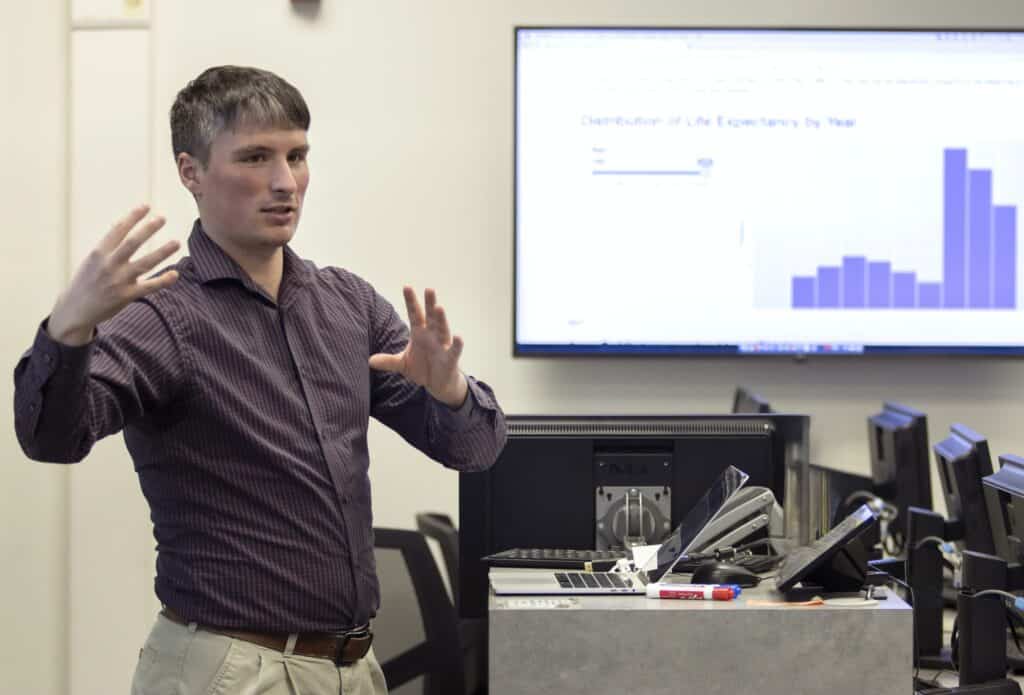
Moreover, Sage said, AI is just one part of the conversation.
He said he expects data scientists to be among the fastest-growing segments of the workforce as the economy increasingly relies on data-driven decision-making.
“Beyond the obvious titles, ‘data scientist’ or ‘data analyst’ people with this degree [will have an opportunity to] work in a really wide range of fields,” he said. “Think business and marketing analysts, sales forecasting, insurance and actuarial science and the computer science side of things. We also see a lot of people in data science work as researchers in areas like medicine and health and the biological sciences.”
Looking ahead, Sage said he believes new societal questions will continue to emerge – noting that people are already using data analysis skills to better understand how large language models (LLMs) generate their outputs.
He said he likens LLMs to a “black box,” where it can be difficult to trace exactly how the output is produced.
“I think data scientists and statisticians have an opportunity to really try to go inside that box and use statistical insight to try to better understand the way decisions are being made,” he said. “Especially in an ethical sense. If we have a better sense of how these things are thinking, we can help figure out whether that thinking is the sort of thing that we want to be making decisions on or ways that we can augment and improve on it.”
As perspectives shift on data – traditionally thought of as numbers and text – Sage said the types of data will become far more diverse, providing greater opportunities to address a wide range of research questions.
Bringing in, keeping students
Sage said he is hopeful that adding a major will attract more prospective students and their families to the area.
“I think having this opportunity with the new major option will help attract students,” he said. “To a larger point, however, we want students to come to Lawrence – not only because we have a data science major, but because we have a major that offers them opportunities they wouldn’t get elsewhere.”
A central component of the program, Sage said, is providing every data science major with practical experience through projects with local businesses or nonprofits, under faculty mentorship.
Such experiences, he said, let students contribute to the community while gaining real-world skills.
“As an example of this, I currently have a team of students working with a local nonprofit organization called Fox Valley Data Exchange,” he said. “This organization’s mission is to collect and share data with hope and the goal of enhancing well-being in the Fox Valley. We’d love to create more of these kinds of opportunities.”
The hope, Sage said, the program will help students build local networks and secure jobs with area organizations.
Inherently interdisciplinary
Though some students may begin exploring data science early in their college careers, Sage said it’s also a field that people continue to learn and grow in over time.
He said he sees data science as inherently interdisciplinary, with the aspects that draw students to it varying widely from person to person.
A great example of this, Sage said, was a student who was pursuing marine biology, and she used data to study manatees and their migration patterns.
“That got her interested in data, because it would help her better understand the fascinating science question that she’s really trying to discover answers for,” he said.
In some cases, Sage said students are drawn to data science through an interest in computers, programming or machine learning for AI.
And though becoming a successful data scientist requires skills across many areas, he said it often only takes one spark of interest to get a student engaged.
“You can be cool and still be in data science,” he said. “Data science is about being curious.”
Furthermore, Sage said he believes data science benefits when people bring a wide range of perspectives and approaches.
“That’s how we learn to ask the right questions and discover the things we were missing,” he said.
Head to lawrence.edu to learn more about the major.