 Green Bay Austin Straubel takes flight with top honors
 3 Sheeps, LeRoy Butler team up for NFL Draft celebrations



April 6, 2026
TWO RIVERS – President/CEO Nathan Grossenbach said many credit unions “grow at their own pace,” and Shoreline Hometown Credit Union is no exception.
However, Grossenbach said when Shoreline grows, it’s because the communities they serve are likewise growing.
“The tried-and-true method for us is we’re small, we’re hometown [and] we serve the local community,” he said. “I don’t think we’ve gotten away from those roots, even though we’ve grown.”
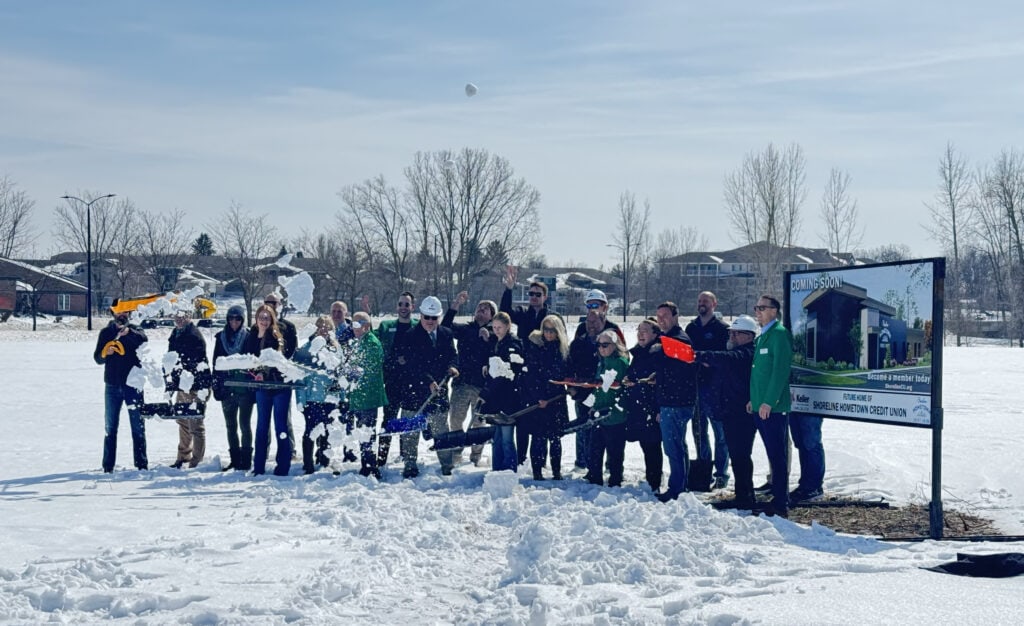
As Shoreline marks 85 years and celebrates the recent groundbreaking of its fourth Northeast Wisconsin branch, Grossenbach said its hometown approach remains both a key differentiator and essential to the credit union’s long-term success.
“A little more than 10 years ago, we were in pretty rough financial shape, to the point where our doors could have closed at any moment, because of some decisions that were made before any of our times [here],” he said. “So, we knew that A., we had to fix financials, [and] B., we had to do a lot of publicity work as well and do a rebrand for us.”
Amid an industry increasingly shaped by mergers and acquisitions, Grossenbach said Shoreline intentionally chose to keep its focus, and therefore, its growth, local.
“I see a lot of complacency in our industry… [and] a lot of those credit unions ultimately merge because they [can’t compete],” he said. “We’re driven by that. We have no desire to merge out – we want to keep moving, we want to keep rolling and the best way to do that is to keep growing.”
With an existing membership in the Greater Green Bay area, Grossenbach said Shoreline was interested in establishing another branch in Brown County – ultimately securing a site at 315 Cardinal Lane in Howard with the help of GB Real Estate Investments’ Garritt Bader.
“Garritt has been instrumental in our growth,” he said.

Grossenbach said conversations with Bader led to a review of several potential sites, with the Howard location ultimately standing out as the right fit.
As one of the region’s smaller credit unions managing $150 million in assets – “10 years ago, $200 million was big, and now it’s classified as a small credit union” – Grossenbach said Shoreline’s M.O. will always be to grow in step with its membership.
“I think our position, which has worked really well for us, is staying local,” he said. “Though [growth] might mean more branches, it doesn’t mean we have to lose the spirit of keeping things local.”
Filling out the charter
By nature, Grossenbach said it’s difficult for a local credit union to compete with larger banks in terms of physical branch access.
“We can’t open branches at the pace of banks because we don’t have shareholders and equity to pull [from],” he said. “But as long as the members keep growing and our assets keep growing, we can keep doing it every couple years.”
Similarly to many other smaller credit unions, Grossenbach said Shoreline was established by a collective of employees in 1941 at the J.E. Hamilton Holly Wood Type Company.
“It was an HR department,” he said. “Whoever had money to give, lent it to people who didn’t.”
From the early ’40s through the late ’90s, Grossenbach said Shoreline operated out of that single office before opening a branch on Mishicot Road in Two Rivers.
“Then, in 2008, we opened up in Manitowoc,” he said. “Then, [it wasn’t] until 2022 when we opened up the Green Bay branch.”
With the ongoing evolution of digital banking services, Grossenbach said physical branches are no longer a necessity for growth.
“Technology has helped so much [with] our ability to grow, expand and reach new markets before we have to [build] a branch,” he said. “Like Green Bay, for instance – we’ve been operating there for almost 20 years, we just didn’t have a physical presence, but we [were serving] 500-600 households [in that area] before we opened up that branch.”
Similarly, Grossenbach said Shoreline’s existing and growing membership in the Howard area made the decision to expand there relatively obvious.
“We see the membership growing outward from central Green Bay into Howard, De Pere and Allouez,” he said. “So, we decided to move to Howard and support the families that are there.”
Grossenbach said Shoreline also has “a really generous charter” – encompassing nine counties in Northeast Wisconsin.
“That’ll include Outagamie [County], all the way down to Sheboygan [County] and all the way up to Door and Kewaunee counties,” he said. “So, for us, it’s more filling the charter out at this point than it is looking for reasons to expand.”
Hometown rewards
Grossenbach said Shoreline’s growth is driven largely by word of mouth, with its customer service and member-focused benefits attracting those seeking a local banking experience.
“The members we bring in… [are] referrals from current members who say the service is great,” he said. “You get same-day turnaround of loans, accounts get opened up quickly and we have the technology of the big banks. We can do a lot of things they can without the headaches that come with the 1-800 number [or] waiting 60 minutes on hold to file a fraud claim.”
By way of Shoreline’s business model, Grossenbach said members each have an equal voice regarding the operations of the credit union – reinforcing confidence that funds remain and are reinvested locally.
“At the end of the day, we’re a cooperative,” he said. “We don’t have a board of directors. We have shareholders and every member, regardless… [has] the same say in the running of the credit union.”
Throughout its 85-year history, and especially now amid an increasingly competitive industry, Grossenbach said Shoreline’s guiding light has been caring for its members.
“I need to take care of all 8,000 of our members, and that has to be done through low fees, low loan rates, high deposit rates and good service,” he said. “I’m held to that standard every single day – not generating profits, but our people being taken care of.”
That attitude, Grossenbach said, “permeates throughout the organization,” among both people and products – leading to organic member growth.
“People realize that,” he said. “They see it, and that’s a big draw for them.”
In addition to the direct advantages members enjoy, Grossenbach said each of their investments with Shoreline positively impacts the communities they serve.
The Hometown Rewards Program, he said, is an example of Shoreline’s mission in action – keeping members’ money local.
“[Businesses] can join the Hometown program for free, there’s never any cost to them,” he said, “but we will push our members as much as we can to shop there A., through marketing, B., through publicity, but then C., they get five-times rewards on their credit card when they shop at a participating business.”
Grossenbach said the more than 200 businesses participating in the Hometown program have seen shopping activity increase by 200-300% compared to pre-participation levels.
He said Shoreline has also distributed roughly $160,000 in self-funded Hometown gift certificates, further encouraging both members and non-members to shop locally.
“It’s really easy for businesses to join in [and] there’s really no downside to it, if you fit our really basic criteria,” he said. “The whole focus is we’re going to mom-and-pop shops. We’re not looking at chains, we’re just looking at people who are in our community who are owning the businesses.”
In Howard, Grossenbach said Shoreline’s team is already working to actively engage new businesses through its Hometown program.
Business development in Green Bay, he said, has been a primary focus over the past two years.
“Our business development officer [has] picked up quite a few businesses, and now we’ll just start moving into Howard, doing the same thing,” he said.
Active involvement, local investment
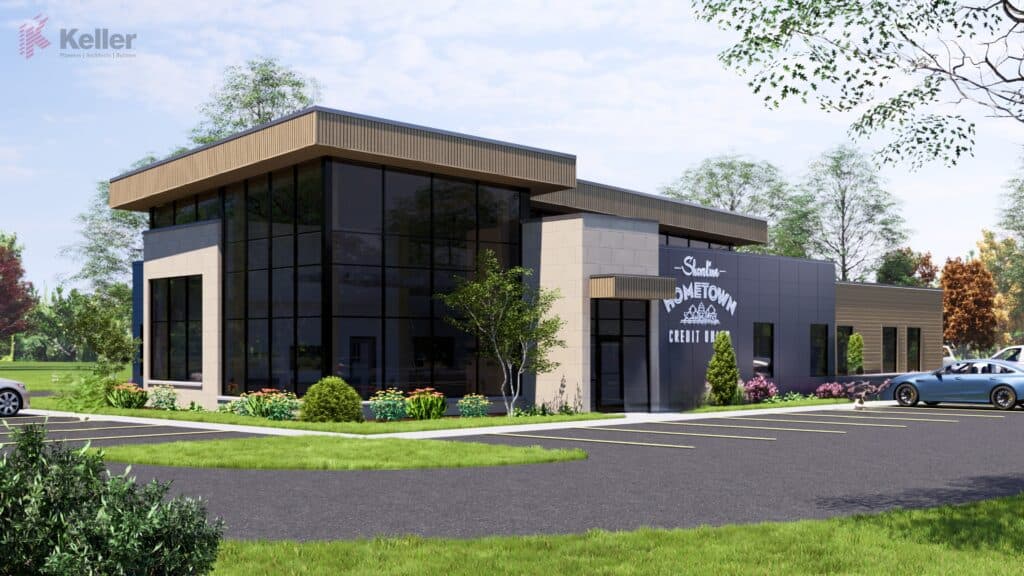
Shoreline’s forthcoming Howard branch, Grossenbach said, will closely mirror its existing Green Bay location, with a few soon-to-be-noticeable upgrades.
“We want it to be a big, showy building, [because] I think the area deserves something that’s beautiful,” he said.
Grossenbach said the expansion into Howard will also provide additional office space for area staff – something that wasn’t factored into Shoreline’s east Green Bay branch.
“We want extra space to be able to pull in staff from the Green Bay market [because our] east Green Bay [location] doesn’t really have that,” he said. “It was designed to be a quick stop, just based on location, and it was our first branch there. But in Howard, we’ll have three branch offices…, four cubes and five management offices as well.”
Regardless of whether they’re working in Titletown or on the lakeshore, Grossenbach said all his staff across Northeast Wisconsin “are hungry for growth.”
“Sometimes, I think the best thing that ever happened to us was the struggle we had [10 years ago],” he said. “It really made us push ourselves to be better and not to get complacent.”
With a workforce and membership entirely based within the region, Grossenbach said Shoreline’s philanthropic efforts are, unsurprisingly, focused on local initiatives.
Much of Shoreline’s support, he said, goes toward community-driven events.
“[The] kinds of things that a family in the community started, or it’s a golf outing, a race, a triathlon, [etc.],” he said. “A lot of our money goes toward those types of events.”
Grossenbach said Shoreline’s active community involvement is recognized by its members, who continue their membership in return – a cycle that enables the credit union to keep reinvesting in Northeast Wisconsin.
“At the end of the day, we’re here [and] you’re more than just a number,” he said. “You’re someone who can get great service with us.”
For more information on Shoreline Hometown Credit Union, visit shorelinecu.org.