AWI prepares welders for workforce – and the world
 Taking the road less traveled



December 29, 2025
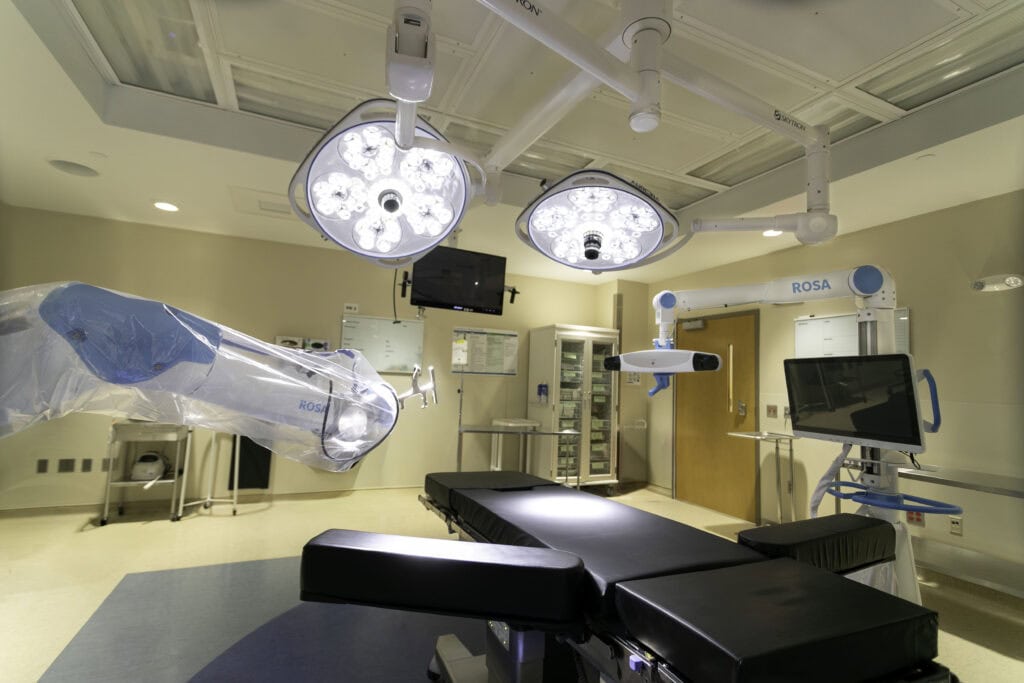
SHEBOYGAN – Thanks to a recent investment by Prevea Health and HSHS St. Nicholas Hospital, patients in the Sheboygan area can now undergo knee replacement surgeries with the help of the ROSA® Robotic Surgical Assistant.
Scott Haskins – a Prevea orthopedic and sports medicine surgeon in Sheboygan – said as opposed to traditional methods, the ROSA robot allows surgeons to perform operations more personalized to each patient’s individual and unique anatomy.
“The [ROSA] knee replacement, in the end, [involves] the same type of components that we used before – so it doesn’t change what the patient gets as far as the specific metal and plastic [replacement component],” he said. “However, it is utilized as an assistant during surgery to improve the accuracy.”
Haskins said the ROSA robot at St. Nicholas Hospital is the HSHS family’s second, joining the system already in use at HSHS St. Mary’s Hospital Medical Center in Green Bay for both hip and knee procedures.
“It has become more and more popular throughout the state,” he said. “We started at St. Mary’s in 2024 with Prevea orthopedics, including some of the surgeons in our group who went up there and did some shadowing work with them. So, it has been in the HSHS here in Wisconsin for more than a year, and they’ve seen very good success.”
In a traditional operation, Haskins said surgeons use “certain anatomic markers” based on the average patient to align the knee replacement and then “adjust from there” in surgery.
The ROSA robot, he said, slightly alters this method by providing doctors with real-time data that assists them in making precise incisions, placements and adjustments during surgery.
“Traditional surgery was very accurate [and] has great results over time, [so] this is really trying to improve on that process even [more],” he said. “The robotic assistant [provides] real-time feedback – both in where the bone structures are and also how the soft tissues are reacting in the knee – down to the millimeter during surgery so we know exactly where to make those cuts for the bone, for the replacement and for any adjustments that need to be made.”
Technology aids in accuracy

Haskins said the ROSA robot has two components.
“One is a camera,” he said. “So, if you have the surgical bed in the middle, the camera is on one side, it has some sensors on it and kind of sits up above [the patient] – almost like an OR light looking down. Then on the other side is the actual robot.”
The robot itself, Haskins said, is covered with a sterile drape and uses a movable arm to guide surgeons throughout the procedure, showing them exactly where to make incisions and adjustments.
“We go through a process of steps to make sure it’s in the right spot,” he said. “At the beginning of the case, we put trackers on the leg which the camera can visualize, and then the robot moves along with it. So, if we move the leg to one side or the other, the robot will shift its position as well.”
The other component – trackers – Haskins said, are “temporarily” inserted into a patient’s leg.
“We put little pins in – two on the femur and two on the tibia – and those come out at the end of the surgery,” he said. “They have some trackers on it [to] show the robot where that knee is located.”
Though traditional knee replacement methods provide consistently accurate results, Haskins said the addition of the ROSA robot can decrease the need for future surgical revisions following a patient’s recovery.
“Traditional knee replacements have a very good track record of 90-95% survival over 20-25 years – survival meaning not having to go in for another surgery,” he said.
Haskins said knee replacement revisions can be required for numerous reasons.
“The metal can loosen; you could break around it if the component wasn’t right where it should have been before; there may be persistent pain and swelling, [etc.],” he said. “It’s relatively rare, but when you take into account the aging population and how many thousands of these surgeries are done every year, we want to make sure we’re reducing the need for that revision surgery in the future.”
Haskins said the ROSA robot is simply another tool that helps surgeons reduce the likelihood of patients needing to return to the OR for future revisions.
“The goal is getting everything accurate down to the millimeter and degree where we’re putting everything in,” he said. “[Having] that help – so the patient has the best motion possible and the best stability of the knee – over time could help with better function and potentially less need for further surgery.”
Community benefit
Haskins said the ROSA robot was installed at St. Nicholas Hospital this past fall and has since assisted in “many procedures” since its first use in October.
“This is kind of one of the busier times of the year for knee replacements,” he said. “So, at this point now, we’ve done quite a few.”
In addition to their “extensive training in knee arthroblasty,” Haskins said surgeons using the ROSA robot undergo further training specific to the technology.
“We took a course which included a certification,” he said. “We utilized virtual and cadaver surgical demonstrations, as well as some shadowing, and we got a certificate to utilize the technology.”
Haskins said at HSHS St. Nicholas, the orthopedic team plans to use the ROSA robot “for basically every knee replacement.”
“There may be certain circumstances where that wouldn’t be possible, [and] we talk with every patient about what we’re utilizing [in the OR], so they would [have to] give consent,” he said. “As far as the cost goes…, as far as I know, this does not affect the cost [of the procedure] to patients.”
Haskins said he is “thankful” to the leaders at Prevea and HSHS for investing in the increasingly popular technology to ensure St. Nicholas Hospital continues to provide the highest-quality care to patients in the Sheboygan area and beyond.
“As a surgeon, you try to continue to utilize the tools to improve the outcomes for your patients,” he said. “We wanted to bring this to the community to really help benefit the community… [and] the leaders at Prevea and HSHS – who also saw the value of acquiring this technology – worked hard to get it to St. Nicholas for us to use.”
For more information, visit hshs.org or prevea.com.