Beyond the brittle: Uncle Tom’s celebrates 50 years
 La Crosse chamber’s CEO, board chair positions held by women



February 2, 2026
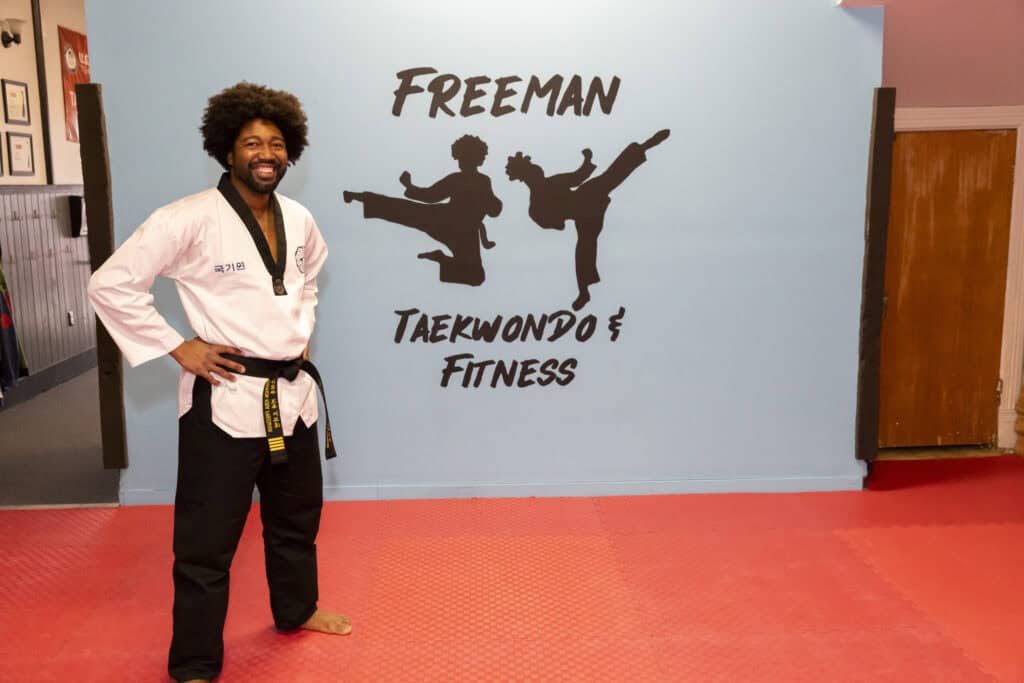
STEVENS POINT – After traveling the world with taekwondo, Stephon Kiba Freeman said he planted roots in Stevens Point, opening Freeman Taekwondo & Fitness at 929 Main St. in December 2024.
With 17 years of experience – including five as a teacher – Freeman said his goal with the studio is to keep students active while helping them grow personally.
In just a little more than a year of operation, Freeman said the community has embraced the studio, and its growth has been rapid.
Life-long passion
Freeman said his interest in martial arts began in childhood, sparked by watching Jackie Chan movies and discovering Bruce Lee, though he wasn’t able to take classes at the time.
He said his first real chance to take taekwondo came in college at the University of Wisconsin-Stevens Point, where it counted for credit.
“[That] was 2009 and was through a program with Stevens Taekwondo Academy,” he said. “It was awesome. Every time I had an opportunity, I was taking taekwondo, but unfortunately, there are only so many health and wellness credits you need to graduate.”
Freeman said this early exposure kept him practicing taekwondo through college and later motivated him to compete and train for the Olympics.
A self-described naturally active person and fast learner, Freeman said he realized that once he fully committed to taekwondo, he could become quite skilled.

“I knew I already had explosive power,” he said. “I’m already fast – I have been an athlete since high school.”
Just as he was exploring competition opportunities, Freeman said a new school opened in the area.
He went to check it out and said he ended up staying for about nine years.
During that time, Freeman said he traveled across the United States – and even to a few other countries – competing, challenging himself, facing Olympians and going up against Olympic qualifiers.
Though he never made it to the Olympics, he said “I gave it a really good run.”
“For someone in the middle of nowhere Wisconsin, where there wasn’t taekwondo competition, no magnitude of people to train with, I did pretty well for myself,” he said.
Freeman said it took until his final competition in 2019 for him to claim a podium finish, placing third at the USAT (USA Taekwondo) National Championship.
“What makes that win so special is that in 2018, I had ACL reconstructive surgery in November, and I had the competition in July,” he said. “I followed the PT’s instructions to the T – nothing more, nothing less.”
Freeman said that same drive and discipline now guide him as a teacher, first at the studio where he trained and now at his own studio.
“I had given myself a timeline for the Olympics, and it didn’t happen, and I didn’t want to dwell on that,” he said.
When his daughter was born in 2018, Freeman said she knew he wouldn’t have the same time or energy as before.
“As soon as I saw her, I knew I was just going to love this kid, and I needed to be there for her,” he said.
Freeman said before his daughter was born, his teaching was centered on competition, but afterward, he shifted toward helping students grow and develop as individuals.
Teaching, opening a studio
Freeman said he started teaching at the school where he had been a student in 2020, prompted by his teacher’s persistent encouragement.
“[During] the time I was working with Five Rings [Martial Arts], I learned a lot in a short matter of time,” he said. “I was an adult fighting black belts between 180 and 200 pounds. You have to learn pretty quick or you lose your head. That’s just how it is in the competition world.”
Freeman said his athletic nature taught him how to manage distance, conserve and channel energy and push himself effectively during training, which has been essential in guiding his adult students.
When Five Rings Martial Arts closed in 2024, Freeman said a community of students and families turned to him, asking if he would open his own studio.
“[My immediate response was], ‘No, not planning on it – that seems like a lot of work,’” he said.
Though he was in the process of growing his art business, Kiba Freeman Art, which he had been building since 2015, and raising his two children, Freeman said he couldn’t stop thinking about opening a studio.
Even as his art business thrived, he said the words of Goku from “Dragon Ball Z” – “If I don’t, who will?” – kept echoing in his mind.
“I wanted to keep doing taekwondo, and I helped build a community that would be fragmented, because they don’t know where to go,” he said. “They were used to working with certain instructors, and I kept thinking about the impact I’d already had in just the couple of years I was teaching.”
When the Five Rings space became available, Freeman said he was able to purchase the equipment at a discount.
Though he had originally planned to open a school five to 10 years down the line, he said he realized the timing – and the ready-to-use space – made now the perfect moment to start.
“It was a situation of the universe saying ‘your timeline is great, but how about this?’” he laughed.
After talking it over with his wife, Freeman said he reached out to former Five Rings students, asking for their input on the idea of opening a new school.
“I needed to know there was buy-in, because there’s a lot of up-front costs to buying and creating this business,” he said. “There were a good number of interested people who said they’d train or wanted more information. Essentially, the buy-in was there.”
Between late September and December 2024, Freeman said he focused on opening the school.
Leveraging his connections in the taekwondo community, Freeman said he reached out to a CPA who also practiced the sport – someone familiar with both the business model and what works best for a martial arts studio.
“There were so many things I had to think about, from business name to advertising, making the space my own, getting approval from the governing body of taekwondo in Korea and of course, day-to-day things like scheduling,” he said. “Having that connection on my side from the start made it much easier in the long run.”
‘A lasting impact’
The studio officially opened in January 2025, and soon Freeman said new students – many who hadn’t attended the previous school – began inquiring.
“They were just looking for martial arts schools, and I had just opened,” he said. “I don’t know how… I think it’s because the other taekwondo school in the area doesn’t have much of an online presence.”
From the beginning, Freeman said he’s focused on building a studio that draws people in on its own, without the need for excessive advertising.
“I want people to come here because they want to be here, not because they keep hearing an ad over and over,” he said. “I want to help develop better people, whatever their goals are. I have students come in who want to build more strength; they want to get off the couch and be more active. I have some parents who bring their kids to help burn off steam and learn some life skills, too.”
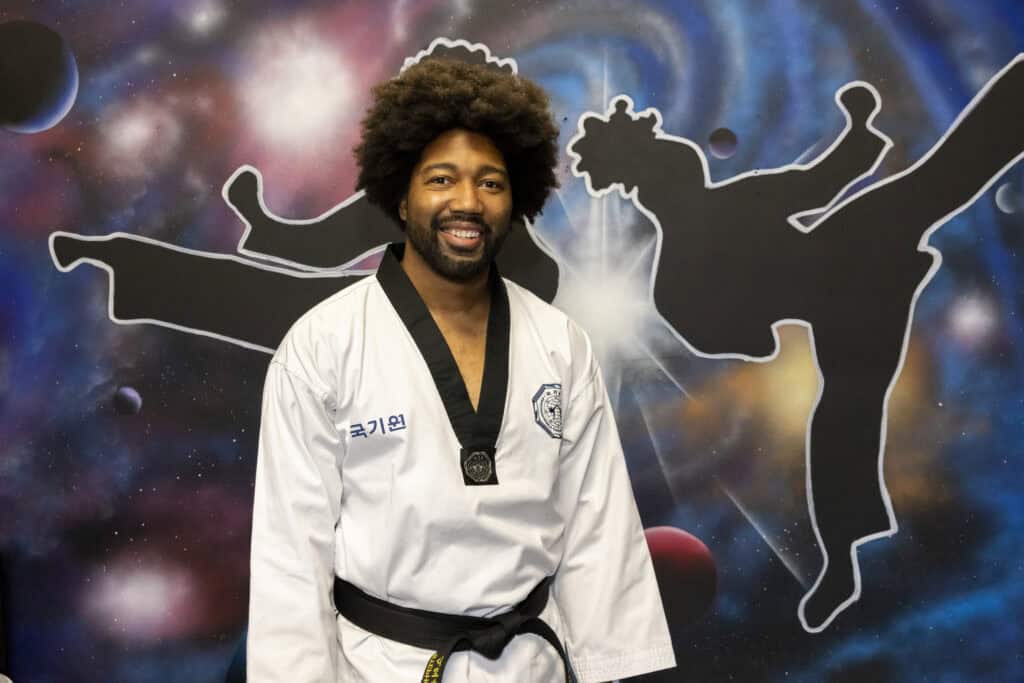
Freeman said his ongoing focus is on building a community and watching it grow over time, helping people enjoy both the physical and philosophical aspects of taekwondo.
Teaching, he said, allows him to share what he’s learned and continue learning himself.
“As I was getting better in certain aspects [of taekwondo], it was a good challenge for me to figure out how to explain it to someone who may not have the same [knowledge or skill set],” he said.
Freeman said his students vary widely in both age and skill, and he’s observed that many parents, after trying various other activities, find that taekwondo has a lasting impact – “they see a different kid.”
Within the studio environment, he said children develop focus in ways they might not in other activities, from how they take correction to learning not to be overly goofy or disruptive.
“It’s cool to see the kids forming friendships and sticking with it,” he said. “I’ve had a good amount of family members doing classes together – whether that’s Dad and his kids [or] a mom, dad and kids or two siblings who are in various age groups.”
Freeman said the studio isn’t only geared toward kids, with classes also attracting teens and adults who enjoy the unique physical and mental challenges taekwondo offers.
Adaptable teaching style
Freeman said he keeps class structure simple, starting each session with a general overview of the skill students will focus on.
This, he said, could be learning a new form, practicing a pattern or breaking down a challenging technique into manageable steps.
Some days, Freeman said, emphasize strength, conditioning and drills, while others move at a slower pace to refine techniques.
His teaching style, he said, is flexible, guided by a general plan but adaptable to the students, young or old.
“Classes are 45 minutes, so I try to break it up and not do the same thing [the whole time],” he said. “The first eight to 10 minutes are warming up. It gets them moving, hearts pumping blood, gets people loose and stretching. A lot of times, we tend to feel strength in those parts. Then we move on to the workout.”
Freeman said workouts include specific drills like ladder exercises for agility and mobility, targeted kicks or practicing patterns.
He said he runs these drills in cycles to cover all eight color-belt forms.
“That’s a lot to teach if you have all the belts in one class, and I’m trying to teach all of them their form, so I do it in cycles to teach low-belt form and high-belt form,” he said. “If you’re a low belt, you only learn that. If you’re a high belt, you’re reviewing the low-belt forms because, in theory, you’ve [already] learned them.”
Freeman said he considers regular review a crucial part of training and uses review cycles to help students avoid the stress of trying to catch up before their next belt test.
Benefits of martial arts
Freeman said he encourages everyone to try taekwondo, highlighting its benefits for flexibility, focus and mindfulness, but emphasizes that the most important outcome is helping students become better people in ways meaningful to them.
“Through the principles of taekwondo and using physicality, you have better self-control,” he said. “If you can control your body, you have a better understanding of yourself. You know when you’re being triggered and how to control it, and you know what comes easily to you and how to use it.”
Freeman said his teaching is focused on helping students apply what they learn in class to the outside world.
He said his goal is for students to develop integrity, not simply be “yes, sir” followers.
“I work on integrity, especially with the younger students, using simple examples for them to practice at home,” he said. “An example [of this] is if Mom says you can’t have a cookie, you’re not grabbing it when she’s not looking. It’s about self-control and teaching that it matters because the only control you have is yourself. You can’t control anybody else. I really emphasize that to my students.”
Freeman said taekwondo’s long history speaks for itself, consistently fostering confidence, pride and character while also teaching practical self-defense skills.
“I want students who come here to leave here with a mental understanding, emotional understanding and philosophical understanding of themselves,” he said. “And we’re doing it through the art of taekwondo.”
Freeman said one student who played a key role in his choice to start the school told him how practicing taekwondo has built her confidence and resilience over time.
“We discovered her strengths, she pushed herself through certain things and overcame others like vertigo,” he said. “As she got more balance and coordination, she noticed it stopped bothering her. I can’t say it’s a cure-all, but when you build confidence [and] you’re able to do things you weren’t able to before, it clears up other issues.”
Visit freemantkdfit.com for more information.