Business support is critical to alleviating blood shortages
 Providing customers with ‘sunshine after sunset’


February 9, 2026
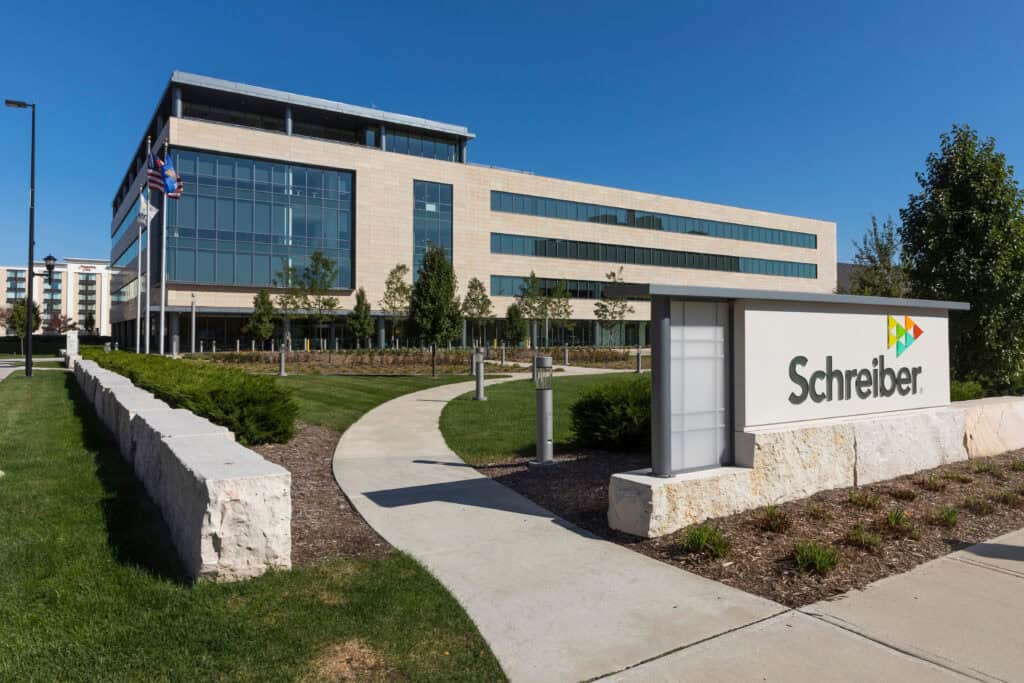
GREEN BAY – Since its founding in 1945, Schreiber Foods has grown into a 10,000-employee, $7 billion company (per schreiberfoods.com) – a magnitude that’d make it a major factor in any city’s economy, let alone one the size of Green Bay.
Trevor Farrell – Schreiber’s president as of Jan. 1, and set to become its CEO Oct. 1 – said the weight of that responsibility is not lost on him.
Born and raised in Green Bay, Farrell said that connection makes his stewardship feel all the more personal.
Being named Ron Dunford’s successor by Schreiber’s board of directors, he said, was “exciting, [yet] humbling.”
Even with his 28 years’ experience with the company and the support of his board, teams, predecessors and family, Farrell said there’s no such thing as full certainty heading into such a role.
“There’s always going to be this little inch of doubt in the back of your mind,” he said, “but that’s really small. I feel confident I’m the right person at this moment in time for our company, and just incredibly blessed by the opportunity.”
‘Never dreamed of being the CEO’
Growing up in Green Bay, Farrell said he was aware of Schreiber Foods from a young age.
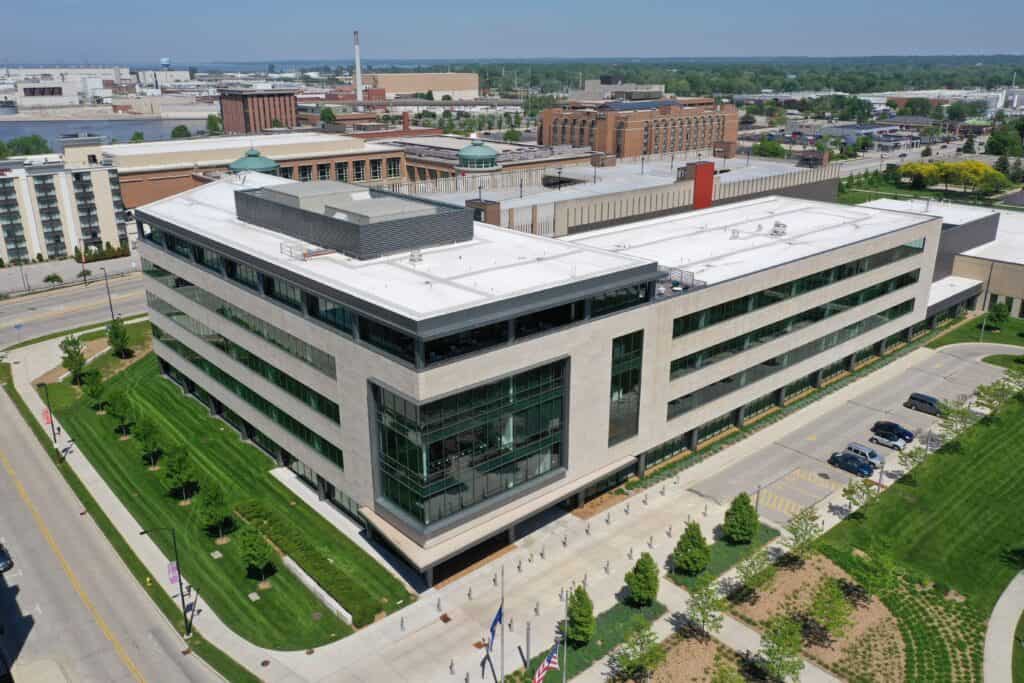
“I grew up about a mile from this building (400 N. Washington St.)…, and I would [often] drive by Schreiber’s offices, which used to be on Pine Street,” he said.

After graduating from Premontre High School (now Notre Dame de la Baie Academy), Farrell said he earned his bachelor’s degree in accounting and management from the University of Wisconsin-Madison.
Though Farrell said returning to Green Bay was not his original plan – “I had some job offers in Milwaukee and in Chicago that I was actually a bit more attracted to” – he and his now-wife, Brenda, chose to return to Green Bay to be near family and build their life together.
“I wouldn’t necessarily say I always dreamed of being in Green Bay, and I certainly never dreamed I would work for a dairy company, but your life moves in interesting ways,” he said. “I couldn’t have scripted it any better, the way it’s turned out.”
Farrell said his early career experience saw him utilizing his numerical skills, earning his MBA from the University of Wisconsin-Oshkosh and finding his way into the food industry.
That path eventually brought him to Schreiber, though he said he could never have anticipated the customer-brand dairy company would represent the “last step” in his career.
“I certainly had this feeling from my youth of knowing it was a great company, but never knew the heart that Schreiber had,” he said. “Once I got here, I felt like it was home for me – and that the people of this company were family.”
Despite the trajectory of his career at Schreiber, Farrell said he “never dreamed of being the CEO – that was not a goal of mine.”
“I just knew I wanted to make an impact on people’s lives, and my career has just sort of evolved,” he said. “I always raised my hand, took risks and moved around.”
Farrell said his move to president/CEO marks his 11th role within Schreiber.
Through a combination of lateral and advancing moves, he said he has focused on learning the business, influencing its direction and helping develop the people around him.
“It wasn’t until the last couple years that CEO became something that really was a goal of mine, or a thought, even,” he said.
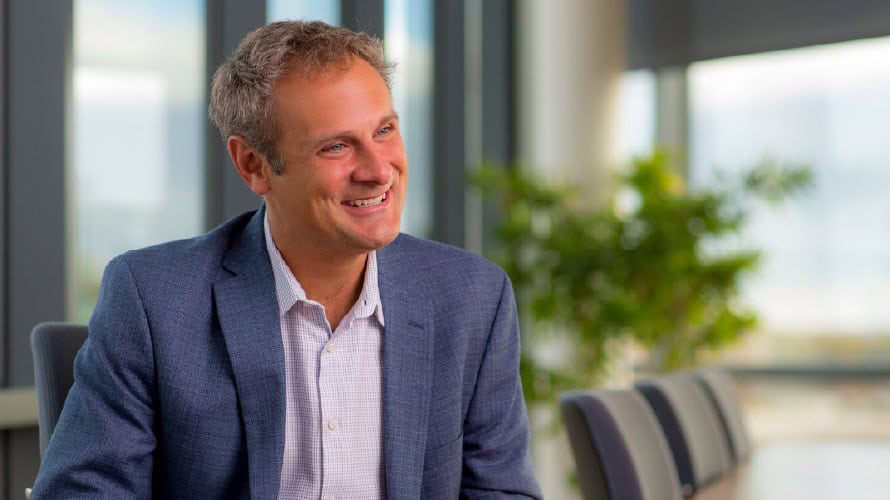
With a consistent drive to learn and prolonged ability to influence, Farrell said he was rewarded with the trust of his peers and given increasingly consequential opportunities, right to the top of the organization.
“People have to believe in you, and you create that over a lot of years of doing what you said you were going to do, and making sure people realize you truly care about them,” he said.
Farrell said he also credits his parents for instilling in him a sense of productivity and accountability.
“I think you have to have an urgency and a drive toward results,” he said. “That’s been something that’s sort of always been in me. Maybe it came from my mom and dad early in life and was developed over time with a lot of good influences I’ve been fortunate enough to have. But this urgency and drive for making things better have been, I think, parts of my success.”
‘Doing good through food’
Whether describing his personal motivation at Schreiber or the company’s considerable, sustained growth, Farrell said “it’s always been about people” – in and outside the company.
“I think Schreiber has always kept the customer in the center of the table,” he said. “We call ourselves a ‘customer brand,’ and throughout [our] 80-plus-year history, when we’ve made strategic decisions, we’ve done it alongside and with our customers.”
Externally, Farrell said customers are treated like and referred to as partners.
Schreiber’s employee stock ownership plan (ESOP), he said, treats employees as partners and has fostered a culture of loyalty and trust that he considers central to the company’s success.
Formed in 1999 – not long after he joined the company – Farrell said the ESOP helped create “the sense of belonging and camaraderie” pervasive at Schreiber.
“For me, this company always felt small enough – like it was family, and it could be part of my life – yet big enough that there was opportunity, challenge and ‘stretch’ career-wise,” he said.
Farrell said Schreiber’s influence embraces its own form of “stretch,” as the company’s mission of “doing good through food” radiates beyond its operation.
“It’s always going to be about the people of Schreiber first, but part of that is making sure we’re taking care of the communities in which we participate as well,” he said.
Farrell said “doing good through food” means “making the right decisions…, thinking outside yourself.”
Per Schreiber’s website, its mission includes the Schreiber Foods Foundation’s philanthropic support for food, housing and education, in addition to company donations and “sponsorship support to organizations and events that support food insecurity and basic needs in our communities.”
“We have a lot of different programs at Schreiber,” Farrell said. “Things like Partners Helping Partners, where, if somebody’s struggling or they’re going through a life event, typically we’ll have other employees step up – whether it’s financially or through service – to try to help them through that moment.”
Other core considerations, he said, include food safety, environmental responsibility and individual development.
Farrell said the company’s “doing good through food” philosophy resonates with customers and is widely embraced by its employee-partners.
“It gives them a sense of purpose that I think keeps us bound together,” he said.
Farrell said he regards the mission statement as one of the leadership team’s best achievements in recent years.
“I’m going to carry that on and expand upon it,” he said. “If people have a purpose that’s beyond themselves, it’s what’s going to make our company great, and it’s what’s going to help our organization impact the communities in which we serve – and that’s important to me.”
Learning, leading
When he received the formal offer to become Schreiber’s next president and CEO, Farrell said he had to contemplate the full significance of the commitment.
“The first thing I needed to decide was whether I could put my whole heart and soul into it,” he said. “I had to believe and know that myself, and that [the role] fit the life of my family. My wife and I have three kids who are sort of in their early lives and careers, and I want to prioritize that and make sure I can balance what this job requires and what I want to be for those most important in my life.”
After deciding to accept the promotion, Farrell said his preparation for the transition began “about a year and a half ago,” with third-party assistance brought in to help navigate the changes.
To personally prepare for the new role, he said he began devoting a new level of energy to his own development.
“I read and listened to more leadership development [content] in that 18 months than I had in probably the rest of my career,” he said. “That’s been really good. That thirst for learning has always been in me, but that maybe got ratcheted up a bit because it’s a big job. It’s a huge responsibility, and I want to do it better than anybody who ever has, so you’ve got to work to get there.”
Farrell said he credits much of his confidence in taking on the new leadership role to those who came before him and the wisdom they’ve provided.
“Across those 11 jobs [at Schreiber], I’ve had that many different leaders, and I’ve always tried to take things away from each and every one of them,” he said.
For example, from Dunford – who he described as “an incredible visionary” – Farrell said he learned the art of writing down each powerful lesson he gleans from interactions, books, podcasts, etc.
“I have three or four folders of lessons I’ve learned throughout my life, and a lot of those have come from my predecessors,” he said. “When I travel, I’ll often grab a handful of them and catch up, and remember some of the things that moved me in the past.”
Farrell said he’ll carry forth an appreciation for how Dunford “created an ownership spirit that’s stronger today than when he inherited the company.”
“[Dunford] has brought innovation and a muscle for innovation differently than we’ve ever had in the 75 years before him,” he said. “I want to hang onto those things, for sure.”
Further, Farrell said Dunford’s focus on leadership development will leave a lasting impression.
“I have never seen a leader who has more passion for growing people than Ron…,” he said. “His heart and soul have been in leadership development, and I want to be part of helping to carry that on as well.”
Farrell said Mike Haddad – Schreiber’s chairman of the board, who retired as president/CEO in 2019 and was succeeded by Dunford – showed the value of a more global and technological mindset, while also underscoring the importance of connecting as individuals.
“When you’re with Mike, you feel like you’re the only person in the world,” he said. “[He has] this magical connection with people, and I’ve seen him in particular do it with customers. I want [Schreiber going forward] to have that sense of purpose and presence.”
In honing his own leadership style, Farrell said concepts like “hunt and hustle,” focus and agility are central to his messaging and coaching, drawing inspiration from a source he considers invaluable.
“It always starts with people,” he said, “and having a heart for being truly present with people and caring about them in a real, deep way. When you do that, you can move them to be part of something greater. We’ve been able to achieve that for 80-plus years at Schreiber, and I want to carry that on.”
‘This is our time’
Farrell said thus far, the transition “has been pretty seamless.”
In a company-wide presentation announcing the change, he said the very first slide simply displayed a number: 10,515 – the exact number of people employed by the company at that moment.
“This moment in time,” he said he proclaimed, “is for all of us. It’s for every single Schreiber partner. I’m just a small piece of it. I want to be an enabler to the success of this entire organization… This is our time.”
Schreiber’s past growth, Farrell said, stands as an “incredible foundation” for the exponential growth he anticipates.
“I really do see that for Schreiber in the years ahead,” he said, “but it’s going to be because 10,515 [people] did their small part to help us achieve it, and that’s been my message: let’s go get after this together, because we’ve got a beautiful place to start, and now it’s up to us to make it happen.”
Beyond a focus on growth, Farrell said he foresees Schreiber “becoming a global standard for quality, reliability, innovation and customer-brand leadership” amid his tenure as president/CEO.
His ultimate goal, he said, is “to leave Schreiber stronger, more relevant and better positioned for the next generation than we are today.”
Achieving such a goal, Farrell said, starts right back with the people.
“[I anticipate] our customers will trust us fully with their brands,” he said. “I [fore]see a family of Schreiber employees saying, ‘This is the best place I’ve ever worked.’”