 Is Oshkosh on pace to reach its housing goals?
 A century of counsel – Menn Law Firm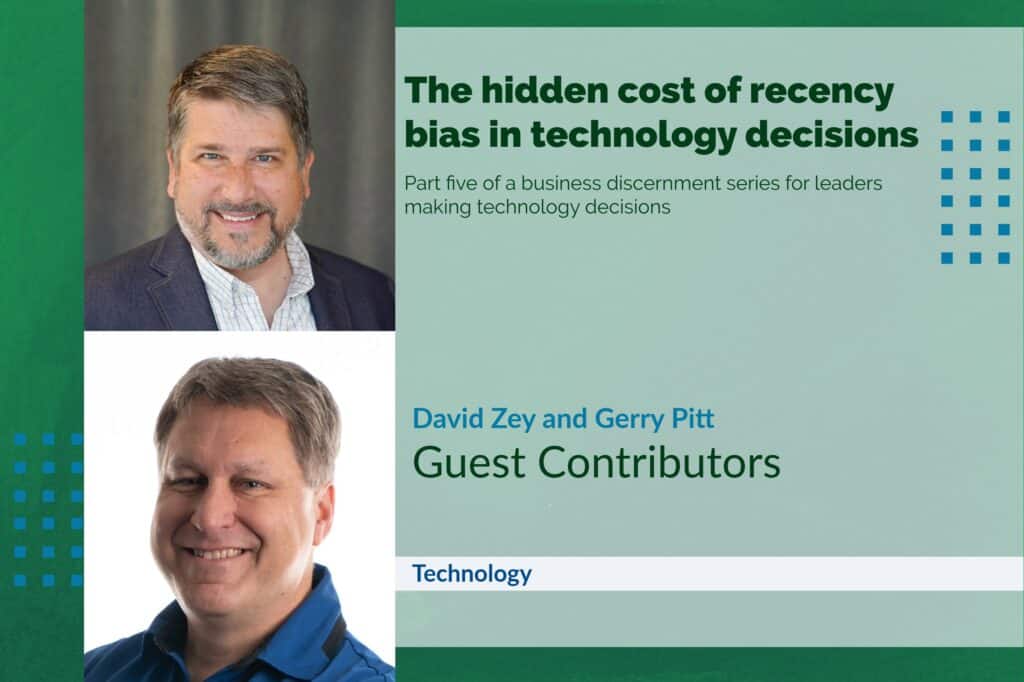


February 9, 2026
Part five of our broader series focused on discernment in business technology decisions – this column explores how decisions take shape when the environment surrounding them is active, fast-moving and highly reinforced.
In psychology, there is a well-established concept known as recency bias.
It describes our natural tendency to give greater weight to what is recent, visible and frequently repeated.
On its own, this tendency is neutral.
It helps people orient quickly in complex environments and make decisions without evaluating everything from first principles.
In business, recency bias interacts closely with trends.
Trends are not inherently good or bad – sometimes reflecting genuine shifts in capability, cost or opportunity.
Other times, they reflect how ideas are framed, repeated and reinforced across the market.
More often than not, they are a blend of both.

This can create a subtle but important tension for business owners.
When a particular technology direction begins to feel clear and compelling, is that clarity emerging because the moment is genuinely aligned with the needs and readiness of the business?
Or is it being shaped by the surrounding environment in ways that feel grounding before they are fully understood?
The difference often comes down to agency:
- Do decisions feel informed by the realities of your business or carried forward by momentum?
- Do they feel owned or simply well supported?
- Are you choosing a direction because it fits how your organization operates or because it fits the moment as it is being presented?
Discernment is the ability to notice how confidence forms before a decision is finalized.
Not to reject the moment, but to understand whether it is contextual or trend-driven, serendipitous or structured.
What follows is not a critique of technology adoption, but an exploration of how timing, reinforcement and perception interact, and how business owners can remain grounded in their own context while navigating a market that moves quickly and confidently.
How this often shows up for business owners like Ben
Ben runs a growing company.
He is decisive by nature, and his instincts have served him well.
When something feels directionally right, he moves.
His team knows this rhythm and, most of the time, keeps pace.
Over the span of a few months, Ben begins to notice a shift.
There is no single moment that stands out.
Instead, it feels like a gradual alignment.
A peer mentions a new approach they are considering.
A vendor references it in passing, not as a pitch but as part of what they are seeing more broadly.
Ben notices similar language appearing in articles and conference agendas, framed as a natural evolution for companies like his.
Individually, none of these moments feels significant.
Together, they begin to form a picture.
The idea becomes easier to recognize, easier to describe and easier to imagine inside his business.
It starts to feel less like an option and more like a direction that is settling into place.
Ben does not feel rushed – he feels oriented.
The conversations around it sound reasonable and measured.
No one is pushing urgency.
Instead, the questions assume forward motion:
- Is this something you want to plan for this quarter or next?
- Are you seeing similar pressure from customers or partners?
- Do you want to be proactive rather than reactive?
The language aligns with how Ben sees himself as a leader – prepared, forward-looking, responsible.
As the weeks pass, the same phrases repeat.
This is becoming standard.
We are seeing strong momentum.
Most companies your size are moving in this direction.
At some point, the idea stops feeling like a proposal and starts feeling like the obvious next step.
What Ben feels is not excitement or hype – it is steadiness, confidence, a sense that the ground beneath the decision is firm.
There is a faint internal check.
Ben notices he has not fully walked through how this change will land with his people or how it will interact with existing workflows.
That hesitation is easy to set aside.
He has moved this way before, and it has usually worked, as long as his team could keep up.
The decision feels settled before it has been fully tested against the realities of the business.
What is the risk?
The risk does not show up as a clear failure or a broken initiative.
Instead, it shows up as friction that feels manageable at first.
Workflows require accommodation; people adjust how they do their jobs; and small inefficiencies are accepted because the overall direction still feels sound.
The systems involved may function, but they do not land cleanly.
They require effort to absorb.
Early on, that friction is easy to rationalize.
Every meaningful change has a learning curve, and every transition introduces some disruption. Because the decision already feels justified, these signals are treated as temporary rather than diagnostic.
A similar pattern can emerge when solutions surface from within the organization itself.
In many cases, ideas originate in the IT function after exposure to conferences, peer groups or vendor ecosystems.
These solutions are often legitimate and well intentioned.
The risk is not their validity, but their point of entry.
When a solution arrives already framed as necessary or inevitable, leadership discernment can be applied too late in the process, after assumptions have already settled.
Over time, whether the signal originates externally or internally, those accommodations begin to accumulate.
What once felt like progress starts to feel heavier; work slows in places that are difficult to isolate; and adjustments are made locally to keep things moving, without necessarily revisiting the assumptions that shaped the original decision.
The organization adapts, as organizations do.
Course correction remains possible, but adaptation increasingly happens inside the boundaries of a direction that settled early.
Momentum remains intact, while clarity lags behind it.
Decisions shaped heavily by recency bias tend to surface later as change management strain, not because the change was wrong, but because alignment was assumed rather than earned.
This does not eliminate flexibility – it reshapes it.
Strategic choices become easier to defend than to re-examine.
The work of alignment does not disappear – it is deferred and redistributed.
Nothing here guarantees a negative outcome – that is precisely what makes the influence easy to miss.
What is better: Decisions that are earned, not assumed
A more durable approach to technology decisions does not attempt to filter out influence from the market.
Trends, momentum and recent developments all carry information.
Ignoring them entirely would be just as limiting as following them blindly.
The difference is intentionality.
In a more grounded decision process, recent signals are allowed a voice, but not an unearned seat at the table.
They inform the conversation without defining or defending the outcome.
For a business owner like Ben, this shift is subtle but meaningful.
The starting point changes.
Instead of beginning with what is gaining traction, the conversation begins with what the business is actually experiencing:
- Where is work slowing down?
- Where are people compensating for system gaps?
- Where does effort fail to translate into value?
These questions anchor the discussion in lived reality.
Technology enters as a response to those conditions, not as a proxy for progress.
The materials are often less polished but more precise.
Process maps replace vendor diagrams, constraints are named openly and tradeoffs are acknowledged rather than smoothed over.
Recent developments still appear, but they are evaluated against context:
- What does this make easier?
- What does it complicate?
- What assumptions does it carry about how work should be done?
Momentum becomes context, not justification.
Instead of asking when the business should adopt a given approach, the question becomes whether it solves a problem the business actually has.
Confidence forms more slowly, but it rests on understanding rather than repetition.
For Ben, this means moving with intention rather than momentum.
He still acts decisively, but the decisiveness is grounded in clarity.
His team feels the difference because the change connects directly to how their work actually happens.
Over time, this approach allows decisions to evolve with less accumulated weight.
Change remains possible, but it costs less for the organization to absorb.
Recency bias still exists, it still shapes perception – but it no longer drives the decision, it contributes insight without claiming authority.
That is the difference between decisions that feel supported by alignment with the moment and decisions that are earned through deliberate grounding in the business.
Discernment as a leadership advantage
Recency bias is not a flaw in leadership.
It is a natural human tendency that becomes especially influential in fast-moving, trend-driven markets like technology.
The hidden cost is not choosing the wrong solution.
It is allowing confidence to form before it is anchored in the realities of the business.
Discernment is the ability to recognize that moment.
Not to resist progress, but to reclaim agency.
To remain aware of trends without being carried by them, and to ensure decisions are informed by context rather than defined by momentum.
In a market full of movement, this kind of discernment becomes a leadership advantage.
It allows business owners to move decisively while staying grounded, to act with confidence that is earned rather than assumed and to build technology foundations that last beyond the moment in which they were chosen.