 Breakfast on the Farm at El-Na – the sequel
 10-4, good buddy: Schneider is celebrating 90 years


March 2, 2026
WAUSAU – For 50 years, CEO H. Bren Hartinger said the Graphic House has brought customers’ visions to life through signs of every size, material and location imaginable.
Whether a client seeks an architectural statement piece, an illuminated identifier or a digital messaging center, Hartinger said the Wausau-based custom sign and service company delivers.
Each engagement, he said, begins with a simple but strategic question: Why do you believe you need a sign, and what are you trying to achieve?
Hartinger said the answer might be to market a brand, communicate information, showcase pride of ownership or guide visitors through a campus.
Whatever the goal, he said, those responses shape what comes next as the nationally recognized signage partner gets to work.
From garage-based operation to state-of-the-art company
Hartinger said it’s been quite a journey since he founded Graphic House in 1976 as a small, home garage-based sign shop.
Before launching the company, Hartinger said he worked as a sign installer, where his curiosity grew beyond installation and into the art, design and intent behind signage.
That curiosity, he said, led him to the Chicago Institute of Lettering and Design, and down a path to a career in sign painting.

“I was a sign painter and commercial artist, so I started painting trucks and windows, things that didn’t require a lot of the capital I didn’t have,” he said. “All I needed was a paint box and some paints and thinners.”
That modest beginning laid the foundation for a company that Hartinger said now provides comprehensive solutions, including custom design, engineering, fabrication, installation and ongoing service.
Over the decades, Hartinger said Graphic House has evolved alongside the industry itself.
What once required hand-drawn layouts, painted renderings and neon lighting, he said, has transformed through advances in technology.
Today’s process, Hartinger said, blends decades of skilled craftsmanship with precision machinery, 3D design tools and modern lighting solutions – such as LEDs – all while maintaining the attention to detail that has defined Graphic House since day one.
“Once we got the assets, we wanted to get more into electrical signage, architectural signage and higher-brand signage,” he said.
Hartinger said growth carried the company into numerous verticals, creating visual identities for financial institutions, medical facilities, schools, churches and other businesses.
Along the way, he said Graphic House grew into a UL-licensed organization staffed by well-trained, highly educated and experienced team members.
Designers, fabricators, project managers and installers, Hartinger said, work collaboratively with a shared commitment to quality, craftsmanship and lasting relationships.
“We have about 500 years of experience [in the industry], and the majority of our people have been here more than 10 years, some upwards of 40 years,” he said. “They have allowed us to be where we want to be.”
Hartinger said that place is squarely centered on creating signage that resonates, whether static on-premises displays or electronic messaging centers that communicate events, product information, time or temperature.
Though operations began in Wausau, he said the company’s footprint now extends statewide, with sales team members in Eau Claire and La Crosse and Milwaukee operations under the Poblocki Sign Company brand.
Hartinger said Graphic House acquired the intellectual property of Poblocki in 2024, allowing the company to continue serving many long-standing clients while introducing expanded capabilities and services.
“They were the best of the best in the sign industry; they were our hero and North Star in the industry,” he said. “We were excited to have the opportunity to [take on] such a great name and the great relationships they had with architects and engineers. Acquiring their name and the value of Poblocki aligns with where we want to be as a company.”
Built in house, built to last
Hartinger said signage continues to be produced in Wausau, where Graphic House operates two facilities.
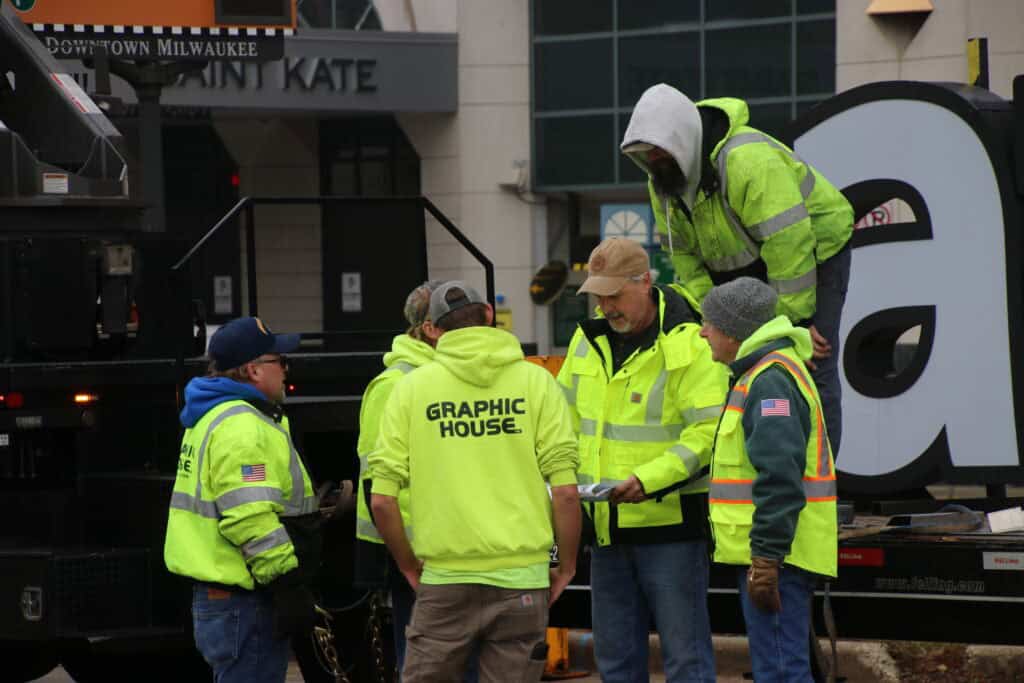
“Everything is built in house in Wausau, and we don’t [outsource much other than some electronics],” he said. “We fabricate everything ourselves out of flat stock: steel, pipe and other materials.”
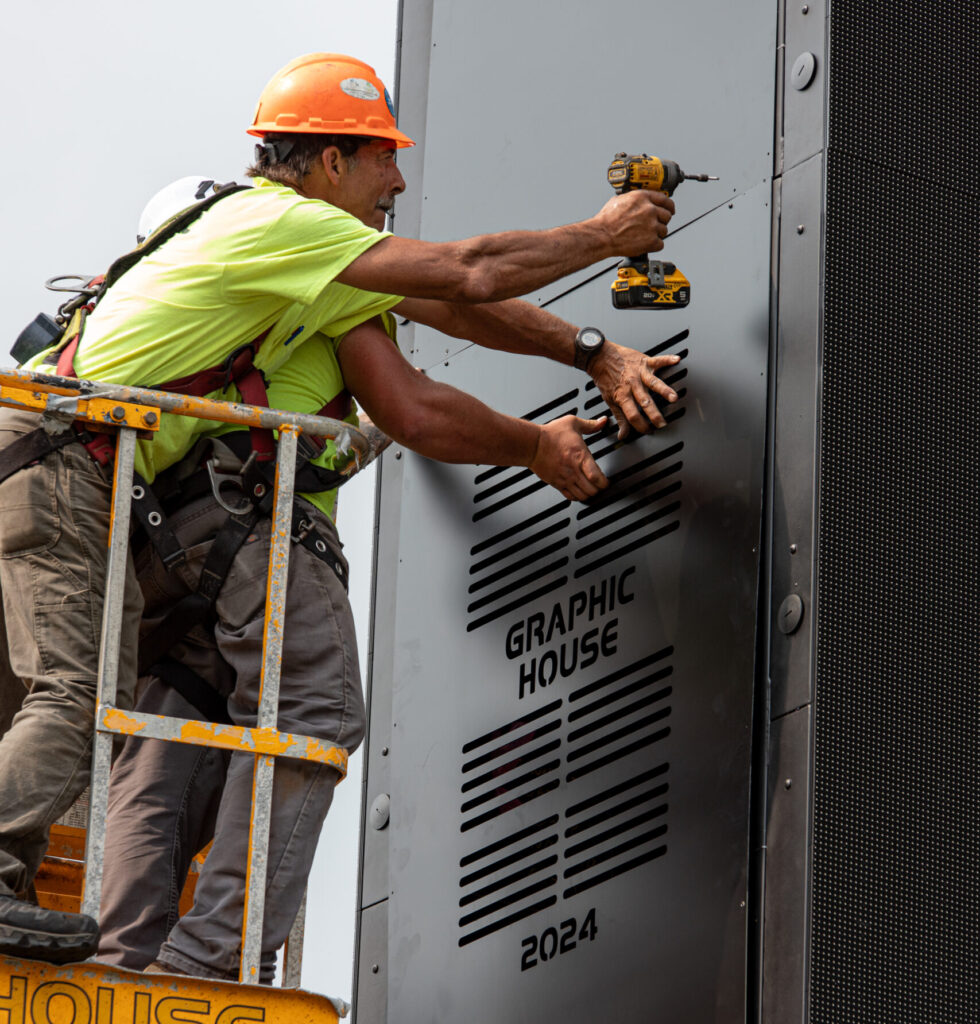
Controlling fabrication internally, Hartinger said, is more than a point of pride – it’s a strategic differentiator.
“It’s something we talk to our clients about because if you go to a company that doesn’t fabricate, they don’t control quality and make decisions based on the lowest price,” he said.
Hartinger said that control extends beyond fabrication to long-term service and maintenance, reinforcing the company’s emphasis on durability and accountability.
Culture by design
Inside the shop and office, Kim Berens – vice president of marketing for Graphic House – said culture carries as much weight as craftsmanship.
Berens said she describes the atmosphere as homey and family-oriented – a culture reflected in summer cookouts, grilled cheese lunches in the onsite kitchen, theme days, holiday parties and even office dogs that keep things light.
“We’re very family-oriented, and we work hard to work with people and their schedules,” she said. “We strive to be flexible, and the family culture just adds to it.”
The “it,” Hartinger said, is something both fragile and essential.
“We probably have the best culture we’ve ever had right now as we have a lot of great people, including the four latest people we added to our sales group,” he said.
Hartinger said new hires are intentionally onboarded, working in-house and completing up to 12 months of training as part of the company’s broader commitment to growth across all departments.
“We require people to grow and be progressive; we want to extract the best they have and help them grow and achieve greatness,” he said.
Berens said that philosophy has led to frequent internal promotions.
“We have employees who were in the shop now working in purchasing and others who want to grow in their specialties, and they can do that as well,” she said.
Hartinger said that is good business sense as the industry itself demands constant adaptation.
“We often talk about how we can’t build a sign tomorrow the way we’re building it now,” he said. “We have to get better, do it faster and make it less expensive, and that’s what is driving us.”
Hartinger said that mindset has fueled investments in state-of-the-art facilities, ongoing training and a recent nearly $2-million investment in new cranes and service trucks equipped with the latest technology and equipment.
“If you stay where you are today, you won’t be around tomorrow, so we’re constantly looking at what we can do to increase opportunity and productivity,” he said. “That permeates many aspects of the business, from drafting software to fabrication to process enhancement.”
Now certified as a Woman-Owned Business Enterprise by the state and a Woman-Owned Small Business (WOSB) by the federal government, Hartinger said the company is co-owned by his wife, Beth, who also serves as chief financial officer.
Midwest roots, national reach
Though the majority of Graphic House’s work is located within the Midwest – Minnesota, Wisconsin, Iowa, Illinois and Michigan’s Upper Peninsula – Hartinger said team members travel wherever projects require.
“We go nationwide, but our sweet spot is the Midwest,” he said.
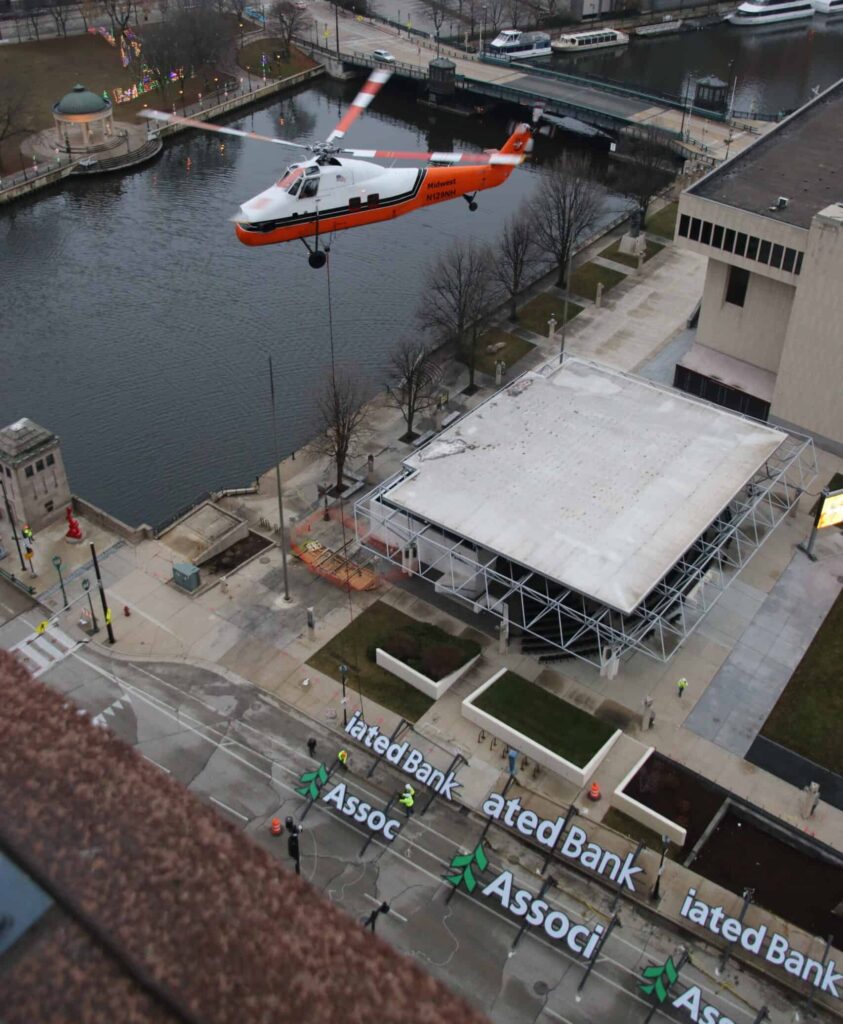
Some of the company’s more complex work, he said, includes signage for Eskenazi Health in Indiana, Paine Field Airport in Washington’s Snohomish County and outdoor illuminated signage at the Associated Bank Milwaukee Tower office.
Hartinger said each of these projects presented unique challenges.
“The Associated Bank install was our first helicopter install,” he said. “It took us a year to plan out, but the actual installation of letters at three elevations took just 31 minutes to install because of a great project management team. All our departments work together, but [project management] is at the core of planning.”
With the Eskenazi Health project, Hartinger said they sought to replace outdated wayfinding with more than 65 new monuments and pillars, including eight glass tower signs measuring more than 24 feet tall.
The team, he said, engineered custom outdoor signs visible day and night, featuring backlit lettering and illuminated glass towers.
Hartinger said each tower was constructed using individual baked-in glass images, designed for both structural integrity and safe transport.
“We had to buy the glass out of Chicago and go through the process of laminating that glass,” he said. “If [an opportunity like this] comes up, we figure it out, as we did with the cement pillars.”
Hartinger said recent work includes 18-foot-tall by 40-foot-wide video screens for a Kalahari Resort location – which builds on previous projects for the resorts in the Pocono Mountains and Sandusky, Ohio.
“We have such talented artisans in the organization, from the design to those who build it,” he said. “Everything we do every day is a little bit different than the day before, and that brings a lot of excitement to people. We don’t see signage as a commodity. Every sign is a custom piece, part art, part engineering and part experience.”
Blending generations
As the company approaches its 50th anniversary, Hartinger said another transition is underway: blending long-tenured expertise with emerging talent.
Hartinger said Operations Manager Roger Ivaska – a 12-year team member – plays a key role in maintaining high fabrication standards, supported by a seasoned crew: Daniel Durr (39 years), Thomas Marciniak (37), Roger Mortenson (43) and Lead Designer Neil Novotny (30).
Outside technicians David Garton (36) and Kevin Fechhelm (38), Hartinger said, bring decades of field experience, along with George Swanson (33) in the paint department.
Lea J. Blaubach, Hartinger said, the company’s top salesperson for three consecutive years, has dedicated 28 years to Graphic House.
“It’s great to have all this experience, but now we need to start replacing some of that,” Berens said. “The nice thing with youth is that there are new ideas, and the mix of the older and newer employees has been very good for us.”
At the end of the day, Hartinger said the goal remains consistent: deliver not just a standout finished product, but a seamless experience.
“Once [customers] give us the go, they can relax as we make sure everything is right and goes smoothly,” he said.
Hartinger said the Graphic House team will kick off its 50th anniversary celebration in March, with festivities continuing through June and culminating in a community-focused event this summer.
“We’ve experienced so much over 50 years, but you don’t remember the hard times,” he said. “You remember the experiences with people; those are the great things you remember.”