Making IT personal for 25 years
 ‘It’s time for the building to have a fresh look’




November 9, 2026
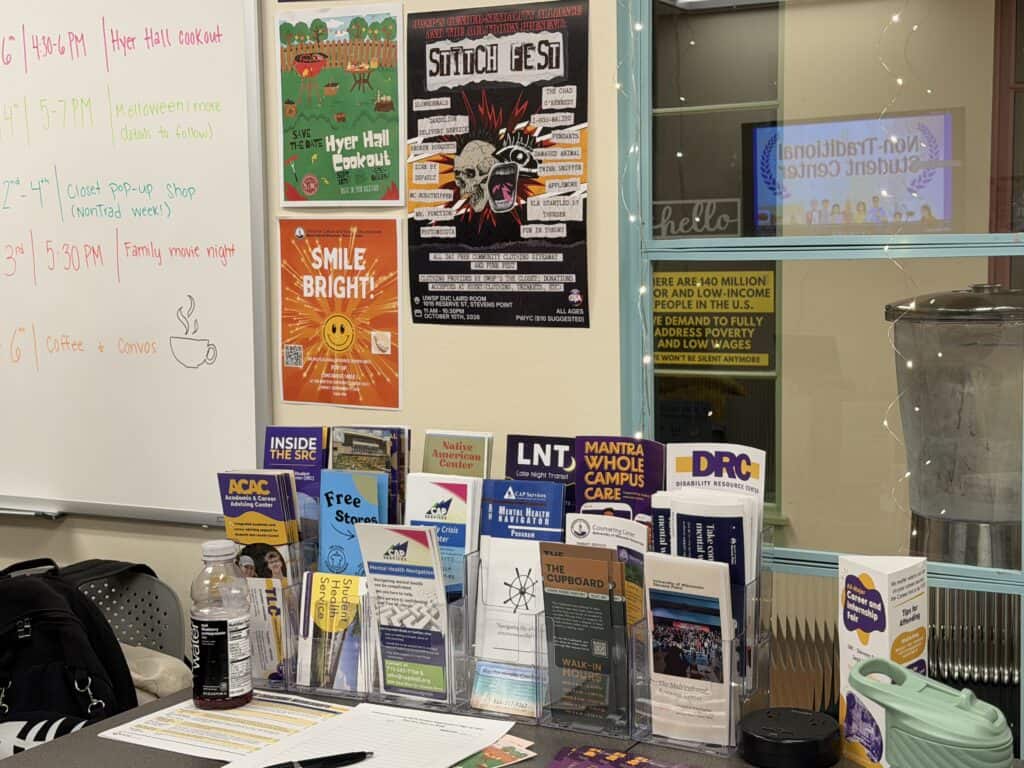
STEVENS POINT – A project years in the making – the new Non-Traditional Student Center (NTSC) – has opened at the University of Wisconsin-Stevens Point (UWSP) as of the fall 2026 semester on Sept. 10.
Per uwsp.edu, the center is a space where these students will find community, while being supported by a professional staff member that is available throughout the entirety of the Dreyfus University Center (DUC) operating hours.
The UW system generally defines non-traditional students as those who fall into one or more of these categories:
- Adult and returning learners, 24 years and older
- Part-time students
- Full-time workers while enrolled
- Financially independent
- Parents or caregivers
- Military veterans
Offering a sense of belonging
Prior to the NTSC, UW-Stevens Point had a student organization – the Alliance of Non-Traditional Students, known as ANTS – that provided support to non-traditional students.
According to NTSC Coordinator Emily Fabry, ANTS advocated alongside the Student Government Association and Division of Student Affairs to bring the NTSC to life.
“For history and context, this whole idea of a dedicated center started as a three-year funding program that was meant to be a trial period, essentially,” Fabry said. “We are in year three of that trial period, and currently the plan is to make it a permanent budget line item for next year. What we’ve built has been really successful so far.”
She said what makes the center special to the community is that up until now, non-traditional students haven’t had a place on campus to call their own.

Fabry, who has worked at the university for seven years, noted how these students “haven’t had a sense of belonging or a place where they could go for navigating the barriers they face in education and life, which are different from what an 18-year-old, traditional student might be experiencing.”
The NTSC provides a space for resources such as computers, a color printer, a study space, and a lounge area where the students can congregate in between classes.
It also has a microwave and a refrigerator – significant appliances, Fabry said, as many of the non-traditional students don’t have school meal plans as those who live on campus do.
She said this space opens the door for deeper and actual connection to other students, both traditional and non-traditional.
“I think the opportunity to connect with other non-traditional students and be able to talk about the barriers, struggles, or things going on that only they can understand is something worthwhile.”
A tradition of non-traditionalism
While non-traditional students are not a new concept, Fabry said their numbers have typically been much lower than that of traditional students.
“Our non-traditional students have always existed in the system; it’s just been less common for people of an older age, or those with dependents, to go back to college and start a college journey,” she said. “With the change in our society of how certain jobs have faded out or become less sustainable with technology, we now have people wanting and willing to take that path.”
Fabry also cited a demographic “domino effect,” wherein people having fewer children leads to fewer people in the school system all around, with fewer seniors graduating high school and, thus, fewer traditional students going to college.
However, on the other hand, she said this has opened the door for bringing non-traditional students in, either as first-time or returning college students.
With more non-traditional students in the mix, Fabry said over time, UWSP has needed to reassess how it’s providing the unique services they deserve.
The university’s goal, she said, has been to create an environment where everyone involved – from professors to college employees to traditional students – can learn the best practices for supporting non-traditional students, who sometimes need assistance getting up to speed with traditional students.
“The more we can change the culture for our non-traditional population, the more welcoming the university looks,” she remarked. “And most importantly, the more they can see themselves graduating from here.”
Embracing future growth
So far, Fabry said, UWSP’s non-traditional students appreciate the NTSC and the sense of community that’s come with it, particularly among those with more relatable life circumstances.
“This isn’t a dig at the younger, traditional-age students who they sit in class with,” she clarified. “It’s a different approach to where the non-traditional students are in their education journey and life.”
Fabry said the center sees a steady stream of students coming in and out almost hourly, often stopping to print something, use the space for research, or simply for a quick check-in because they have back-to-back classes.
She said her passion for such accommodations stems from her experience as a hall director at UWSP working with 18-year-olds trying to figure out how to navigate their freedom, and has only grown regarding all students trying to find ways to make life work.
“For me, the biggest change I’ve seen throughout the years is in our non-traditional students being able to show up authentically as themselves,” Fabry said. “Since serving in this role, one of the best examples I can give is serving our students with children in their lives. We have worked to promote our events as kid- and family-friendly, too, with this new space. Of course, we don’t want that for all our events on campus, but at the same time, we want to encourage inclusion.”
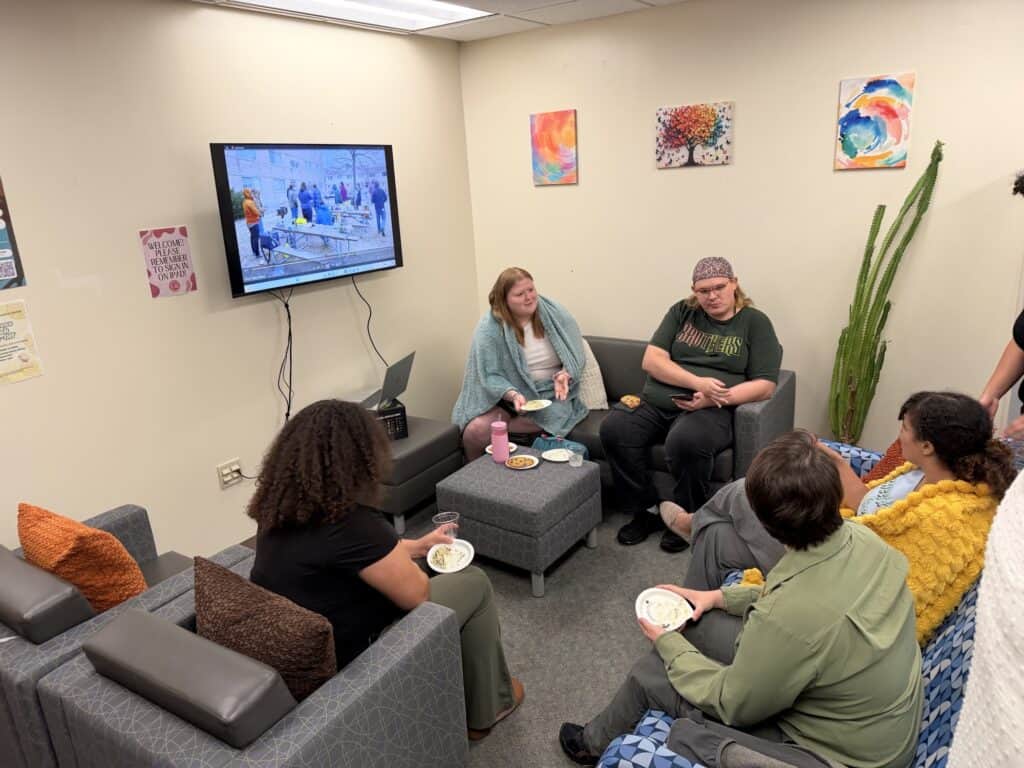
As a result of the center opening, she said she’s started seeing students bring their families to NTSC events to share their educational experience, which carries the added benefit of exposing more people to the university, including non-traditional students’ children.
“These kids spending any amount of time on campus gives them exposure – not just from their parents’ or guardians’ perspective, but from a general exposure standpoint,” Fabry said. “When they’re ready to go to school in the future, they’ve got a better handle on what that looks like, functions, and maybe even feels like.”
She cited a recent example of a UWSP student who was studying in the center while helping her daughter with spelling homework.
While such examples may not be consistent – at least not yet – Fabry said each instance gives more comfort to students who may face a similar situation.
Advocacy in action
Fabry said she is no stranger to the different culture shifts happening in education, and that while their version of the NTSC is unique to UWSP, she believes it could lead the way for other schools to do the same thing.
“If we want to talk about being competitive in higher ed and making sure we meet our budget requirements, we need to start looking at more of these being across universities and how we can support that day to day,” she said. “A lot of the conversation I’m having is about how we can accommodate things like orientation and trainings – basically all of those ‘beginning of the year’ things for non-traditional students.”
In advocating for the NTSC to help provide equal access to educational opportunities for all, Fabry said she now collaborates with different departments across campus.
This collaboration, she said, has included working with the admissions office to connect with newly admitted non-traditional students to let them know the NTSC is available, and working with veteran services to help with financial aid and benefits.
“A lot of the advocacy is in the action of getting out and getting the name out and showing that we’re doing things,” Fabry noted. “What our students need is the ability to say they’re a non-traditional student and their needs are different. The last two years have been a lot of throwing ideas out and seeing what sticks. The ability to be open to those conversations is what matters.”
She said her overall efforts target the destigmatization of the non-traditional student path, and assuring students they don’t “have to be 22” when they graduate.
This involves the normalization of switching majors, which Fabry noted has been a big part of her conversations with students.
“I teach a first-year seminar course where I talk about self-motivation for students,” she said. “If you don’t know what you want at 18, that’s okay. There are plenty of stories from our non-traditional students of how they’ve gone through life and later realized what they want to do. These stories are powerful and make an impact.”
Fabry said her messaging is simple: having more non-traditional students on campus offers different perspectives, and it proves that while you can’t always control what life is throwing at you, you can control how you respond – an important life skill the younger traditional students can also learn through exposure.
The space and beyond
Throughout the NTSC’s first month and a half of operation, Fabry said it has seen 337 visits, with 155 distinct students.
She said she’s proud of how the center’s utilization numbers are comparable to those of the campus’s other, longer-established student centers.
The usage thus far, Fabry said, along with the approximately 30 individual meetings she has held with students at the NTSC, has proved how the space was needed.
“Having students stop by and chat or ask questions about getting with advisors and so on – that’s a win,” she said. “Then, we have students who are connecting with each other who may not have otherwise. A fine example of this was some students and I having a conversation about parking on campus and how it affects them. These may be small things to someone else, but they’re important things that connect humans to humans, and that matters.”
Such conversations can have impact beyond the NTSC, Fabry said, with the parking topic in particular being shared with the Student Government Association, which is working with the Stevens Point Police Department to figure out what can be done better for campus.
Fabry said in general, she’s excited for what will come of the space and the non-traditional student population.
“We’re doing good things now, and there’s room for growth,” Fabry said. “Fall was about getting the word out with various events and pop-ups around campus. Spring will be about getting people in the area for coffee and conversation, with the goal of communicating and connecting.”