 Chippewa Sun rises with solar energy momentum
 Homeschooling parents open The Homie Hub in Oshkosh


March 2, 2026
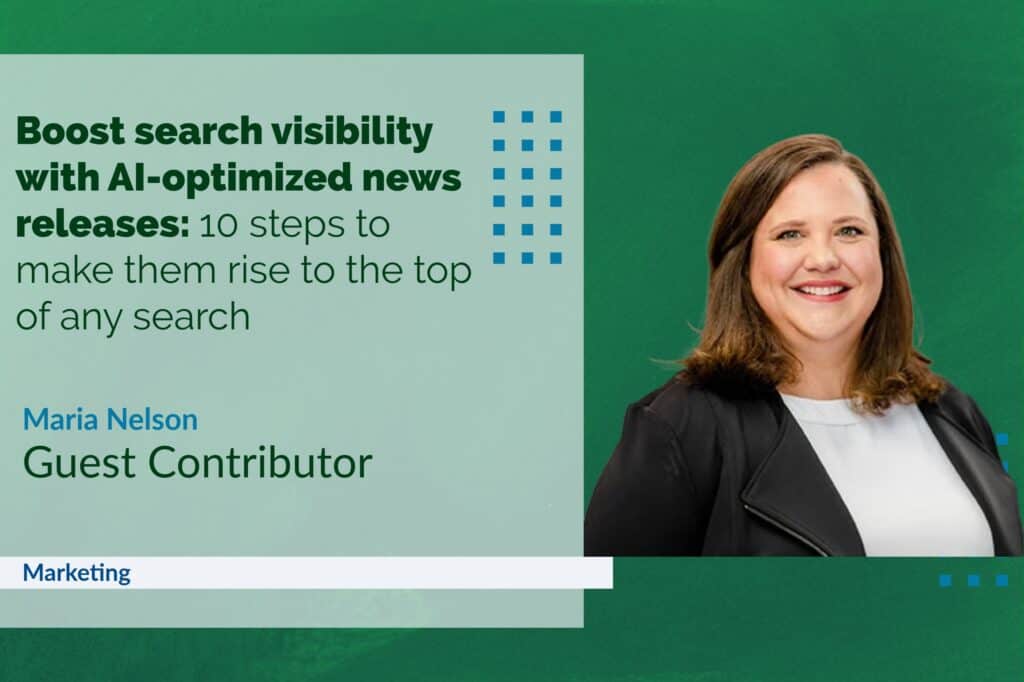
The way we access information is evolving – search engines are no longer limited to basic keyword matching.
They now provide direct answers to questions in a conversational way and retrieve those answers by scouring trusted, high domain-authority websites in seconds.
For businesses seeking online visibility, the traditional standards of crafting a news release no longer apply.
To capture attention in this new digital era, companies must write their news releases for both journalists and large language models (LLMs) – a type of artificial intelligence (AI) trained to understand and generate human-like language.
The easier it is for an LLM to scan, summarize and verify your information, the more likely companies will be cited in the AI’s response to the question it was asked.
Platforms like Gemini, Claude, Google AI and ChatGPT prioritize the meaning and credibility of your content.
This shift means businesses can no longer rely on keyword stuffing, vague language, throwaway quotes or repetitive phrasing.
Instead, companies should focus on highlighting their strengths, being specific, citing credible sources and including hyperlinks that AI systems can follow to verify information.
By doing this, companies are more likely to appear in an AI-generated response, increasing visibility.

A Pew Research study found that 26% of Google browsing sessions that featured an AI summary ended without users clicking through search results, making it even more critical to ensure your content is part of that summary.
Here are 10 easy-to-follow steps to help you get started.
Step 1: Rethink your keyword strategy
Though keywords are still relevant, their role has matured.
AI algorithms focus on understanding user intent and the relationships between concepts.
Keywords should be used strategically, with a strong emphasis on context, accuracy and credibility:
- Focus on relevance and intent – Use keywords that align with the core message of your news release and reflect what your audience is searching for. Consider the intent behind those searches. Are users looking for updates, solutions or insights?
- Be specific and clear – Use precise language and avoid vague or generic terms. For example, instead of saying “new product,” specify “AI-powered marketing platform” or “sustainable packaging solution.”
Step 2: Highlight authority and credibility
Include data, statistics and quotes from credible sources to strengthen content.
Additionally, adding hyperlinks to a company’s website or media mentions from credible outlets allows LLMs to verify and better contextualize the information.
Providing clear pathways to these sources increases the likelihood that the content will be referenced in AI-generated responses.
Step 3: Write a strong, keyword-rich headline
- Include relevant keywords – Use clear, concise language that incorporates key terms.
- Keep it less than eight to 12 words – LLMs favor headlines that are short, punchy and easy to process. Stick to factual, authoritative language that highlights what is newsworthy or beneficial about your news.
Step 4: Structure your content for machine readability
AI algorithms thrive on well-organized information.
A clearly structured document allows search engines to quickly parse, categorize and understand key elements of your news release.
This improves both machine comprehension and human understanding:
- Use a clear hierarchy – Arrange information logically, using clear fonts: H1 for title, H2 for subhead and H3 for major sections.
- Use question and answer subheads – Framing section titles as questions and providing clear answers makes it easier for LLMs to identify and extract relevant information. This approach aligns with how people search for answers.
- Use bullet points – Break down complex information into scannable lists. This makes the information easy to scan for both humans and AI systems.
Step 5: Lead with the 5 W’s in the first paragraph
- Answer who, what, when, where and why right away. Keep sentences short and easy to scan.
Step 6: Incorporate multimedia elements
AI systems prioritize text that includes rich media because it encourages users to engage with the content:
- Use supportive graphics and video – Add high-quality images, infographics or videos to a release.
- Add alt text – Use descriptive file names in alt text for all multimedia to help AI understand the content.
Step 7: Add a quote that demonstrates expertise
Quotes are an opportunity to add credibility and depth to a news release:
- Avoid generic statements – Instead, use quotes to highlight industry expertise, offer thought leadership or explain the significance of an announcement.
- Explain the impact – Focus on how the announcement solves a problem or benefits the audience.
- Avoid fluff – Skip overused phrases like “We’re thrilled to announce.” Instead, provide meaningful context or data that adds value to the release.
Step 8: Add statistics and data to add credibility
AI systems and human readers prioritize content that is factual and backed by data.
Include relevant statistics, research findings or measurable results in a news release to increase its chances of being picked up by AI systems and media outlets:
- Use relevant and recent data – Incorporate statistics or research that directly support your announcement.
- Highlight measurable results – If a product or service has achieved specific outcomes, even in beta testing, include those metrics.
- Cite credible sources – When referencing external data, always attribute it to a reliable source. This not only adds credibility but also helps AI systems categorize your content as trustworthy.
- Avoid overloading with numbers – Though data is important, don’t overwhelm the audience with too many figures. Focus on the most impactful and relevant statistics that support your key message.
Step 9: Use visuals to support data
If possible, pair statistics with infographics or charts.
AI systems prioritize content with multimedia elements and visuals make complex data easier to understand for readers.
Step 10: Add a clear call-to-action (CTA)
A strong CTA guides an audience on what to do next and ensures a news release drives engagement.
- Be specific and actionable: Tell readers exactly what action to take, such as visiting a website or exploring for a service.
Optimizing a news release for AI doesn’t mean losing the human touch.
At their core, news releases are still crafted to inform and engage journalists.
However, they now serve a dual purpose: sharing your story in a way that works for both human readers and AI systems.