 Mel’s, Holiday Acres nominated for inaugural Outdoor Industry Awards



November 9, 2026
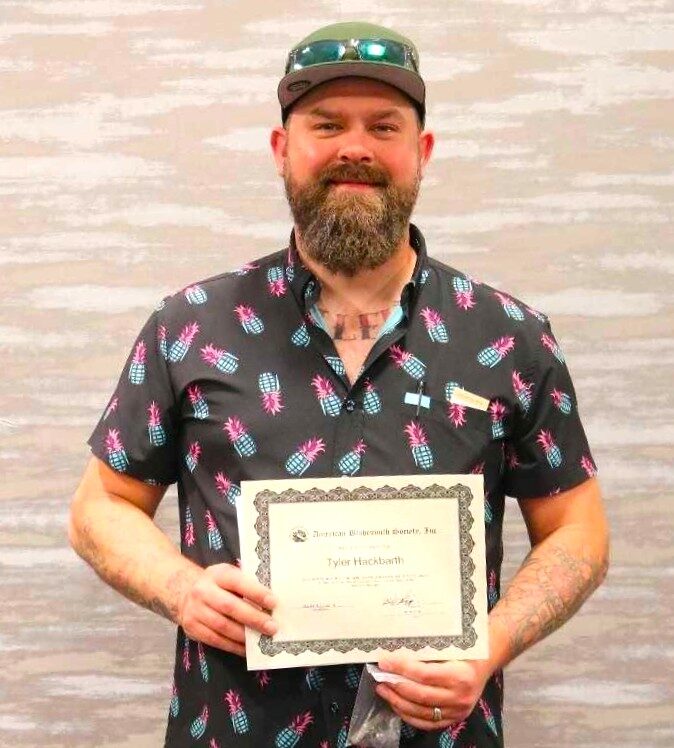
WEYAUWEGA – Growing up in New London before serving his country in the United States Army after high school, Tyler Hackbarth said his path to becoming an American Bladesmith Society (ABS) Mastersmith was a bit unconventional.
After being medically discharged from the Army in 2011, Hackbarth – Owner of the custom knife shop, Wolf River Forge – said he eventually made his way to Weyauwega to begin his life post-military.
“By that point, I’d already been married for five years and had two kids – I just needed to find a job to help support my family.”
Hackbarth – the only ABS Mastersmith in the state of Wisconsin – said after getting a job at a CNC machine shop in town, he went from machine operator to plant manager within three years.
“I worked there up until 2020, but in the meantime, as I was working full-time as a plant manager, I began bladesmithing in 2018,” he said. “I remember watching Forged in Fire on TV, and I thought to myself, ‘I can do that.’ That sparked my interest.”
Forged in Fire is a reality competition show on the History Channel in which skilled bladesmiths compete to create weapons and other edged tools using traditional metalworking techniques.
At about the same time, Hackbarth said his wife encouraged his interest by enrolling him in a blacksmithing class.
Although blacksmithing and bladesmithing are “two different arts,” he said the class further fed his interest.
“I built my own forge, found an anvil, and started hitting whatever steel I could find with a hammer,” Hackbarth said. “For the first Damascus steel blade I ever made, I essentially forged it by hand with a five-pound, mini-sledge hammer.”

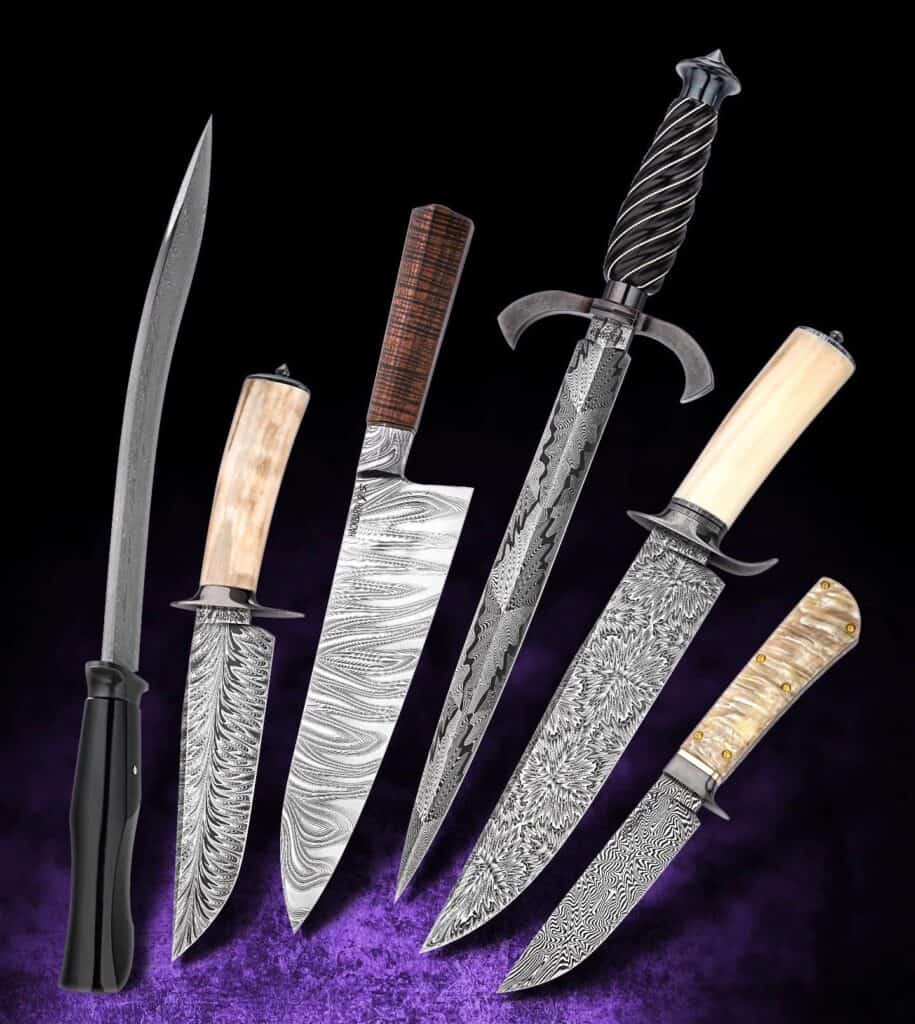
Damascus steel is the shatter-resistant result of two or more types of steel forged together to create a unique, flowing pattern.
After creating his first Damascus blade by hand, Hackbarth turned a log splitter into a forging press.
“Over the course of the next few months, I found a 22-ton log splitter that met my criteria and turned it into a forging press,” he said. “At the end of 2018, I was asked to come on Forged in Fire.”
Ten months into his bladesmithing career and having no idea what he was up against, Hackbarth entered the “Battle of the Branches” on the reality competition show.
Up against the best
Hackbarth said the History Channel show was split up into five different episodes.
One of the episodes pitted four Army veterans – including himself – against one another, while the other branches (Navy, Marines, and Air Force) got their chance in separate episodes.
“I won the Army episode of Forged in Fire, but didn’t win any prize money,” Hackbarth said. “They took the winner from each one of those branches and put them up against one another in a final battle at the end for $50,000. I ended up winning the whole thing.”
With stiff competition, Hackbarth said he walked away from the show with renewed confidence that he could make bladesmithing a career.
“The guys I went up against were good, but at the same time, I was working full-time as a plant manager and putting in 40–50 hours a week into bladesmithing.”
Everything Hackbarth earned from Forged in Fire, he said, went back into his bladesmithing business by way of equipment and materials.
“With the earnings, I bought a power hammer, a nice grinder, a leather sewing machine, and a really nice heat-treat oven,” he said. “That was the beginning of 2019, and toward the fall of that year, I began building my own dedicated knife shop on my property. Now, I probably have $150,000 worth of equipment. I could use some more space, but that’s not really on the agenda right now.”
When he first started making knives, Hackbarth said he sold them cheaply to his buddies.
Eventually, with wait times approaching 18–24 months for a custom-made knife, he decided it was time to work in bladesmithing full-time.
Despite having the workload to support his passion, he said it was still a scary time.
“You simply don’t know what’s going to happen,” Hackbarth said. “Anybody who starts their own business, taking that leap of faith is the hardest part. I did it, and I’ve been a full-time knifemaker since Aug. 1, 2020.”
As a “one-man show,” Hackbarth said he has no plans to hire any employees, but would work with an apprentice to help them learn the trade.
“In June of this year, I became the first ABS Mastersmith in Wisconsin,” he said. “Everything I’ve done in knifemaking, from learning the art of crafting leather to every part of making the knife from the steel to the handle to the sheath, I take pride in every part. When I put my name on a knife, I make every single part of it. It’s not something where I can have somebody come in and make a bunch of knives because there are too many things that can go wrong, so I can’t comfortably let anyone else do that.”
Custom-made art
From start to finish, Hackbarth said it takes him 12–16 hours to complete a Damascus hunting knife.
Combining his “production knives” with his custom-made blades, he said he pounds out about 100 knives per year.
“Maybe at some point, with my machining background, there may be a chance I may start a small knife company,” Hackbarth said. “That would allow me to turn up production and create knives on a larger quantity scale. It’s been on my mind, but for right now, no.”
One of a select few
The path to becoming a mastersmith is challenging, to say the least.
After Hackbarth entered the field and began working full-time on his passion, he held ABS Journeyman status before passing a performance test.
“Essentially, you have to be an ABS member for three years, or you take an ABS-approved class to bring that down to two years,” Hackbarth said. “I was entirely self-taught and never took a knifemaking class from anyone.”
The performance test was administered in the Lower Peninsula of Michigan, where Hackbarth was required to forge a minimum of a 300-layered Damascus steel blade and use it to slice through a one-inch free-hanging rope in one swing, six inches from the bottom.
“Then you have to chop through a 2×4 completely, and then do it again, with the same blade,” he said. “Immediately after your chopping is done, you must then take that same blade and shave with it, demonstrating that the edge is still razor sharp.”
Not having to worry about the blade being aesthetically pleasing, Hackbarth said the performance test demonstrates the bladesmith understands differential heat treatment.
“Finally, after swinging through the rope, chopping through a 2×4 twice, and shaving, you have to bend the blade 90 degrees in a vise without it breaking,” he said. “If you’re good and you get a good heat treat, your blade will come back to almost true. Both of the blades I used have come back to almost true. They are only bent about 10 degrees.”
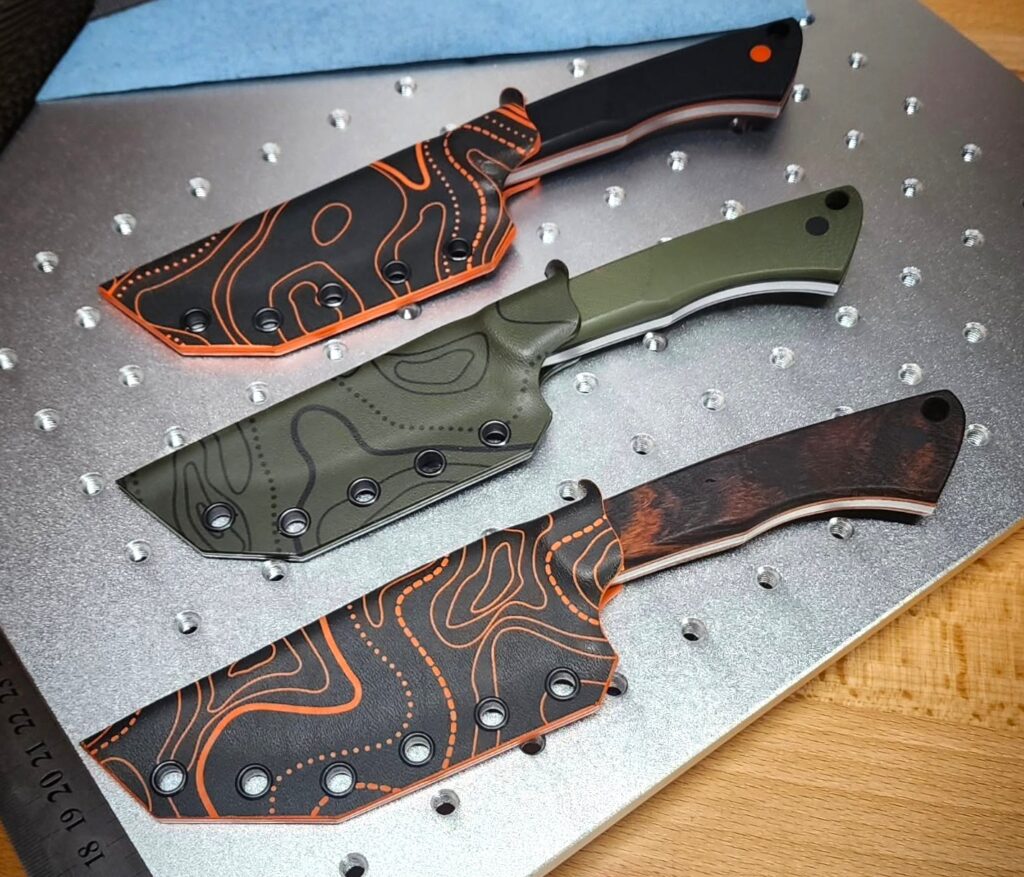
Following the performance test, and when the mastersmith judge signs off, Hackbarth crafted five presentation blades to be judged by a panel of seven mastersmiths at one of two events done yearly.
“Those all have to be mono-steel, satin-finish blades with the perfect hand-pulled satin finish – the most perfect you’ve ever seen,” he said. “Two of them have to be over-six-inch blades, and all five have to have either a guard or a bolster. A bolster is the integral front portion of the handle, or it can be pinned-on steel on the front of a handle. Up to that point, those were five of the nicest blades I had ever made.”
Unlike the performance test before a single judge, Hackbarth did not have to test the five knives against rope or complete other tests – they were strictly for display and judged entirely on fit and finish.
Needing four of the seven mastersmiths to pass a testee, Hackbarth was voted in and became one of only 117 ABS Mastersmiths on the planet.
“I would guess there are around 80 ABS Mastersmiths in the country, and the rest are from outside the United States,” he said. “Some states have multiple mastersmiths, while others don’t have any.”
Hackbarth estimated that if he compressed his work on the five presentation knives into one block of time, he spent about three months, each with a unique Damascus pattern.
For more on Wolf River Forge, head to its Facebook page.