 Quality Tank Solutions building new plant, bringing new jobs
 Sargento builds its own road to CDL talent


August 3, 2026
RUDOLPH – Seven decades in business is a milestone few companies reach.
For Bank-A-Count Corporation, CEO Ron Stoflet said the path to 70 years has been defined by steady expansion, evolving technology and a willingness to adapt.
“We are a commercial printing company focusing particularly on the high-volume production of checks, tax forms and other financial documentation with nationwide distribution,” he said.
Stoflet said he has spent 37 years with Bank-A-Count, holding a variety of roles before becoming chief executive officer.
“I started as a marketing assistant, which was a glorified customer service representative at the time,” he said. “I was quickly promoted to manager of the property management markets for loan payment books in the mid-1990s. I then moved into sales and marketing as director in 2014, and then several years later, I was promoted to the role of vice president.”
Stoflet said he is one of three owners of Bank-A-Count.
Built on humble roots
Stoflet said he began his career as a life insurance agent for Bank of America, covering 13 counties.
Over the years, he said he has witnessed significant changes in the financial services industry and at Bank-A-Count, but one thing has remained constant: the company’s name.

“If you look at our logo, it has an IBM punch card, front and center,” he said. “This is to demonstrate that we always remember where we came from.”
Those humble roots, Stoflet said, date back to 1956 with the company’s early work supporting the local fire department.
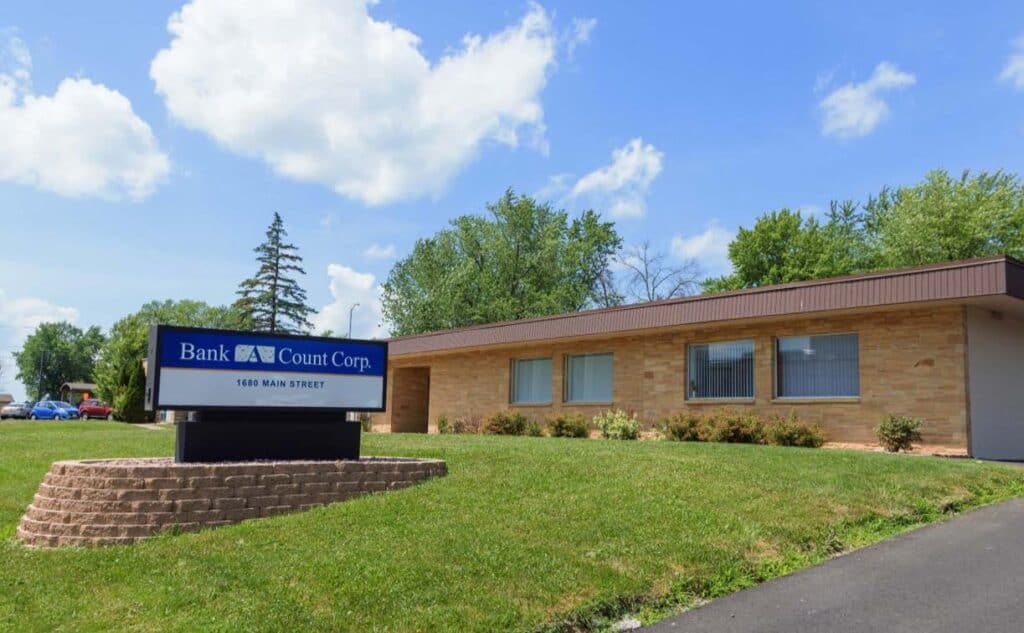
“We started our business [with] the Rudolph Volunteer Fire Department and Farmers and Merchants Bank who actually built the building I’m sitting in right now,” he said. “We moved to the basement of that bank. In 1985, we built a building next to it, which has a tunnel underground connecting the two buildings. We have undergone five additional building expansions since then.”
Since then, Bank-A-Count has evolved alongside the financial services industry, growing from basic bookkeeping and amortization services into a more diverse financial solutions provider.
“In the ’70s we added loan-payment books, followed by the addition of personal checks and business checks in the 1990s,” he said. “We used to receive edit files on floppy disks. All that has now been converted to online processing. We were at the beginning of data-processing [revolution/evolution]. Technology has made its impact through rapid changes.”
Growing through technology, service
Stoflet said one of Bank-A-Count’s biggest differentiators is its approach to customer service, particularly how the company manages and responds to service calls.
“Back in the day, we would receive thousands of phone calls every day, but now, we literally answer [closer to] 200 customer calls daily, even though our customer base is probably 10 times as big,” he said.
When Stoflet joined Bank-A-Count in 1989, the company had 21 employees.
“Right now, we have 41,” he said.
Stoflet said improvements in production efficiency and speed have played a major role in Bank-A-Count’s growth over the years.
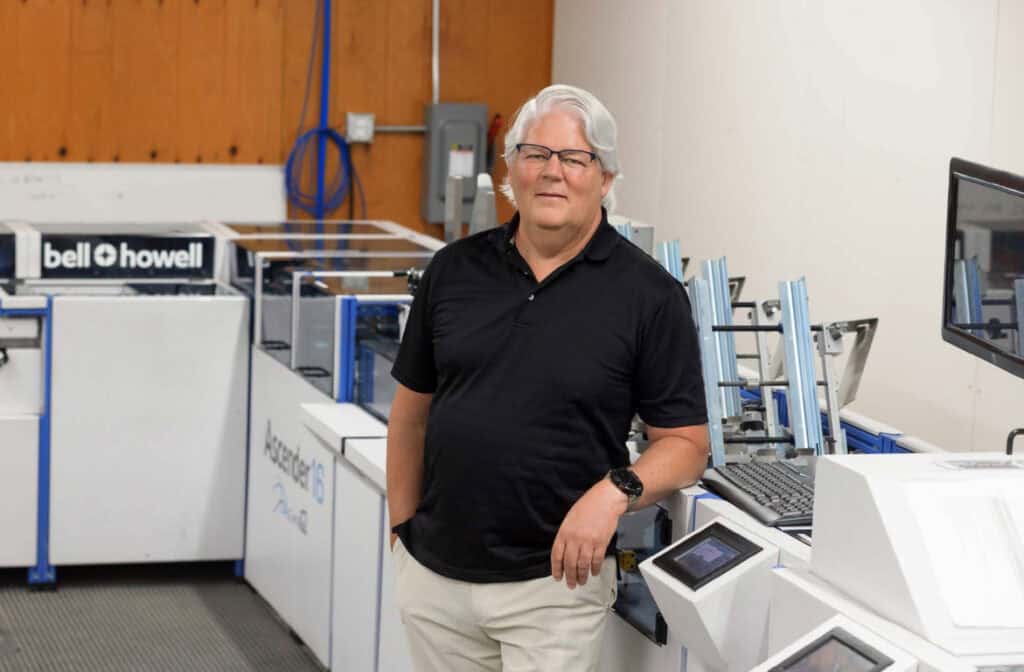
“Our printers are printing 150 [units] a minute,” he said. “Today, we have some printers generating 500 pages or 500 feet per minute. So, our bindery equipment is much faster. Inserting equipment is much faster. So, even though we haven’t [substantially] grown our employee base, our output has significantly increased.”
Stoflet said the company does not take its growth for granted.
“We produce for more than 1,000 banks across the United States,” he said, “and we serve up to 10,000 small businesses, ranging from [finance] companies, property management companies, to the guy in the corner that has a small business – our products can be found practically everywhere in the U.S.”
Rolling with the changes
Despite the broader decline in check usage, Stoflet said Bank-A-Count has continued to grow by gaining market share from competitors.
The company, he said, still produces checks for business and personal transactions, though he acknowledged the industry is steadily moving toward paperless payments.
Stoflet said that shift will continue to shape the company’s future as it adapts to changing needs among its customers, which include banks, credit unions, property management companies, homeowners associations and small businesses.
“We expect to be entering the direct-mail marketing world,” he said. “It’s a natural fit for us because of the equipment we have.”
As more transactions move from paper to digital platforms, Stoflet said adapting to that shift has become Bank-A-Count’s biggest challenge.
“We are able to overcome that because the markets are so big, and we are [a relatively] small player,” he said. “We’re just grabbing more market share.”
Though personal check usage continues to decline, Stoflet said business check demand has remained more resilient.
Building a workforce for the future
Though many companies continue to face staffing challenges, Stoflet said employee retention has not been a major concern at Bank-A-Count.
“Generally, when they [employees] come here, they don’t leave,” he said.
That stability, however, creates a different challenge: managing an experienced workforce as longtime employees eventually approach retirement.
“Staff tenure is putting the stress on us here because in the next two years, we are going to have a lot of our folks retiring,” he said. “We will need the workers to replace them.”
Stoflet said passing along the company’s history and culture to a new generation of employees is an important part of maintaining Bank-A-Count’s legacy.
“Once you bring in newer people, they haven’t evolved through all the changes that have occurred at Bank-A-Count over the years like many of us have who have grown up in the business,” he said.
Stoflet said he began his education studying computer programming before moving into accounting and earning his degree from Mid-State Technical College.
He said he quickly discovered that accounting was not where he wanted to build his career.
“I looked at myself in the mirror and said, ‘I can’t be one of those people with pens in a pocket protector,’” he said. “I then went into marketing and started my career in life insurance.”
Stoflet said he eventually returned to school at night, earning bachelor’s degrees in business and marketing as he continued building his career.
“I’m a firm believer of education,” he said. “We try to offer ongoing education opportunities to our staff.”
Stoflet said one of Bank-A-Count’s strengths is its focus on developing employees and creating opportunities for advancement from within.
“When somebody comes here and they are willing to put their best foot forward, they will continue to grow within the company,” he said. “This is one of the [many] things I like about our company… Most of our positions, when they grow, they don’t grow by title. They grow by knowledge, [which] then raises their income.”
Staying small, staying nimble
Stoflet said Bank-A-Count’s strategy is to focus on a smaller segment of the market while maintaining the flexibility to respond quickly to customer needs.
“We can move around very quickly,” he said. “We can adjust to clients’ needs quickly. We had a client a couple of years ago who was in panic mode. They couldn’t issue [their] checks, and they came to us. All the other [suppliers] they talked to told them two months. We got them up and running in two weeks. In two weeks, we were printing their accounts payable checks and mailing them out. That’s what we do.”
Stoflet said Bank-A-Count views itself first as a customer service company, with products serving as the tools to meet customer needs.
He said the company’s approach includes direct access to employees rather than automated phone systems.
“When customers call, there’s [immediately] a live person on the other end of the line,” he said. “We have two internal customer service people.”
Stoflet said the COVID-19 pandemic changed the way Bank-A-Count conducted in-person business.
Before the pandemic, he said the company relied on two field sales representatives.
“[After the pandemic], the market gave us feedback [that they didn’t need that], and we now conduct everything internally,” he said.
After 70 years in business, Stoflet said Bank-A-Count continues to operate as a small company from a small town while serving customers and transactions across the country.
“We fully expect to continue to evolve and be relevant for decades to come,” he said.
For more, visit bank-a-count.com.