 Sargento builds its own road to CDL talent
 Stevens Point Brewery taps into growing NA craft beer industry




November 9, 2026
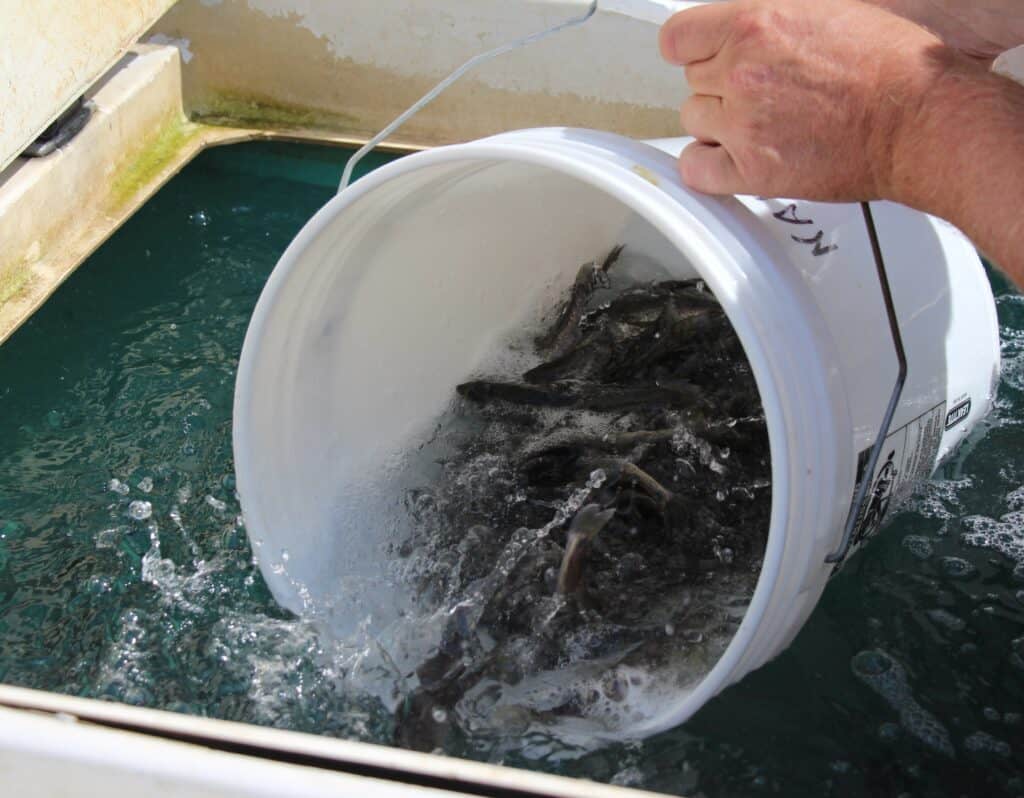
STEVENS POINT – The University of Wisconsin-Stevens Point (UWSP) Northern Aquaculture Demonstration Facility (NADF) has pledged its full support to the multi-state 100% Great Lakes Fish initiative.
Per gsgp.org, the website of the Conference of Great Lakes and St. Lawrence Governors and Premiers (GSGP), the goal of 100% Great Lakes Fish is to “demonstrate how every part of fish caught, raised, or processed in the Great Lakes region can be put to productive use.”
Supporters are watching for the potential this has on the economy and fish industry as a whole, citing the sustainability and profit channels this will bring.
Starting towards success
“Sustainability” and “fish” are two words that were not exclusively married in the Great Lakes region until the 1980s when – according to the GSGP website – a group of concerned leaders came together to ensure the ecosystem and economy would live in harmony well into the future.
The 100% Great Lakes Fish initiative aims to uphold those values by developing new uses and markets for fish byproducts, while also aiming to reduce waste, increase economic returns, create jobs, and strengthen the sustainability of the region’s fisheries.
According to GSGP, 48 organizations participate in the 100% Fish initiative and “represent about 53% of estimated fish volume across the region’s commercial, aquaculture, and recreational fisheries.”
Also participating in the initiative is Tyler Firkus, NADF Assistant Director.
Firkus said his facility at UWSP has been researching the goal of eliminating waste in production and processing, regardless of whether production happens in commercial fishing or research settings.

“There are a lot of different parts of a fish,” he said. “We mainly think of their meat production for seafood, but there are a lot of other products that can be utilized and produced from fish. Products such as collagen, fish leather in some cases, cosmetics, supplements – the list goes on.”
The GSGP shares that “only about 40% of each fish (the fillets) are usually eaten or productively used” while the remaining 60% is “often relegated to inexpensive uses or discarded.”
There’s potential all around, Firkus said, for use of byproducts that currently are not able to be accessed due to a lack of infrastructure.
He noted that UWSP pledged to the producers of the Great Lakes region due to the large amounts of research needed as technologies are being created for this market.
“The 100% Fish pledge is primarily geared towards fish producers, whether it be farm fish or commercial angling operations, because the volumes they’re working with and the processing is all geared around that,” Firkus said. “At the same time, a lot of the research institutions like NADF are raising fish for different projects, and it’s a good way to make sure we’re thinking
of how to design our studies and the endpoints of our studies.”
Even though NADF’s primary goal is not food fish production, he said they can be an active part of the solution and process.
A pledge to progress
The NADF’s focus on optimizing aquaculture means guiding the industry toward better practices, Firkus said, and this movement is one of those.
With UWSP’s “exceptional expertise in freshwater science, aquaculture, and fish nutrition,” as the website states, it is a unique and fruitful opportunity to work with GSGP.
Firkus noted that another participating organization – the current Red Cliff Band of the Ojibwe – runs a composting operation for their commercial fishery, as well as being a part of the 100% Great Lakes Fish initiative.
“We work together on developing that compost,” he said, “and using their products from their commercial fishing and processing operation to help support the operations of their farm and food sovereignty program.”
Despite the now-positive sentiment, Firkus said there was some concern at first when the group running the 100% Fish project reached out.
“Not all research projects are necessarily conducive to their end goal,” he said. “For example, if you’re running a toxicology lab exposing fish specimens to that, it’s going to be hard to use these fish at the end of a 100% Fish study, because you’re not going to eat them.”
However, Firkus said since NADF has a main research branch focused on aquaculture and fish conservation in the Great Lakes, the aligned mission between the two organizations means the NADF can continue research.
“The NADF is really a unique and cool, one-of-a-kind research facility in the Midwest,” he remarked. “We have the space for critical and important research at scale – all to advance fish culture and aquaculture, to optimize stocking programs to supplement wild reproduction, and really dig into the fish physiology.”
With that in mind, Firkus said they are looking at work they have done with Great Lakes fish species and the optimization of aquaculture practices, which puts less reliance on the commercial fishing industry and wild fish stocks alone.
Shifting focus to what’s left
According to the NADF, Wisconsin has over 2,000 registered commercial fish farms, 14 state hatcheries, two federal hatcheries, and all the resources needed to accommodate a significant expansion.
While Firkus said he knows that minimizing fish byproduct waste has not been discussed much for potential use of the various byproducts, he pointed out that it has been treated by processors, commercial anglers, and even researchers as a byproduct that was destined for waste in the first place.
A recent report by the GSGP estimates “24.3 million pounds of fish byproducts are now being productively used in the Great Lakes St. Lawrence region” – which helps prevent about “9.6 million pounds of carbon dioxide equivalent emissions” – adding that the byproducts generate roughly “$3.4 million in economic value.”
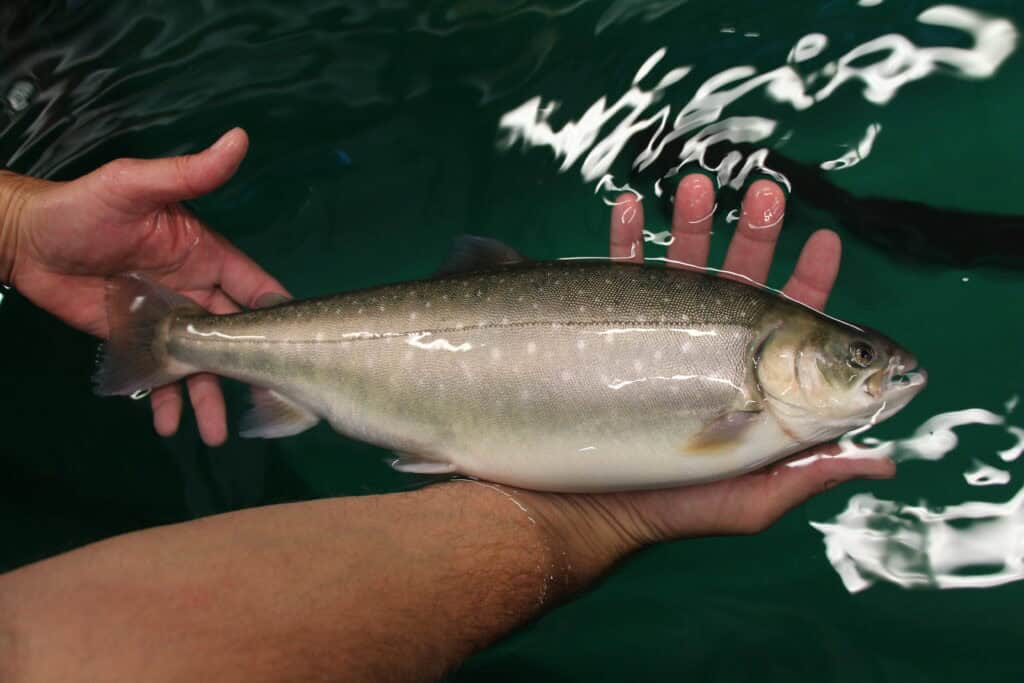
With the pledge and shift to focus on byproduct use, Firkus said that forces economic impact into the conversation.
“This is a paradigm shift, and it’s probably going to take a while for infrastructure to be built out,” he said. “But the fact that now it’s on everyone’s mind is important; we’re setting the area economies for success and economies of scale.”
This kind of large movement ultimately comes down to infrastructure, and Firkus said most commercial operations aren’t able to do much with the byproducts right now.
“The example of Red Band Ojibwe going directly to compost operations is a great way to use 100% of the fish, but it’s probably not the high-value way,” he said. “If we start on a supply side, putting more emphasis on raising and using the fish for the different products, that’s where you start changing minds.”
The future of aquaculture
Besides the shifting economics, the 100% Fish initiative also focuses on future generations of students who are interested in fish culture, aquaculture, and conservation.
“Many of the students who come into our facility – whether they’re graduate students or undergrads – have the conservation mindset and graduation goal,” Firkus said. “By pledging to this initiative, we’re able to get students working on projects with that ‘100%’ in mind. The students get to be a part of finding solutions, and that encourages them. Maybe they’ll eventually find their way into careers as a result of the training they had here.”
The initiative is a mix of altruistic ideals and people in fishing operations being ready to move forward with implementation, according to Firkus.
In an August press release, he stated: “At the UWSP Northern Aquaculture Demonstration Facility, we already work to make productive use of fish from our research by donating fish and fillets and composting eligible carcasses for fertilizer. The pledge allows us to formalize that commitment, share what we are learning, and work with others to advance full utilization across aquaculture and research.”
There are a fair number of private producers, he noted, that are signatories for this movement.
“I think there’s some trepidation because everybody likes the idea of having more channels for making money, but in some cases, that means more work on the processing side,” Firkus said. “At this point, those value-added processes aren’t there yet. All in all, however, this movement provides the impetus to have that infrastructure available.”
Firkus and his crew remain confident in moving forward with this project and are excited to see where this initiative will take the fishing industry of Wisconsin and the Great Lakes.
To learn more about the NADF, visit uwsp.edu/northern-aquaculture-demonstration-facility.