 “Inside the Huddle” – Standing the test of time
 Chippewa Sun rises with solar energy momentum


March 23, 2026
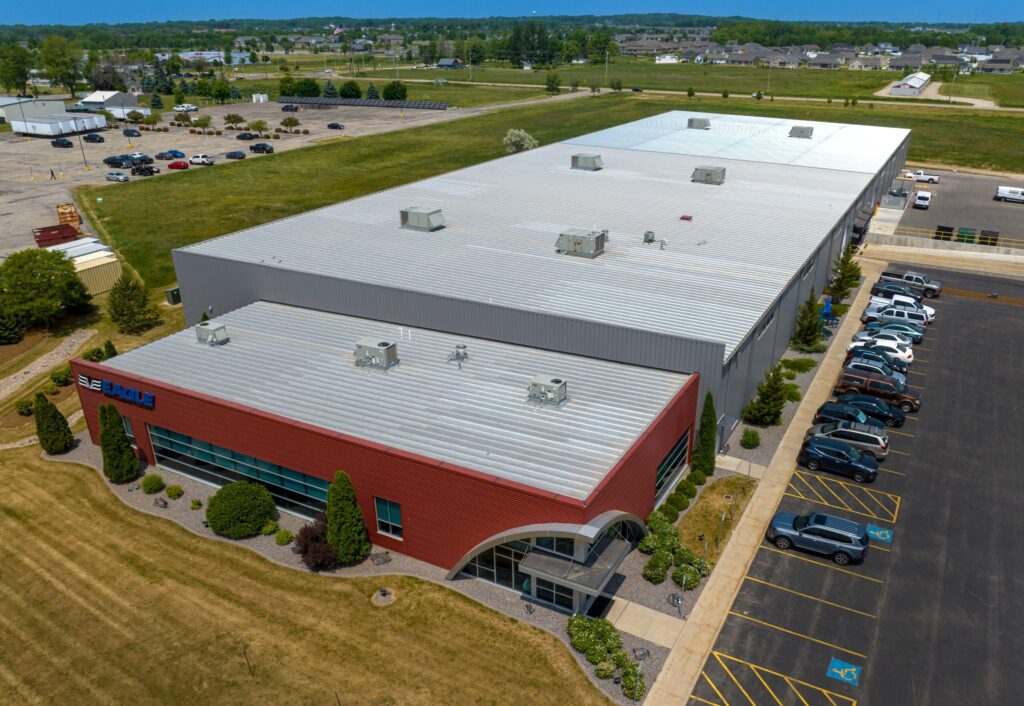
APPLETON – Growth at Eagle Performance Plastics – from 65 employees four years ago to about 100 today – Jason Bailin, vice president of sales, said, is driving new investment in equipment and facility space.
“We’ve seen a 20-30% increase in the last four years in the number of employees,” he said.
To support the company’s continued growth, Jason said Eagle – which manufactures custom-machined plastic components designed to enhance product quality and reduce costs – has completed several upgrades and added new equipment in recent months.
“We’ve had quite a bit of growth over the past couple of years, but most recently, [it has included] additional growth in the office,” he said. “We determined we needed to restructure the office layout to better fit where people are.”
Jason said Eagle also added a hush pod – which is like a soundproof phone booth where employees can take calls, conduct team meetings and hold interviews.
“This way, employees don’t have to book up a full conference room,” he said. “The reason we added a hush pod is because we’re running out of office space.”
To address those space constraints, Jason said Eagle – located at 2929 W. Evergreen Drive – is adding roughly 2,000 square feet of office space beginning this spring.
“The square footage will be added onto the west side of the building,” he said. “We’re primarily adding private offices, along with a few more conference rooms and bathrooms. The expansion is expected to be completed by the end of summer.”
More skilled workers needed

With continued growth driving demand for more workers, Jason said Eagle is hiring machinists, operators and general laborers for its production floor.
He said skilled laborers are in high demand.
“We’re actively recruiting in those areas,” he said. “Recruitment is still pretty difficult, though. There are a lot more schools reaching out in tech ed programs, trying to get kids involved, but that doesn’t seem to change the perception of some who think a four-year degree is required [to make a good living]. You can make a very good living working in the trades.”
Jared Bailin – president/CEO at Eagle – said there are a lot of good machinists/talented workers out there, but many are already employed at good companies.
“Those talented workers aren’t necessarily out job hunting, so it’s difficult to find trained people,” he said. “We’re focusing on hiring people who are already machinists but also looking for workers who are looking to maybe change careers… or ones who have some mechanical ability but aren’t necessarily machinists.”
Jared, who is Jason’s father, said Eagle is also making its internal training program more robust so they can better train people.
To further address the skilled labor shortage, Jason said Eagle has launched a youth apprenticeship program.
“We typically try to hire when they’re going to be juniors in high school, so we have two full years with them,” he said. “On average, we have anywhere between two and four youth apprentices, because we don’t want to overextend our capabilities of being able to give them the necessary help.”
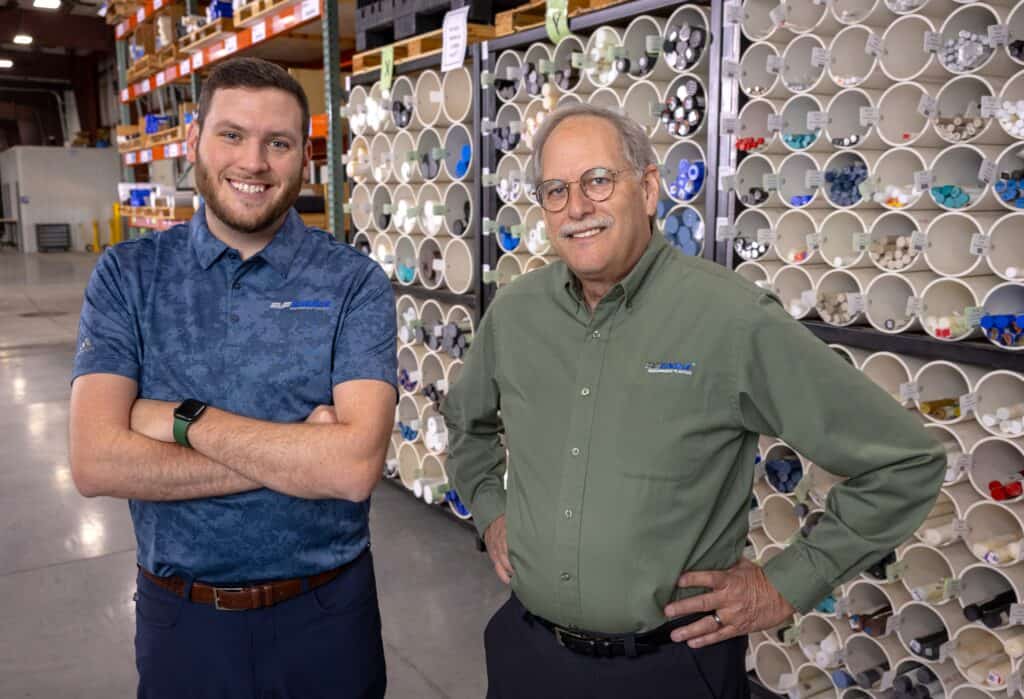
Though the father-son duo said the youth apprenticeship program is going well, there are still difficulties associated with it.
“By the time they’re graduating seniors, they’re almost full-time machinists,” Jason said. “Some of them are running machines and making parts we send to our customers, but we have been struggling to keep them on board after they graduate. Some are going on to attend four-year engineering schools or to become tech ed teachers. We get them to come back on their school breaks, which is a big help.”
More upgrades
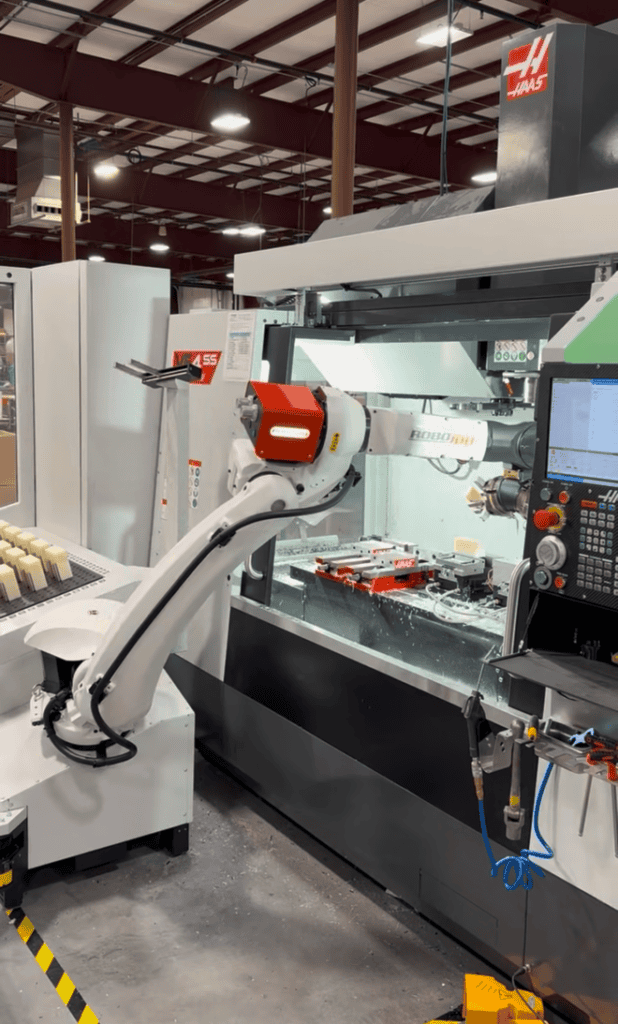
As part of efforts to offset the skilled labor shortage, Jason said Eagle recently integrated a robotic arm with one of its VMCs to increase capacity and improve consistency.
This, he said, is another step toward smarter automation and long-term growth.
“It’s the first robotic arm in our company’s history,” he said. “We envision getting a couple more in the future. Essentially, this allows us to run parts over the weekend without anyone being here, or we can run parts overnight when people call in or are on vacation.”
Which, in turn, Jason said, helps with the labor shortage.
“The robotic arm has a very simple setup/programming time associated with it, so the learning curve is pretty minimal for us to understand how to work it,” he said. “We’ve only run a couple of parts on it because we’ve only had it for about a month, but we anticipate running a few different jobs for multiple months straight.”
Furthermore, Jason said the robotic arm loads and unloads the machine.
“We still have to program the machine and make sure it’s running correctly, but we don’t have to have an operator standing there loading parts or taking them out of the machine,” he said. “It’s basically doing the work of a person. We’re still experimenting with it to see what it can do.”
Sustainability
Though highly prioritized at Eagle, Jared said recycling can be complicated in machining.
“When we’re cutting off a large chunk of plastic for a part, we’re easily able to separate that,” he said. “We put that scrap in different bins. Where we have seen more problems is the shavings that are created from machining. Those shavings mix with other things, so it’s been harder to recycle.”
In 2024, Jason said Eagle began working with a Green Bay company that takes the waste plastic shavings and combines them with other things to make them useful.
“They can combine it with different fibrous paper materials, and they use that as a sustainable fuel source,” he said. “[Through that], we’ve diverted more than 150 tons worth of plastic shavings and scrap that previously went to the landfill, which now gets repurposed into electricity.”
Before finding a way to recycle its plastic shavings, Jason said Eagle would send 12 to 14 dumpsters a week to the landfill.
“Most of our waste nowadays is break room or bathroom waste,” he said. “We now only send two dumpsters a week to the landfill. We’re pretty pumped about what we’ve done. It’s been a huge success.”
To further its sustainability efforts, Jason said Eagle recently invested in an electric forklift.
“We’re always trying to keep sustainability as an important aspect of what we want to do here,” he said. “The electric forklift was just a part of it. We chose to go that route as opposed to the gas-powered ones. We’ve also investigated solar panels and things like that. That’s something we may do in the future.”
More investment coming
Jared said Eagle is continuously investing back into the company to prepare itself for growth.
“The office expansion is really because we’ve added people into the infrastructure to make sure we can grow,” he said. “We added some people this past year in our accounting, HR and sales departments, and we’re continuously buying new machines and equipment. We recently had two new vertical machining centers delivered, and we anticipate possibly adding one or two more by the end of the year.”
Even with the forthcoming 2,000-square-foot expansion – at 69,000 square feet, Jason said Eagle is running out of room.
“There is nothing concrete yet, but tentative plans – if we move forward with [another] expansion in the near future – would call for roughly 36,000 more square feet of shop space,” he said.
Though Eagle still mainly handles smaller part runs, Jared said the company is seeing an increase in larger-quantity orders.
“Mostly it’s smaller quantities – a couple dozen parts or sometimes it’s a little bit larger – but we are seeing some larger orders compared to what we used to,” he said. “In plastics, if you get really large quantities, then you would go to an injection molding, but you need a lot of parts to do that. That’s one reason why we chose to invest in that robotic arm to experiment with.”
For more information on Eagle Performance Plastics and its youth apprenticeship program, visit eagle-plastics.com or find it on Facebook.