Facility expansion increases Galloway Company’s capacity by 150%
 Breakfast on the Farm at El-Na – the sequel



November 2, 2026
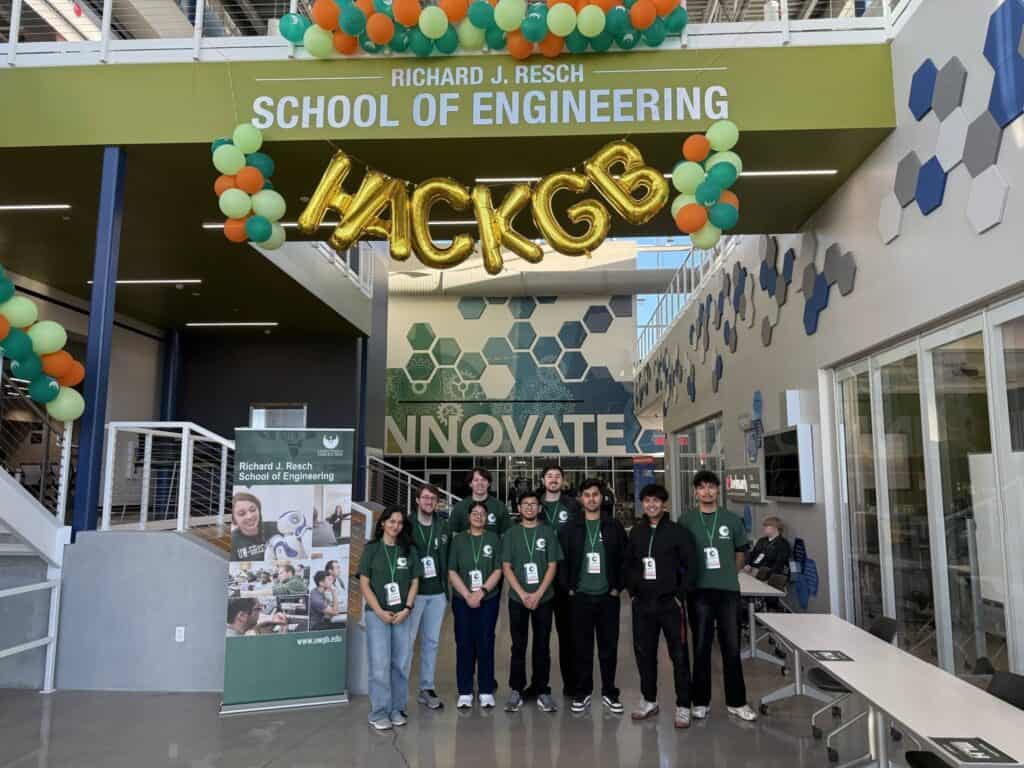
GREEN BAY – Contrary to what the name implies, no computers or network systems were hacked at the recent HackGB hackathon at the University of Wisconsin-Green Bay (UWGB) campus.
The lead organizer of the event, Sachin Shrestha, said hacking – a concept that can carry destructive connotations – is utterly at odds with what a hackathon actually is.
“A hackathon is a place to build everything – everything from scratch,” he said.
Shrestha – who is also President of the Google Developer Group (GDG) at UWGB – said the time-based events are centered on bringing creative ideas to life.
“After your time starts, you start building with your team; you can be a single team or a team of up to four,” he explained. “You start building everything from scratch, you present it, and you can potentially grow that as a start-up in the future if you want to.”
Further clarifying the name, Vice President of the GDG at UWGB Sumit Karki said hackathons amount to the competitive creation of “life hacks” – contemporary slang for boosting personal productivity/efficiency, or shortcuts for overcoming limitations.
“Hackathons are basically competitions where students come up with a solution for a problem…,” Karki said. “Normally they run 24 hours or 36 hours, so that’s a very limited time to solve some problems.”
Shrestha – an undergraduate senior majoring in Software Engineering & Computer Science (AI) – said the idea to host a hackathon at UWGB came to him after he enjoyed and succeeded at national hackathons HackPrinceton and HackIllinois.
Previously, GDG at UWGB Secretary Carlos Guzman said the only hackathons in Wisconsin had been held at UW-Madison and the Milwaukee School of Engineering.

Guzman said those two colleges/cities garner the most recognition regarding computer/engineering prowess – “but that is the mindset, specifically, that we wanted to break.”
“We wanted to contribute to the making of a tech hub, and we know there’s a lot of talent in Green Bay, so why not put our part into it?” he said. “We started organizing the hackathon because students shouldn’t have to travel all the way down to Milwaukee and Madison to experience this.”
Through the GDG’s collaboration with UWGB student-led computer science club 404 Network (Club Not Found) and Stephanie Kaponya – a program manager at the university’s Student Engagement Center – and with 10 months of preparation, Shrestha said HackGB came to life.
The event took place at the UWGB campus’s STEM Innovation Center from 8 a.m. Saturday, Oct. 17 through 7 p.m. Sunday, Oct. 18.
In its first year, Guzman said HackGB had 58 participants competing for over $5,000 in prizes.
He said most of the competitors were between ages 18–24, though some were in their early 30s.
Shrestha noted that only half of the participants were from the Green Bay area.
Per hackgb.com, university and graduate students (as well as those who graduated within the last year) of any ability were encouraged to apply to participate in the free event.
Participants were tasked with submitting their project to their choice of one of four tracks:
- Environment & Sustainability
- Education
- Industrial
- Healthcare & Wellness
“We made [the tracks] broad on purpose, because we didn’t want to limit [participants’] creativity or the ideas on one specific thing,” Guzman explained. “The industrial projects, for example, could be anything that would modernize supply chains or optimize manufacturing – anything related to the industry.”
Hackathons conclude with the awarding of prizes, which, for HackGB, were awarded for each of the above tracks as well as for a number of overall categories, tracks sponsored by event partner Major League Hacking, and categories focused on AI software, Modal and Lovable, and others.
Although the event was created with the best of intentions, Guzman said due to the negative connotations of the term “hacking” and relative unfamiliarity with hackathons, UWGB’s IT staff summoned the organizers for an “emergency meeting.”
“They were genuinely concerned we were going to invite students to hack the university,” he said, “so [the meeting] was a few minutes of, ‘No, no, no – this is building projects, not hacking the servers.’”
With HackGB 2026 behind them, Shrestha said he and the other organizers intend for it to become an annual event.
“It was a success, because we were able to do everything we wanted, and everything went smoothly.”
What happens at a hackathon?
Even with the lure of potential prizes, what is it about hackathons that sees college students willingly give up an entire weekend to push their cognition to the max?
Guzman summarized the two-day itinerary for HackGB 2026 as follows:
- Day One:
- 8–11 a.m. Saturday: Check-in
- 11 a.m. to noon: Opening ceremony
- Noon: The “hacking” begins, supported by sponsor-led workshops
- Day Two:
- 8 a.m. Sunday: Breakfast
- Noon: Submissions are due
- 1 p.m.: Judging and live gallery demonstrations, featuring 19 judges ranking projects and providing feedback
- 3:30 p.m.: Shark Tank-style pitches for the top five projects
- 5 p.m.: Closing ceremony, featuring a keynote speech (from Chris Chan, CEO/Co-Founder of Kommon.ai) and weekend recap
- 6 p.m.: Prize distribution, as individual track champions and winners are revealed
“Hackathons are opportunities for students to develop projects, but also to develop their personal profiles,” Guzman said. “As students get to learn about new technologies through traditional school, they wouldn’t be in touch with them, and they learn how to use these technologies, use their creativity to build something in a single weekend, actually make a final product work, and also practice their speech or pitching skills.”
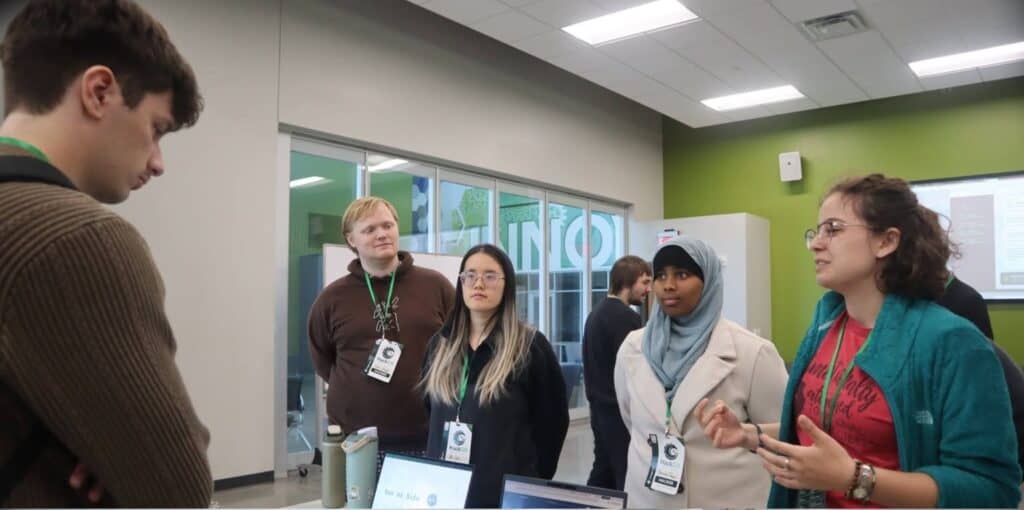
Shrestha said hackathons also provide participants with unique chances to network with event sponsors, mentors, and fellow participants.
He said the camaraderie that develops between participants – who typically sleep (or don’t) on location, eat with one another, etc. – is a big part of what he appreciates about hackathons.
All the HackGB organizers agreed they also enjoy the immersive rush unique to the events.
“Hackathons are that space where you have to forget about everything and focus specifically on making your idea a reality, working with people you’ve never met before…,” Guzman said. “Having your idea become a reality in just 24 hours or 36 hours? It’s amazing; I love that.”
This year’s winners
Out of all the software and hardware creations of HackGB 2026, the following were declared winners:
Main Awards
- Best Overall Hack: Cold Guard
- Best Environment & Sustainability Hack: ReHome
- Best Education Hack: MathWise
- Best Industrial Hack: EyesUp
- Best Healthcare & Wellness Hack: CheckMate
Additional Awards
- Best Hardware Hack: ReHome
- Best Beginner Hack: Gunk Radar
- Best Solo Hack: AirSketch
- Best UI/UX Hack: MedCheck
Sponsor Awards
- Best Use of Modal: AirSketch
- Best Use of Lovable: WheelScares.com
Major League Hacking (MLH) Awards
- Best Use of Vultr: FoxWatch
- Best Use of Gemini API: CodeClash
- Best Use of Solana: ProofSettle
- Best Use of Tiger Data: ReHome
- Best Use of DigitalOcean: EyesUp
- Best Domain Name from GoDaddy Registry: Sus or Safe
One industrial project Guzman cited was software able to track the line of sight of machine operators in order to prevent distraction and/or accidents.
For healthcare, a hack he mentioned was software for tracking which haunted houses are ADA-compliant, created by a participant with disabilities.
Guzman said projects must be started anew, from scratch, once a hackathon begins, and assured judges have methods for preventing cheating.
Per the HackGB website, any newly created intellectual property is exclusively owned by the team who made it.
Hack to the future
As rewarding as the organizers found HackGB 2026, they said they’re eager to apply wisdom from this event to host an even better hackathon next year.
“One of the things that did not meet our expectations was the number of participants,” Shrestha noted.
Guzman suggested the turnout was impacted, at least in part, by the fact that there happened to be a Green Bay Packers home game the weekend of HackGB, which made flights prohibitively expensive.
Karki also said they intend to ramp up promotion earlier in the year for their next hackathon, as they have already done much of the conceptual heavy lifting that demanded so much of their time this year.
Still, the organizers said there were two unexpected benefits to the inaugural event’s lower turnout.
One, Guzman said, was they were able to devote more attention to the individual participants.
“It allowed us to have enough time to make sure we supported their needs, and [showed us] we also know how to handle this smaller number of people,” he said. “For next year or for future years, we can expand and use all the same things. We know what works well, what doesn’t, and just continue with the growth. So, for the learning experience, it was just right.”
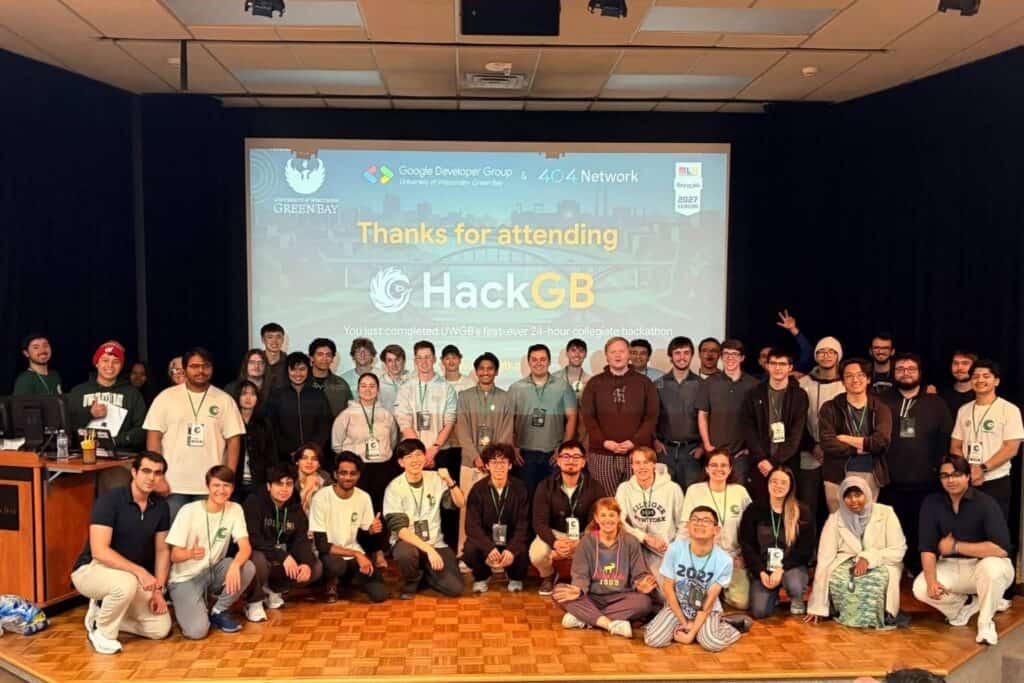
President of 404 Network (Club Not Found) Ethan Wollert pointed out there was a second silver lining to having fewer participants than expected: charity.
“We ended up having an extra 115 meals, which we donated across two shelters: Freedom House and then also the New Community Shelter,” Wollert said.
Guzman said it was a way to pay forth the organizers’ gratitude for all who made HackGB 2026 possible.
Just as the organizers noted a marked increase in participants’ enthusiasm between this year’s opening and closing ceremonies, they said they hope to see momentum continue to build for 2027.
At the heart of HackGB, Shrestha said, is improvement.
“If you have something in your mind that you want to solve, or if you are facing some kind of challenge in your life, a hackathon is the place to solve it.”