 Voyageurs Bakehouse expands into new downtown Green Bay space
 A long time brewing – Northwoods brewery opens its doors


April 6, 2026
DE PERE – Since 14 million hours equates to nearly 16 centuries, such a duration of time may be difficult to fathom.
But as The Foth Companies recently surpassed 14 million hours of collective work without a single lost-time incident, the engineering services firm shared a few equivalencies on its social media pages for perspective on what can be done in such a time:
- Take 7,000 trips around the world
- Build the Golden Gate Bridge 28 times
- Complete 2,000-plus years of full-time work
Foth’s Director of Health and Safety, Chris Seider, said no matter how high the number is, the most important digit to him is zero – as in, zero lost-time incidents reported.
What constitutes such an incident, he said, is any “work-related injury or illness that results in medical treatment above and beyond first aid.”
“That’s the baseline of what would make it a recordable [incident] that also results in our members’ inability to report to work due to the severity of their ailment,” he said. “Real simply, think if somebody gets hurt so badly that in no way, shape or form are they able to work or function, or [if they need] a surgery or something like that.”
For Foth to hit 14 million hours without a lost-time incident, Seider said “gratitude is owed to everybody within the organization.”
“None of this happens without literally every single person within our organization committing to the philosophy of safety every single day,” he said. “All credit really goes to our members and what they’ve done at every level of organization to make this happen.”
‘Culture of protecting our people’

Seider said Foth’s approach to safety likely mirrors that of many other companies – a “safety program, safety training, core processes” – what he’d consider the bare minimum.
“Everybody’s got them, everybody should be doing them and they are important,” he said.
From this baseline, though, Seider said Foth goes to the next level.
He said the “special and unique” company’s incident-free streak started and continues with its people/members and corporate culture.
“One aspect of our culture is what we call being safety-minded,” he said.
Seider said Foth defines that with the phrase: “No job is so important and no work is so urgent that we cannot take the time to perform safely.”
“Stated differently, none of us is going to deliver anything to Foth or to Foth clients that will ever be worth putting our own personal health and safety on the line for, period,” he said.
Seider said this mindset is reinforced at every level of Foth and embraced by the company’s 700-plus members.
“Never once, over my almost 14 years with the organization, have I seen us do anything other than live by that cultural philosophy,” he said. “Meaning, we’ve never been overrun by an operations decision, a financial decision, anything else, other than living by ‘we’re going to protect our people no matter what it impacts the organization.’”
Nothing, Seider said, supersedes the safety of Foth’s members nor the “culture of protecting our people.”
“If the project doesn’t happen, but it protects our people, we’re cool with that,” he said. “If the project gets delayed, but it protects our people, we’re cool with that… Nobody’s going to question that decision.”
Seider said Foth’s cultural expectations extend beyond internal practices, emphasizing the company does more than just perform work safely.
“We strive to design safety into our work so our clients will continue to benefit long after we can complete our projects,” he said.
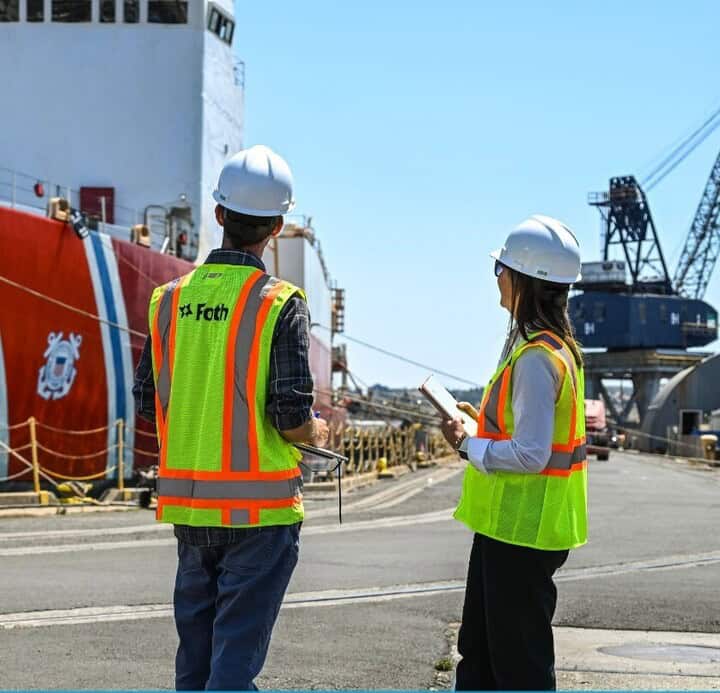
When Foth designs a project – from manufacturing equipment to roadways, bridges, facilities, airports or environmental restorations – Seider said the company prioritizes protecting both the community and the individuals working for its clients who are affected by the project.
“By creating safety and a safety-minded mentality into how we deliver our projects, my 700-plus members can protect tens if not hundreds of thousands of people impacted by the projects that we deliver…,” he said. “It’s not just a policy and procedure – it’s a mindset.”
Comparing cautiousness
Seider said the Foth mindset that has led to a lower rate of lost-time incidents than that of comparable companies has done so in an industry that already has exceptionally stringent standards.
“The [U.S.] Bureau of Labor Statistics collects data, and they create benchmark industry information, and our industry benchmark is extraordinarily low,” he said.
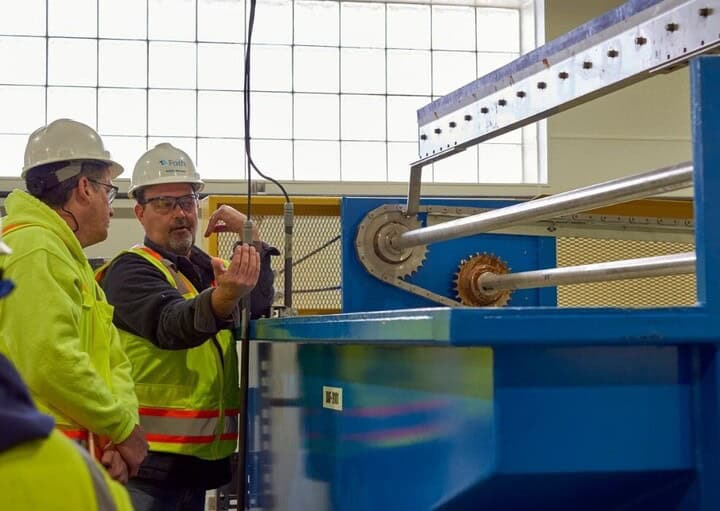
Seider said Foth’s members embrace these higher standards, setting themselves apart from others in the engineering industry by approaching safety and project work differently.
“That’s what has been that special piece for me and in what we’re celebrating here,” he said.
Outside of Foth, Seider said some may question the merit of such celebrations, suggesting “you’re just a bunch of engineers – you don’t do anything [that’d risk injury].”
“The reality is, we’re not that type of engineer – we are field engineers,” he said. “We are out there working at these sites, so the hazards do exist. We drive more than two million miles a year for our clients and for our projects, and the roadways are extraordinarily dangerous places to be, so things do happen.”
Seider said recordable incidents that don’t result in lost time still occur at Foth, but happen at a much lower rate than in similar organizations nationwide.
Foremost, he said Foth’s 14-million-hour feat celebrates “our existing members, the work they put in and what they’ve achieved.”
“No. 2, I think it’s great for prospective new members and potential future recruits to be able to see what type of organization Foth is and our care for safety,” he said. “Not just what we tell them in the recruiter talking points, but what truly is represented by tangible and pretty exceptional results.”
‘It’s come from everybody else’
In the 14 years he has held his current role as “kind of the figurehead who, by title, owns the safety program,” Seider said there has never been a lost-time incident at Foth, as the ongoing streak started just before his arrival.
Seider said by no means, though, is he the sole cause for the company hitting the 14-million-hour mark.
“I am one singular person,” he said. “I’ve worked hard over my career and over my 14 years at Foth to help mold, build and frame out the culture, tool sets, the expectations and all those things, but the true performance has not come directly from me. It’s come from everybody else.”
Still, Seider said for him to ably helm the company’s health and safety team has required him to continually learn and grow throughout his career.
Starting his career in manufacturing – “my dad was a plant manager” – Seider said he quickly developed a passion for the industry, its people and processes.
The people side, he said, led him to pursue a degree in human resources and start working as a recruiter out of college.
“The company I was working for, they fired the safety manager because they weren’t doing anything, and they let me start to play and dabble in that field,” he said. “I fell in love with safety, and after about a year of doing both jobs, HR and safety, I made the shift over to 100% safety, and have never looked back.”
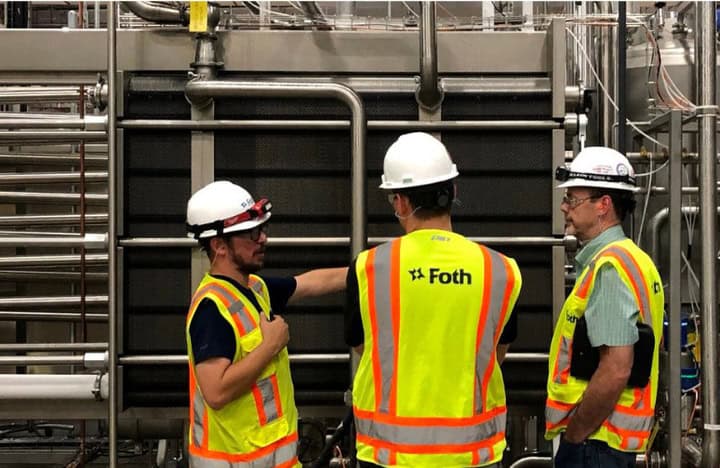
Seider said the switch was not drastic as “safety is actually part of the HR profession,” and played well into his passion for working with people.
Since the earliest days in his career in safety – predating his time with Foth – Seider said he’s seen industrial safety continue to evolve.
“I remember when I started, the concept of ‘zero’ was kind of a radical thing,” he said. “If you were a company putting the poster on the wall that says ‘we are striving for zero [lost-time incidents],’ people would look at you funny, or think you were bold and you were doing something that was never attainable.”
After 20 years working in safety, Seider said now, “zero” posters are commonly found in workplaces, and it’s increasingly rare to have to “fight” for safety.
“In fact, at Foth, I don’t have to fight at all…,” he said. “In the early days of doing safety, it felt like you were always arm-wrestling with leadership and production simultaneously, and trying to convince everybody around you that this was a good idea and was something that needed to be done.”
Such “arm-wrestling,” Seider said, is “all but gone” for most organizations now.
“We’ve had enough generations who are just growing up and experiencing nothing but this type of world where safety is a core principle or a core attribute of the culture…,” he said. “People all realize, collectively, across all scales, that this is good for everybody. It’s good for the business, it’s good for the people. This is just something we should be doing as a default.”
Seider said the greatest professional fulfillment comes when Foth’s safety culture becomes self-sustaining – when members act safely on their own, not simply because they are being supervised or guided.
“They’re doing it because they know it’s the right thing to do, and it’s what they need to do, and all of a sudden, something that in many organizations would never have occurred if the safety director wasn’t the one physically making it happen – it’s just happening,” he said. “That’s the maturity level of the organization – a culture we all strive for as safety professionals.”
No complacency here
In an industry where reaching one million hours without a lost-time incident is considered monumental, Seider said Foth must remain vigilant – avoiding complacency, monitoring changes and anticipating where the next incident could occur.
In order for Foth to make it to 15 million hours or beyond, he said “there’s no one singular thing” to emphasize.
“I’m a big proponent of ‘throw everything at it and see what sticks,’” he said.

Seider said it’s paramount to continue bringing in the right people, even if it means waiting to find them.
“We recruit in a manner that we will leave positions open for an extended period of time, even if it’s painful to the organization, to make sure we are hiring individuals who are a true cultural fit to the organization,” he said.
Meanwhile, Seider said he’ll continue to employ foundational programs, policies, procedures and trainings.
Holding Foth’s safety in such high regard, he said he’s slightly superstitious when it comes to celebrating the streak – that to do so is to “tempt fate.”
“You almost don’t want to verbalize the successes, because you feel like the moment you do, something’s going to happen or something’s going to occur,” he said. “There’s a ‘celebrating in silence’-type of thing that sometimes happens for you.”
Pressure aside, Seider said he needs to keep his “foot on the gas pedal” to manage safety for Foth’s team and maintain the company’s momentum.
“My challenge is always that we don’t know where the next incident is coming from,” he said. “We probably haven’t even pondered what’s going to cause that next incident yet. So, we have to continue to act like we’re not at 14 million [hours]. We have to continue to look at our work, challenge our work [and] adapt to a changing environment.”