Packerland Veterinary Center makes its mark with orthopedic services
 Green Bay native named as Schreiber’s next president/CEO


August 10, 2026
GREEN BAY – It may be a new year, and there may be a new Leader of the Pack, but the message from the team’s annual financial meeting stayed consistent: “The Green Bay Packers are in very strong financial shape.”
“I want to begin by making two critical points,” Packers President and CEO Ed Policy said. “No. 1, the Packers are in very strong financial shape, and No. 2, we’re going to invest whatever it takes to field a championship-caliber team. But we all know the NFL is more competitive than ever, both on and off the field.”
As the only publicly owned team in the National Football League (NFL), the Packers are required to publicly release their financial statements.
“We’re proud we are the only publicly and community-owned team in the league, and we’re not looking to change that in any fashion,” he said. “Our ownership structure has served us well, and it continues to work well.”
At the same time, Policy said the team must continue adapting to changes in how NFL franchises are financing growth.
“We do have to make sure we’re doing the things we need to do in terms of revenue generation and long-term stadium plans in order to make sure we can always keep up with this arms race in the NFL,” he said.
The numbers
This was Policy’s first financial meeting as the team’s president and CEO – taking over for longtime leader Mark Murphy, who retired from the position and the league last July.
Running an NFL team, Policy said, is more expensive than ever, so “our business is getting more complex.”

Looking at the numbers, Policy said two things in particular stand out this year.
“First, you’ll notice we’re reporting nearly $134 million in non-operating income this year,” he said. “That’s an increase of nearly $132 million over last year. So that’s almost a 7,000% increase.”
Policy said the increase is due to two things, “two drivers.”
“One is gains in our investment in the corporate reserve fund,” he said. “It’s been a good year for those investments.”
Policy said the income boost was also driven by the NFL’s sale of NFL Network to ESPN, for a 10% equity stake in ESPN.
“This gain takes into account and reflects the Packers’ share of that large league-wide transaction,” he said.
Policy said the financial statements also show an operating loss of about $1 million.
“Now, keep in mind that does not include the non-operating income I just discussed,” he said. “If you take that into account, our net income lands at about 132.5 million this year, which is up about 47%.”
The last time the team recorded a decrease in operating profit, Policy said, was during the COVID-19 pandemic year.
“Revenue took a hit [during that season] because of the inability to have people in the stadium,” he said.
Before that, Packers Director of Public Affairs Aaron Popkey said the last time the team recorded a decrease in operating profit was in 1989.
Policy said the “small operating loss” is due to “an enormous increase” in player costs this year of nearly $130 million.
“Our overall expenses went up about $118 million – specifically $118.7 million,” he said. “Some of our expenses actually went down, but our player costs went up $130 million, which is an abnormal year for us.”
Policy said that increase in player cost is driven by the structure and timing of player contracts.
“This includes signing new players, but it also includes accelerating previously paid compensation to players who were either released or traded throughout the course of the year, if they still had time remaining on their contract,” he said.
An example of this, Policy said, is the Micah Parsons transaction.
“In that transaction, we did record a significant number for Micah’s new contract,” he said, “but if you remember, in that transaction, we also traded Kenny Clark. So, we also reported a significant number in acceleration for trading Kenny, who had two years left, I believe, on his contract at the time.”
Policy said the team is also recording acceleration from several other players during this timeframe who were released or traded while they still had time left on their contracts.
“For example, this also would include Jaire Alexander’s contract, Rashan Gary, Elgton Jenkins and Nate Hobbs,” he said. “This is really, as most of you know, just the cost of doing business in the modern NFL.”
A changing game
On the reverse side, Policy said revenue generation continues to be “very strong” at both the local and national level.
“National revenue is up 4.8%, or [a little] more than 453 million,” he said. “Local revenue was up 4.75% at nearly 300 million. And keep in mind, that was with us just having eight regular season games last year, as opposed to nine regular season games the year before.”
Policy said the team will again have nine regular season home games this season.
“That always results in a little bit of an uptick in revenue because having one extra regular season game versus a preseason game results in it – it’s a higher ticket price and, generally, it’s going to be higher attendance as well,” he said.
In that same vein, Policy said the team is going to be “more aggressive” with revenue generation going forward.
“I’ve been a little bit candid about this in the past, too,” he said. “We all know the cost of competing in the NFL is going up, and other teams have access to capital sources that we just don’t have.”
Though the Packers don’t have billionaire owners like other NFL franchises, Policy said the team has still managed to compete at a high level.
“They’ve always had billionaire owners, and we’ve been able to compete with them pretty well on that basis,” he said.

However, Policy said the landscape is changing as more NFL teams sell minority ownership stakes to private equity firms and other wealthy investors, giving those franchises additional capital they can use to strengthen their competitive position.
“For example, a team can sell 5-10% of their equity, and without giving up any controlling interest in the team, they can raise more money than we have in our capital reserve fund in just a matter of months,” he said.
A good example of this, Policy said, is the Miami Dolphins.
“Somewhat recently, Miami sold 1% of the team for a total enterprise valuation of $12.5 billion,” he said. “They were able to raise $120.5 million by selling just 1% of the team. So, it’s like other teams have access to this ATM that we just don’t have right now.”
That’s why, Policy said, the team’s corporate reserve fund is “so crucial.”
“I’m very happy it was a good year for our investments in the corporate reserve, which now stands at just more than $700 million – I believe it’s right around $701 million at this point,” he said. “But it’s really important to keep in mind that it took us more than 30 years to raise that amount of money.”
Continued growth of the corporate reserve, Policy said, will remain critical to the Packers’ long-term financial health.
The future
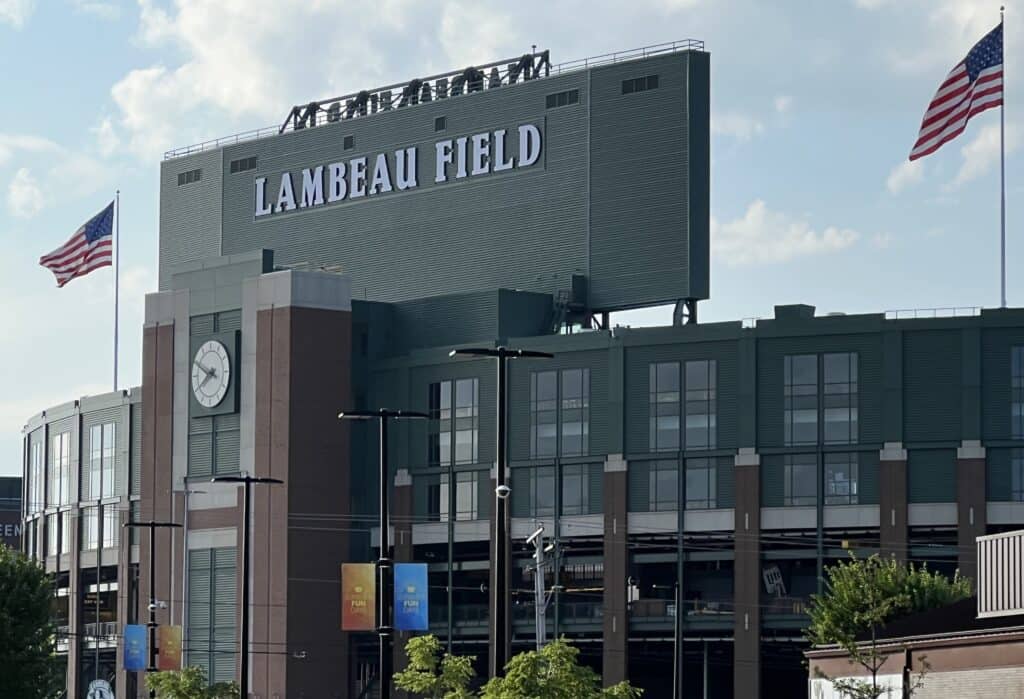
Policy said the Packers will place greater emphasis on generating revenue through sponsorship opportunities at Lambeau Field and throughout Titletown.
“I want to mention, we are not selling the naming rights to Lambeau Field,” he said, “but we are going to look at some other assets on our campus. We certainly would look at the entitlement rights to our practice facility, and we did just recently sell the entitlement rights to the football field over in Titletown, which is now called Emplify Health Field in conjunction with our partners at Emplify.”
Policy said expanding the number of major events hosted at Lambeau Field will be another priority moving forward.
“We hosted two very successful Luke Combs concerts back in May, and we had about 93,000 people here between those two nights,” he said. “And I’m very excited we’re going to be hosting Notre Dame versus Wisconsin to kick off the college football season Sept. 6.”
Policy said other NFL teams have benefited from significant public investment in newer or renovated stadiums and facilities, something the Packers have not had access to.
Moving forward, he said developing a long-term, collaborative agreement with Lambeau Field stakeholders – including the city, county, state and stadium district board – will be critical.
“We look forward to talking to all those stakeholders and collaboratively developing a long-term plan for Lambeau Field,” he said.
Policy said he would like to rekindle lease discussions with the city after an earlier round of negotiations failed to gain traction.
“Lambeau Field is a tremendous public asset that benefits certainly everybody in Green Bay, Brown County and throughout the State of Wisconsin, whether you’re a football fan or not,” he said. “I think it’s important for all those stakeholders to educate ourselves as to how important Lambeau Field is to us culturally and economically, and to figure out what needs to be done in terms of the care and feeding of Lambeau Field to make sure it remains not only iconic but state-of-the-art for the next 50 years or so. I think we’re all going to have to play a role in making sure it stays up to Lambeau Field standards.”
In closing, Policy ended the Packers’ annual financial meeting much as he began it – with optimism about the team’s future.
“I feel very good about the Packers’ financial strength and condition in the medium term and the short term certainly,” he said. “But we are keeping a very close eye on some of these long-term trends and looking at how they impact us in our financial health in the long term.”
Policy said maintaining the financial flexibility to continue investing wisely will remain critical to building a championship-caliber team, whether through player contracts, football operations or facilities.
“We have to make sure our football leadership has every tool in their toolbox that every other team has to compete,” he said. “We’ll never tell them which tools to use or how to use them, but we have to make sure they have every tool to compete.”