 A century of counsel – Menn Law Firm
 A ‘Haven’ of blueberries awaits pickers in Bear Creek


May 4, 2026
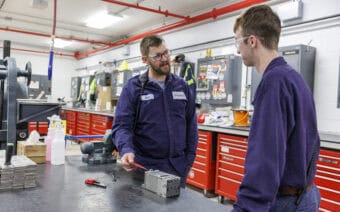
As I walked through the shop floor, something I made a point to do every day, I could feel the tension beneath the surface.
Supervisors stretched thin.
Experienced hands training yet another wave of newcomers.
A quiet resignation among the people who’ve stayed, watching their colleagues cycle in and out like a revolving door.
The Bureau of Labor Statistics consistently places manufacturing among the sectors with the highest voluntary turnover rates, currently at 39.9%.
For plant managers and operations leaders, this is not a statistics problem – it’s a daily operational reality.
Every departure ripples outward: production schedules slip, overtime costs climb, quality metrics wobble and the burden lands squarely on whoever stayed.
The instinct, understandably, is to fight fire with money.
Sign-on bonuses.

Wage bumps.
Better shift differentials.
These tactics are not wrong – compensation is important, because we all need to provide for ourselves and loved ones.
But leaders who have managed long enough know that a bigger starting check rarely solves the underlying problem.
It delays it, maybe.
Attracts a new cohort of workers who will face the same invisible dead end as the last group hit.
And then the cycle repeats.
So, what is that underlying problem?
Discernible trajectory
The answer has less to do with wages than with something harder to quantify: employees’ sense of where they are going.
Manufacturing workers are, on balance, a remarkably loyal group.
They show up.
They take pride in what they build.
They form strong bonds with their teams and often define themselves by their craft.
But loyalty has limits, and one of the most reliable ways to erode it is to leave people in the dark about their own futures.
The manufacturing environment can be particularly prone to this.
Career paths are often murky or assumed rather than communicated.
A high-performing machine operator may have no idea whether advancement is realistic for someone in their role – or what skills would even be required to get there.
Supervisor positions feel distant, reserved for insiders.
Development conversations, if they happen at all, tend to be vague: “Keep doing what you’re doing” and “We’ll see.”
That ambiguity, repeated over months and years, quietly transforms loyal employees into candidates.
The most capable workers are typically the first to go.
That is not a coincidence.
They have options, and they eventually exercise them – often for companies that offer not just a job, but a discernible trajectory.
This is the turnover dynamic that compensation packages cannot fix.
You can pay someone more to stay in a role they’ve outgrown, but you cannot buy the sense of forward motion.
And without that, even well-compensated workers begin to feel stuck.
Manufacturers navigating this most successfully tend to share a few common traits.
They treat people planning with the same rigor they apply to production planning.
They identify where talent gaps are likely to emerge before those gaps become emergencies.
They have real conversations with employees about development, not once a year in a formal review, but consistent development and performance conversations.
They make those conversations actionable, connecting employees to concrete skills and visible opportunities rather than open-ended encouragement.
There’s also an organizational benefit to this approach that often goes unacknowledged: it forces leadership to think honestly about bench strength.
Intentional people practices
When a key supervisor leaves or a skilled technician retires, organizations that have been planning proactively already know who’s ready to step up.
Organizations that haven’t been planning, scramble, promote out of necessity rather than readiness or make a hire from the outside that brings its own set of challenges.
The reactive mode is expensive in ways that rarely show up cleanly on a P&L statement.
The training hours.
The productivity lost while new hires ramp up.
The overtime paid to cover gaps.
The quality issues that tend to spike during high-turnover periods.
The institutional knowledge that walks out the door with every experienced departure.
When you add it all up, the true cost of turnover in a manufacturing environment can easily run two to three times an employee’s annual salary – sometimes more for highly skilled roles.
None of this is to suggest that wages don’t matter, or that working conditions are irrelevant.
They absolutely do.
But what we see consistently, people don’t leave companies nearly as often as they leave uncertainty.
When employees can see a future – when they understand what growth looks like, what it requires and that the organization is genuinely invested in helping them and their families get there – the calculus changes.
Suddenly, a job becomes a career.
A paycheck becomes a path.
That shift in perception is more durable than any sign-on bonus, and it compounds over time in ways that bonuses cannot.
Manufacturers that will win the talent competition are unlikely to be the ones with the deepest pockets.
They’ll be the ones who figured out how to make every employee feel like a long-term contributor rather than a short-term cost, and built their people practices and systems around that conviction.
What I learned walking the floor every day was just how important our manufacturing team members were.
And when we started investing in them like we did every other team member, our operations team became a strength of our organization, which fueled our growth from $5 million to $30 million in revenue in four and a half years.