 Raise a glass to 150-plus years of brewing tradition
 AI: Endless possibilities, finite budgets



August 24, 2026
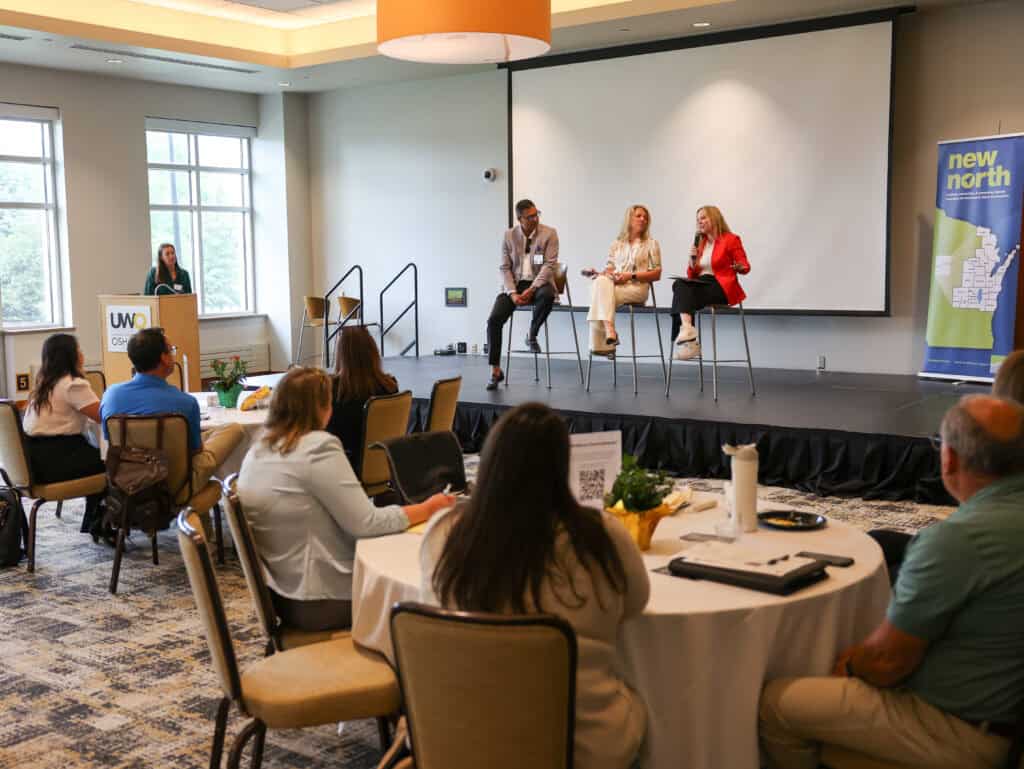
OSHKOSH – Hospitals, care facilities and independent practices across Wisconsin continue to face workforce challenges, but one message came through clearly at the NEW Healthcare Alliance: the problem cannot be solved alone.
Hosted by New North’s NEW Healthcare Alliance Aug. 5 at the University of Wisconsin-Oshkosh (UWO), the event brought together healthcare leaders to tackle the state’s workforce crunch.
Though health care has recently surpassed manufacturing as Wisconsin’s largest employment sector, keynote speaker Matt Krues of UW-Extension’s Community Development Institute said the growth is concentrated in the state’s largest metro areas.
“Health care and social assistance now accounts for almost 16% of all employment in the state of Wisconsin – more than 460,000 individuals,” he said. “But one thing to keep in mind is we have primarily seen losses in healthcare and social assistance employment in our rural or non-metro areas.”
Even further, Krues said regardless of the “disproportionate” loss of employment, the healthcare workforce growth Wisconsin has seen may not align with the actual care needs of its aging population.
“When we look at the change in our aging population, this is an industry sector that will become increasingly important to a lot of individuals in the State of Wisconsin,” he said.
Digging into where exactly the healthcare industry has seen employment change, Krues said, once again, the workforce growth has mostly been concentrated in general, surgical and ambulatory healthcare facilities, as well as in administrative positions.
“On the other side, we see nursing and residential care, residential intellectual disability, mental health and substance abuse facilities and outpatient care centers have [had] a big loss in terms of total employment,” he said. “It’s not uniform across the entire healthcare industry, which has implications [when] thinking about the types of skills, the types of occupations, the types of health care we need going forward.”
As speakers throughout the symposium made clear, addressing those challenges will take more than one organization – it will require higher education, economic developers and healthcare providers to work together.

With the largest nursing college in the state, UWO Chancellor Manohar Singh said the university’s involvement in the symposium marks a “recommitment” to its mission.
“That is, very specifically, serving healthcare needs, especially focusing on where we have a long way to go to make an impact [on] rural areas,” he said. “Our national nursing exam licensure passage is the highest [in the state].”
And Singh said on average, UWO is sending 300 healthcare professionals into the workforce each year, with the majority being Wisconsin residents.
“Not only are we very proudly producing talented superhuman beings, but also at a quality level that is world-class,” he said.
Maintaining that level of education for its nursing students, Singh said, involves intentional partnership with local health systems.
“As our students go out and advance the mission of health care for all and health care for dignity, we are innovative – as that is needed – not only in terms of technological advances, but also in terms of our thought processes, of our curricula [and] identifying [the] needs of our society,” he said. “We are truly a step ahead of many institutions in this field, and that is because we’re surrounded by a community who are willing to hold our mission close to their heart, walk with us [and] contribute to the shared vision.”
Prevea Health President and CEO Ashok Rai opened the event by acknowledging an “obvious reality” – many of the healthcare organizations represented in the room were competitors.
“We compete for patients, for contracts and, more relevant to today, for the same people,” he said. “I’m not going to pretend otherwise, but here’s the distinction I’d offer: we compete over the talent pool. We do not compete over the size of it.”
Bolstering Northeast Wisconsin’s healthcare workforce with quality and compassionate providers, Rai said, is not a “zero-sum game,” requiring specificity and collaboration to succeed.
“I’ve come to believe that the farther the decision is from the bedside, the worse the decision will be,” he said. “Academic programs cannot be built on a general sense of a shortage.”
An aging population, workforce
Looking at Wisconsin’s healthcare and social assistance industries, Krues said the percentage of employees aged 55 or older is roughly 23%.
“We do see that some industry sectors [in Wisconsin] have more than 30% of their total employees aged 55 and older,” he said. “But many of those industry sectors – like agriculture, real estate, public administration – are smaller in terms of their total number of employees.”
With more than 100,000 employees aged 55 or older in health care, Krues said though “the percentage may be lower, the numbers are sizable” in terms of people approaching retirement age.
“It’s the largest employment sector with employees aged 55 or older, second to manufacturing,” he said. “From a broad labor force perspective, regardless of what industry they’re employed in, we can see that counties across the State of Wisconsin have almost doubled in terms of their share of employees age 55 or older [between 2000 and 2025].”
In Northeast Wisconsin, specifically, Krues said several counties report having more than 30% of their working population aged 55 and older.
In this context, Krues said care providers’ biggest workforce competition isn’t each other – it’s other industries.
“The challenge is not just thinking about the types of skills that are needed, the types of occupations that might be needed, [but about] the raw number of individuals who may be leaving the labor force,” he said. “We are expected to decline in our share of working-age individuals… So, how do we think about health care, for lack of a better word, competing for those employees with the other industry sectors as well?”
Following the keynote, four current UWO students were invited to answer questions regarding their experience receiving an education in health care.
When asked what inspired their decision to pursue a career in health care, each student reflected on a moment in which they were serving others – a characteristic Singh said is especially important for healthcare employees.
“The biggest challenge we face is talent, and talent is not about how good you are with your craft – it is about how caring, how human you are,” he said.
However, regardless of one’s passion for the industry, the student panel revealed other hurdles they’ve had to overcome – complicating the problem beyond simply finding compassionate people to educate.
The students each addressed challenges they have and are currently facing while pursuing an education in health care – including, but not limited to, financial stress, schedule inflexibility and quality clinical opportunities.
Though clinicals normally serve as the introductory educational experience for health care, the UWO student panel discussed the lack of opportunity among local hospitals, even in a larger metro area.
And the culture of the working environment, they said, was not ideal regarding how they retain students’ interest in the program and, more importantly, in Wisconsin.
“Success for us is no longer measured only by enrollment or graduation,” Seon Yoon Chung, UWO’s College of Nursing dean, said. “Today’s success also depends on how effectively we connect our students with employers in our communities, technology and opportunity… That is why experiential learning, the internships, the clinical placements, employer engagement and community partnerships are so important.”
Apprenticeships, upskilling, technology
A later panel examined how workforce challenges are amplified in rural areas, with Froedtert ThedaCare’s Kristi McCoic, BayCare’s Ashwani Bhatia and Wisconsin Department of Workforce Development Secretary Amy Pechacek discussing medical apprenticeships as one way to ease barriers for students.
With years of experience in HR and rural healthcare recruiting, McCoic said organizations must “start embracing more creative staffing models.”
“With my rural background, I think to meet the current and future healthcare workforce needs, we have to challenge the status quo on how we educate and elevate those individuals who are interested in healthcare careers,” she said.
Though apprenticeship programs exist throughout the country, Pechacek argued Wisconsin – being the first state to introduce the practice in 1911 – does it differently.
“What makes it different in Wisconsin than everywhere else is we are an earn-while-you-learn model, meaning you earn money as an apprentice for not only your hands-on work experience but also for your associated time in the classroom,” she said. “That is why it is such an economic equalizer and a tool that allows everybody to have a successful career. Not just a job – a career.”
However, Bhatia said to achieve this, health systems and other providers must start meeting students where they are.
“We need to be able to create that connection where we can motivate these kids earlier,” he said. “We need to go and meet them in their communities.”
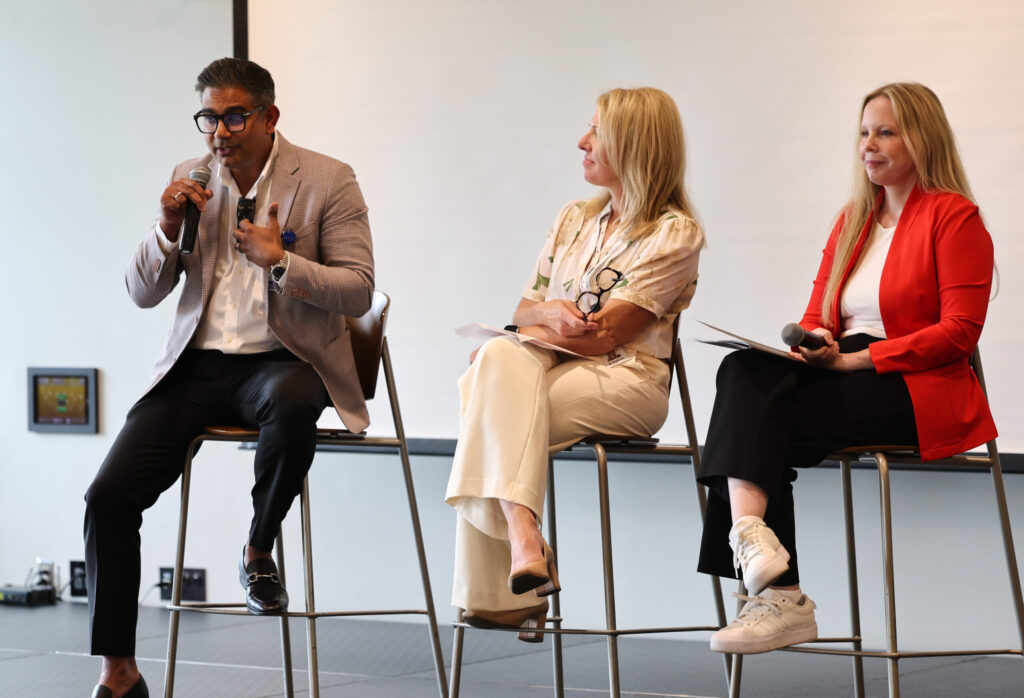
Beyond attracting additional talent, McCoic said another opportunity healthcare employers can consider is upskilling current employees to free up entry-level positions.
“Earlier this year, we did a kickstarter program where NWTC (Northeast Wisconsin Technical College) actually looked at what the common gen eds required across most of the programs are…, and we offered 130 seats to our current employees… free of charge as a way to see if they were wanting to upskill or go to that next step for them,” she said.
Most of those classes, McCoic said, were offered 100% online – but, as Krues said in his keynote, technology cannot serve as the only solution to address workforce challenges and care deserts, especially in rural areas.
“We see places like Calumet, Outagamie, Fond du Lac, Brown [counties], where there’s a pretty low share of places that don’t have broadband access,” he said. “But we get to places like Oconto, Marquette, Door, Marinette, Waushara, Florence counties [where] 20-40% of broadband‑serviceable locations do not have broadband access.”
As technology, specifically AI adaptation, continues to permeate across the healthcare industry, Krues said an important distinction to make is that technology cannot provide care.
“What AI will do in a lot of instances is transform our jobs and the types of skills that are needed,” he said. “Existing occupations may have lower exposure [to AI], but there’s also a lot of opportunity… to infuse AI into the success of our healthcare systems moving forward.”
Both McCoic and Bhatia also addressed how the increased use of technology in health care points to the wide variety of career opportunities within the industry.
“We need executives in health care, we need managers, we need HR, we need IT,” Bhatia said. “Cybersecurity is a huge threat to health care.”
Above all else – regardless of what position healthcare employers have open – McCoic said the most effective way to combat the workforce shortage is to grow a local talent pipeline.
“The best recruitment tactic was to just grow our own,” she said. “Look at those students who are within our community…, and then the staff who are already on our team who we can upskill.”
Using Froedtert ThedaCare’s current partnership with the Bay Area Workforce Development Board as an example, McCoic said funding from the DWD’s Workforce Innovation Grant: Healthcare Employment, Access and Rural Transformation (WIG HEART) grant is helping the health system explore the idea of paid healthcare apprenticeships in Northeast Wisconsin.
“[We’re] super excited to be part of the WIG HEART Rural Health grant with Bay Area Workforce Development [looking at] bringing apprenticeships into this area,” she said. “Skilled trades have been doing this for years, and we, in health care, are behind. We can grow apprenticeship programs for nurses, surgical techs, all these great positions that we need, [but we have] to get outside of our norm and do something different.”
Ultimately, the symposium underscored that Wisconsin’s healthcare workforce challenges will require providers, educators and community partners to rethink traditional approaches and work together to build a stronger, more sustainable talent pipeline.
For Northeast Wisconsin, McCoic, Bhatia, Krues, Rai, Singh, Pechacek and Yoon Chung agree: addressing the workforce shortage means moving beyond competition and finding new ways to grow, train and retain the healthcare workforce the region needs.