 Stepping out from private-label ‘shadows’ to serve community
 100% resilient, renewable energy healthcare campus



October 5, 2026
GREEN BAY – For employers struggling to fill jobs, Aspiro in Green Bay is revealing a potential talent source that may be hidden in plain sight.
At Aspiro, President Ryan Ruzziconi said helping individuals with disabilities find meaningful work is part of a much broader equation connecting inclusive employment, caregiving and labor force participation.
When an individual with a disability has an opportunity to work or participate in consistent daytime programming, he said that person can gain income, skills, independence and community connections.
At the same time, Ruzziconi said a parent, guardian or other caregiver may gain something important, too: the opportunity to work, maintain regular hours or simply have time to manage other parts of life.
Wisconsin’s seasonally adjusted unemployment rate was 3.2% in August, according to preliminary estimates from the U.S. Bureau of Labor Statistics released by the Wisconsin Department of Workforce Development.
Even further, the state’s labor force participation rate was 64.7%, 3.1 points higher than the national rate.
Within that picture, Ruzziconi said individuals with disabilities represent a workforce opportunity businesses may not have fully considered.
“What we say is, [employing an individual with disabilities] creates a ripple effect,” he said. “We touch far more than the people we serve directly.”
Ruzziconi said he believes that effect deserves more attention – particularly in a labor market where employers continue to search for dependable workers.

“When a person with a disability gets a job, a local business gets a committed, reliable team member; when a family gets day services, parents can stay in the workforce and that brings stability to the home; and when a child gets early intervention support, they start life on a strong footing,” he said. “It’s not just clients we serve – our programs make our area stronger and more connected.”
Ruzziconi said Aspiro works directly with individuals with disabilities to develop skills, identify employment opportunities and provide support in workplaces throughout the region.
He said its programs also provide structure, recreation, socialization, daily living skills and other services that can create opportunities for family members to pursue their own careers, knowing their loved one is supported and engaged.
“It is an intersection of workforce development and caregiving that can be easy to overlook,” he said.
For employers, Ruzziconi said the message is equally straightforward: Among Americans with disabilities ages 16 to 64, 38.1% were employed in 2025, compared with 74.8% of those without disabilities, according to the U.S. Bureau of Labor Statistics.
“With a competitive economy, and Wisconsin operating with historical lows in unemployment, we tell businesses that there is a whole other workforce that often goes overlooked,” he said.
Filling a real business need
Brian Stenzel said he has seen what that workforce can contribute firsthand.
Stenzel, president of Boomerang Management – which includes EPIC Event Center, the Green Bay Rockers, Boomerang Catering, The Bassball Cages and Capital Credit Union Park – said he first encountered Aspiro years ago while working at Festival Foods.
Stenzel said Aspiro clients helped repackage Turkey Trot pumpkin pies that arrived without labels, labeling the products and preparing them to go back onto trucks headed for the grocer’s community races.
Later, as he became involved with Capital Credit Union Park and EPIC Event Center, Stenzel said Aspiro became a workforce partner there, too.
The relationship, he said, has continued for roughly six years.
“I don’t know what we would do without Aspiro,” he said.
At Capital Credit Union Park, Stenzel said groups of four to eight Aspiro participants typically work about once a week.
At EPIC Event Center, he said four to eight Aspiro employees may work two or three times a week depending on the event schedule.
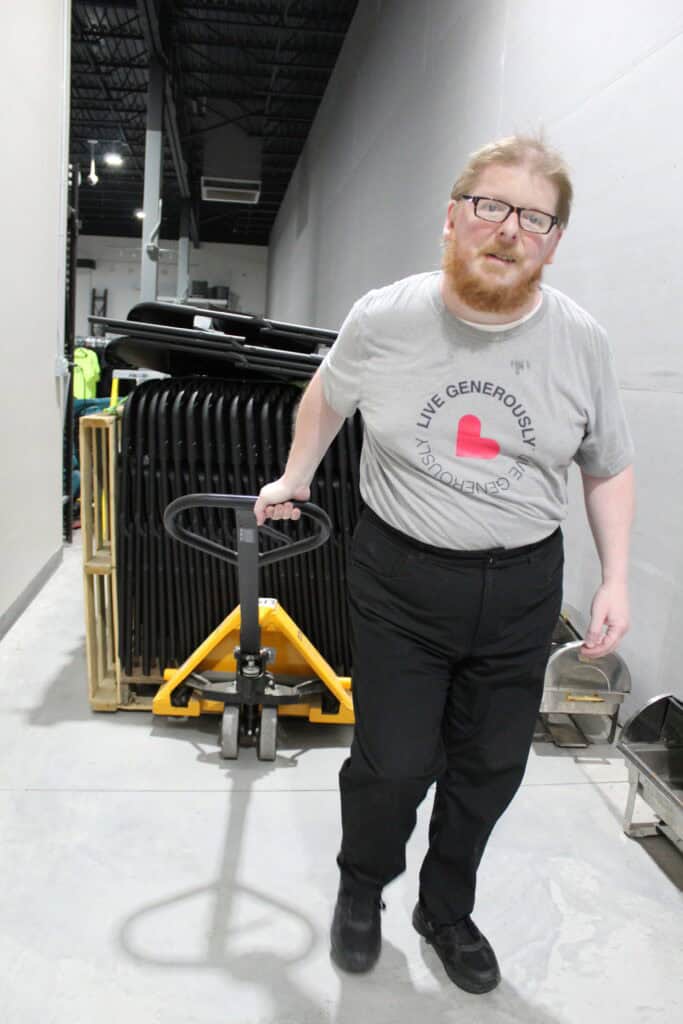
Their responsibilities, Stenzel said, include tasks such as stocking paper products, cleaning, setting up and resetting spaces.
If an event requires 50 tables and 500 chairs, for example, he said Aspiro participants can be part of the crew preparing the venue or resetting it afterward.
Though there is a community benefit to the partnership, Stenzel said what Aspiro provides Boomerang Management operationally shouldn’t be overshadowed.
“As a company, we love giving back to the community, but on top of that, they provide valued services for us,” he said. “A lot of the time when we need cleaning or setup done, it’s a weekday before noon, and that’s not just an easy [part-time role] to fill no matter what the duties are. It’s also not enough work to hire a staff just to do that, and a cleaning company contract only does part of the duties.”
Aspiro’s model, Ruzziconi said, instead asks employers to consider the actual work they need completed and whether an individual with a disability could meet that need with the appropriate structure and support.
That process, he said, starts by talking with a business about its pain points.
Sometimes Ruzziconi said a position has gone unfilled for an extended period.
In other cases, he said a traditional job structure may not fit the available workforce.
“If they’re worried about hiring an individual with a disability who can work four hours a day, we talk about turning it into two part-time positions,” he said. “Sometimes, it’s that simple, and the business is extremely grateful.”
Sometimes, Ruzziconi said the challenge is helping employers to recognize the available skillsets.
An example Ruzziconi points to is a manufacturer that struggled to find a drill press operator.
He said Aspiro had a participant trained to do the work, and that individual remains one of that company’s most reliable employees.
“It’s working with that business to understand what their needs are and sharing what’s available from our skillset perspective,” he said.
Multiple paths into the workforce
Aspiro’s individualized approach to workforce empowerment, Ruzziconi said, reflects the breadth of the nonprofit itself.
Founded in Green Bay in 1957 by 67 families, he said the organization now serves more than 1,600 individuals across 10 counties through programs spanning early childhood through adulthood.
Paths to employment through Aspiro can take several forms, Ruzziconi said, one of which is Group Supported Employment – a program that places small groups of participants in community workplaces with an in-house job coach.
Partners include EPIC Event Center, the University of Wisconsin-Green Bay, AmeriLux International, Encompass Early Education and Care, Pepsi and Capital Credit Union Park, he said.
At his businesses, Stenzel said participants have demonstrated not only their ability to perform the work, but their enthusiasm for it.
“Their pride is second to none as far as the job they do and their work ethic, and it’s incredible how much energy they put into what they do,” he said.
The connection is noticeable among Boomerang employees as well, Stenzel said.
“Our full-time and part-time staff working alongside them absolutely enjoy working with the staff from Aspiro,” he said.
Aspiro’s Employment Services program, Ruzziconi said, is another path toward employment – working with individuals and families to identify abilities, find long-term employment and help employers with training and support.
Project SEARCH, he said, provides immersive workplace training, while prevocational services at Aspiro’s Stiles Road facility provide manufacturing-style experience through projects such as sorting, repackaging and labeling.
Together, Ruzziconi said the programs offer individuals with disabilities different ways to participate in the workforce and their communities.
More than one person
The workforce implications don’t end with Aspiro participants, Ruzziconi said.
For families, he said access to reliable programming can help create the opportunity for a parent or caregiver to remain employed, return to work or maintain the hours needed to pursue a career.
More than six in 10 employed caregivers nationally report making workplace accommodations because of caregiving responsibilities, according to research cited by the University of Wisconsin-Madison Division of Extension’s Employed Caregiver Survey program.
Those accommodations can include using flexible schedules, reducing work hours or leaving employment altogether – making the potential workforce implications of caregiving substantial.
Respite care makes that connection particularly visible, Ruzziconi said, by providing temporary care for children and adults with disabilities, giving primary caregivers time away from daily caregiving responsibilities.
For Aspiro families, Ruzziconi said services that give an individual with a disability meaningful ways to spend the day can therefore have an effect that extends beyond that individual.
Day and assisted day services offer structured activities, education, recreation, volunteering and community engagement, he said, with additional care available for participants who need it.
Building Full Lives, Ruzziconi said, is an Aspiro program that takes participants into the community to explore careers, volunteer, develop life skills and gain experience navigating everyday activities.
He said Aspiro also offers recreation and wellness programming, part of what he describes as an emphasis on supporting the whole person.
“If Aspiro doesn’t exist, then individuals with disabilities would likely do what happened in the past: stay at home once they leave high school and [not necessarily] getting into the community for health and wellness or socializing,” he said.
That philosophy reflects the circumstances that led to Aspiro’s creation nearly 70 years ago, Ruzziconi said, at a time when institutionalization was common for individuals with disabilities.
He said the families who founded Aspiro envisioned a path that would help their children develop daily living skills, socialize and participate in their communities.
The same principle runs through Aspiro still to this day, Ruzziconi said.
A participant may spend some days in day services and others in Group Supported Employment, he said, with Aspiro working with the individual and family to create a schedule based on that person’s goals and needs.
That consistency can provide families with something essential, Ruzziconi said: time.
For a caregiver, he said it can mean the opportunity to maintain a work schedule, pursue employment or manage responsibilities that otherwise must be balanced around caregiving.
For the individual served, Ruzziconi said it means something different but equally important: greater independence.
Work, wages, independence
Ruzziconi said he wants to emphasize that employment through Aspiro isn’t charity.
Participants are doing work businesses need and are paid for that work, he said, but the benefits aren’t solely economic.
Ruzziconi said he repeatedly hears from employers that participants are dependable, arrive on time and perform quality work.
He said businesses also describe a positive impact Aspiro participants have outside of their assigned tasks or duties.
“We hear all the time [that] not only do our clients show up on time, are dependable and do very good work, but there are cultural benefits,” he said.
At the center of it, Ruzziconi said, are needs shared by virtually everyone.
“Individuals with disabilities want the same things we do: meaningful work, friendships and independence, a place in the community, socializing and having opportunities opens that door with businesses to be a mutually beneficial thing,” he said.
Stenzel said he has personally seen participants’ sense of pride and ownership over their work.
When he toured Aspiro’s renovated Dousman Street facility during its ribbon-cutting, he said several participants recognized him and told him they couldn’t wait to return to EPIC Event Center or Capital Credit Union Park.
“For some of them, it’s the highlight of their day to work at our facility and it’s cool to see them light up [and have] responsibility,” he said.
Building capacity for what comes next
Aspiro is preparing to serve more people as demand grows, Ruzziconi said.
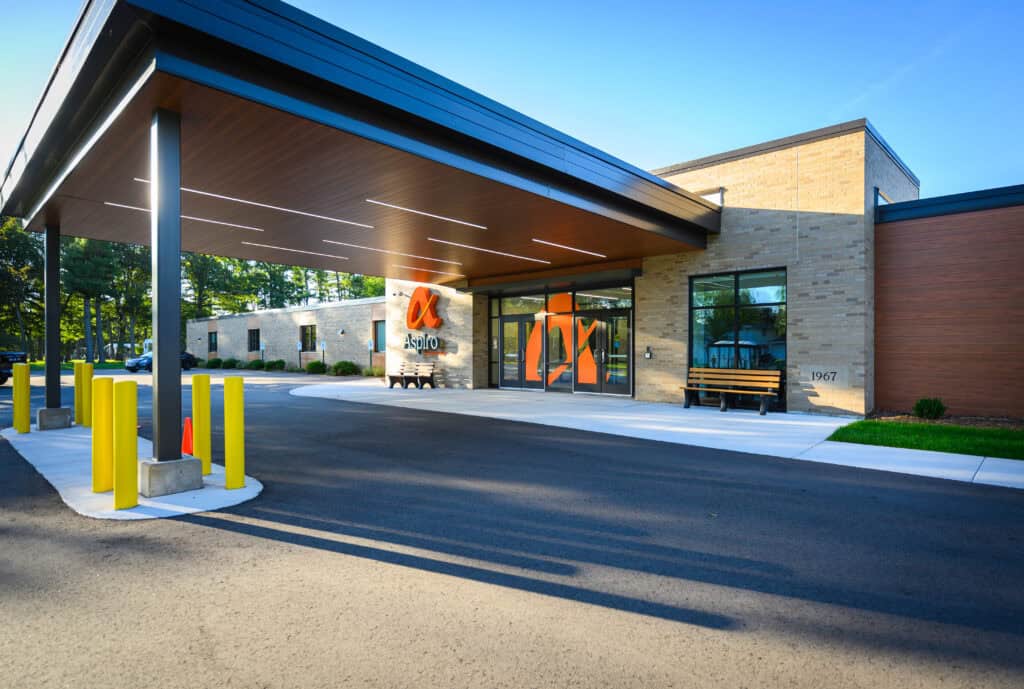
Its recently renovated Dousman Street facility added classrooms, a teaching kitchen, gym, art and music spaces and room for future programming, he said – adding that Aspiro also expanded into Marinette County in September.
For businesses, Ruzziconi said he wants Aspiro to become part of the conversation when traditional recruiting isn’t producing the workers they need.
“We’re here, and we’re available to help businesses any way we can,” he said. “If they have any issues with filling roles or can’t find an employee or have had open positions, come talk to us and see how we can help with that.”