 It’s game, set, match for The Serve
 Sara’s Artisan Gelato set to franchise



November 2, 2026
MENASHA – For an 11th year in a row, Faith Technologies Incorporated™ (FTI) has been named one of the healthiest places to work in America.
Each year, Healthiest Employers® – a leading recognition program for workplace wellness – honors the top 100 workplaces throughout the country that are proactively taking steps to prioritize employee health through comprehensive wellness programming and benefits.
Healthiest Employers evaluates companies across a variety of categories such as strategic planning, workplace culture, employee engagement strategies, leadership commitment, program metrics, and communication practices.
Though FTI has made the list 10 times prior, this year the company was ranked No. 14, skyrocketing from No. 61 in 2025.
The significant rise in FTI’s national ranking, Alyssa Kwasny, Wellness Program Director at FTI, said, reflects the organization’s ongoing investment in creating an environment where team members and their families can thrive.
Guided by its Culture of Care, Kwasny said FTI provides programs, benefits, and resources to support physical, mental, and emotional well-being while helping team members improve their overall quality of life.
She said she believes the higher ranking is due to a combination of things, including the fact that they’ve had a dedicated wellness program in place since 2004 and are continually working to improve it.
“It’s really been ingrained in our culture for over 20 years, and we really take that holistic approach to well-being, not just focusing on that physical aspect, but we have our program focusing on mental well-being, emotional, financial, and social,” Kwasny said. “We know that all of those things impact each other in some way. So, if I had to guess what made us make that big of a jump, it’s how we’re continually evolving our program year after year. It never stays the same. It never stays stagnant.”
In developing their wellness programs, she said FTI is always seeking employee feedback – whether through an annual survey they conduct, or by simply having one-on-one direct feedback.

Kwasny said listening to what their team members are looking for in wellness programs and what kind of support they may need is an important part of how FTI’s wellness programs evolve – whether that’s making an existing program better, or by adding something new to their programs.
“It’s just listening to what our team members’ needs are and evolving those programs to fit the needs of what they are looking for in that wellness support that they need,” she said.
Prioritizing mental health
Over the last several years, Kwasny said, FTI has made a huge shift in their wellness programs with an increased focus on mental health – especially because mental health is a major concern for companies in the manufacturing and construction fields.
“Construction is one of the top industries with suicide and mental health concerns,” she said. “It’s been on our radar for years, but I think just over the past six years, for sure, we’re really just tuning more deeply into it and truly listening to what our team members are needing for support.”
Kwasny added that it’s a tough, labor-heavy industry where people work long hours.
“It’s also male-dominated, and statistics show that males have a higher tendency [for suicide or other mental health issues],” she said. “There’s a lot of travel involved in this work, so you’re away from home, and you’re isolated. That’s why connections are so important and why we focus on those social aspects in our programs.”
Kwasny said FTI focuses a lot on storytelling within their organization, where team members are encouraged to share their stories of where they’ve been on their mental health journey and trying to ensure that people know they’re not alone.
“Those stories are all on our team member portal, and we have rows upon rows of stories from our very own team members sharing their own experiences,” she said. “That allows others to be able to see that and know that they’re not alone in what they might be going through, and that there are others [in the company] who they can talk to, or just have a peer-to-peer conversation with [those other team members].”
Kwasny also said they’ve had some very brave team members make videos – called Mental Health Moments – that are shared company-wide and if someone wants, they can reach out to that person to talk about what they’re going through, get advice, or be pointed in the direction of support and resources that helped them and may help others.
“It’s about making those connections,” Kwasny said. “That’s a very big piece of it.”
Kwasny said she thinks the industry overall is doing a good job of talking more about men and mental health issues, while trying to reduce the associated stigma.
“I attend an annual conference that’s specifically for construction companies and mental health,” she said. “It allows all of us to come together with one mission to improve mental health and reduce suicide in our industry specifically.”
FTI’s additional benefits
FTI offers medical insurance premium discounts, as well as a robust mental health benefit through Lyra Health – a leading global workforce mental health care provider – Kwasny said.
Part of FTI’s mental health program, she added, provides 16 free coaching or therapy sessions, and no-cost mental health visits through their health insurance, as well as no-cost access to the Headspace app for team members and their families.
She said FTI also offers a “Time to Recharge” benefit – which provides each team member two hours of paid time off every month that they can use toward self-care, personal development, or professional health services — whatever gives team members access to the resources they need to reach their health and well-being goals.
“That’s outside of their regular PTO hours,” Kwasny said. “They can take that time for whatever they may need it for, whether that’s a counseling appointment, meeting with a health professional, or maybe it’s spending time outdoors or practicing mindfulness, or spending extra time with their family, whatever it is. It’s just for them to be able to take that time to reset and recharge every month. That’s definitely been a favorite benefit of our team members, because it really sends that clear message that we want them to take care of themselves and that it’s not only something that we encourage them to use – it’s expected, and it’s supported by the organization.”
Another benefit that sets Faith Technologies apart from many other companies, Kwasny said, is their Lifestyle Spending Account.
Under this benefit, she said FTI gives every team member $400 a year to spend on different things that support their total well-being, including gas, food, pet care, utilities, etc.
“It’s anything to support their overall wellness,” she said. “Maybe it’s toward their gym membership, exercise equipment, fitness trackers, what have you. But we’ve also added in there hundreds of other things that just support their total well-being.”
Kwasny said, as an example, groceries, gas, auto maintenance expenses, baby expenses, and pet expenses are rising in cost.
“We want to make sure that we’re able to support the employee when it comes to ensuring that they’ve got money for groceries, money for reliable transportation, money to help cover utilities, or mortgage or rent.”
Kwasny also noted that FTI is always looking at areas where they can improve the health and well-being of their team members; musculoskeletal problems can be a major issue for folks in the construction industry.
“When we saw that at the top of the list, we also saw concerns about weight management and diabetes,” she said. “So, for 2026, we rolled out two new programs to combat both of those. One of them is called Hinge Health, which is a virtual physical therapy program to help combat chronic pain.”
Kwasny said FTI also rolled out a program through Virta Health that is a weight management and diabetes reversal program.
“So, we’re always just trying to look at the data to see where the gaps are, and then finding what we can do on the proactive side of things on the wellness side to really address where those holes and gaps are.”
Prioritizing safety and care
Oftentimes, Kwasny said there is a certain stigma attached to mental health, especially when it relates to men.
That’s why she said FTI doesn’t treat mental health as a separate topic, but rather as a part of overall health, safety, and performance topics.
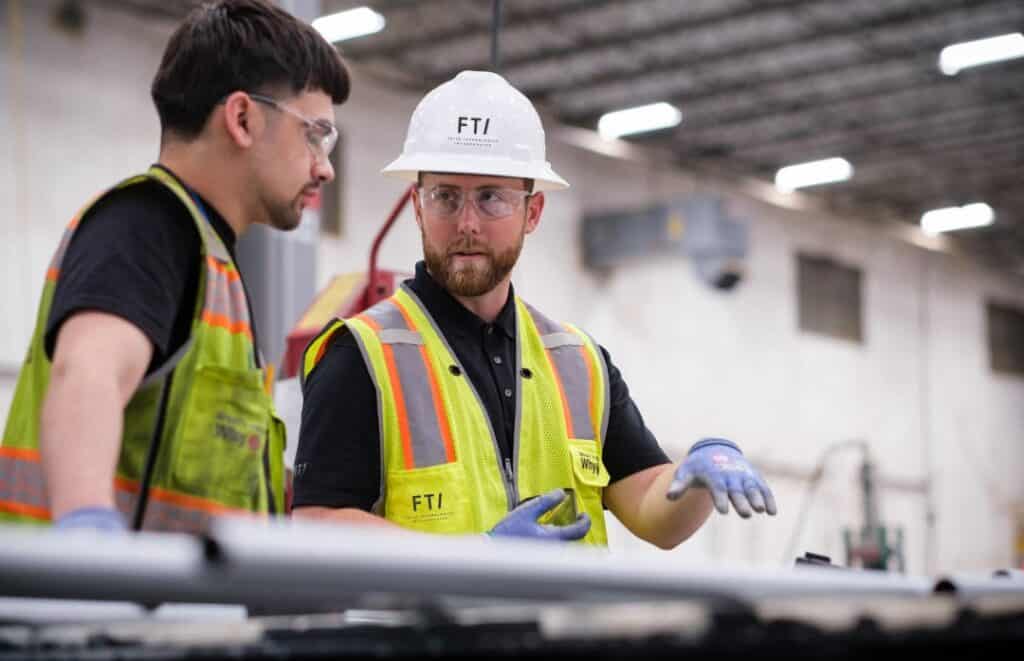
But safety goes beyond the protection offered by a hard hat.
Often, Kwasny said, it’s what’s underneath, and you can’t always see if there are emotional or mental health issues brewing, but if one team member is dealing with an issue, it can affect that person’s entire team.
“Safety, of course, is number one being in the industry that we’re in, and mental health is right along there with safety,” she said. “Mental health is safety. We want to make sure people are bringing their whole selves to work. And if they’re not in a good place to be at work that day, we want to have those conversations and make sure that they’re gonna be able to do their job safely and productively.”
Kwasny added that they reinforce that message with all of the leaders at FTI.
“We’ve got leader training and team member education,” she said, “and we really try to encourage those everyday conversations, trying to destigmatize and normalize those everyday conversations so that it’s not something out of the norm when they bring something up to their leader, or their peer, that they’re going through something, or that they are needing, you know, support from somebody else.”
For example, Kwasny said Safety Bulletins is a weekly email communication sent out to all employees that focuses on a specific safety topic.
“Every week mental health is built into those safety bulletins,” she explained. “So that helps better tie safety and mental health together. It helps ensure that people are thinking through that, again, mental health is safety, and [you can’t have one without the other].”
When she talks with new hires, Kwasny said one of the things that stands out to her is that time and time again, they tell her the culture at FTI is unlike anywhere they’ve ever worked and that they feel people genuinely care about one another and their success.
“To me, that’s a sign that our efforts are truly making a difference, and that those conversations around mental health and well-being are really becoming that natural part of how we support each other,” she said. “Our Culture of Care is really the foundation of how we support our team members. It’s how we do business. It’s a belief that interaction matters, and that when people feel valued, respected, supported, and accountable to one another, that both individuals and teams really can achieve their full potential.”
Over the years, Kwasny said FTI has consistently received recognition from other organizations for being a healthy workplace.
One of the other major ones they’ve received is the Bell Seal through Mental Health America – a certification program that recognizes employers who meet high standards of mental health support and employee wellness – from which Kwasny said they’ve received the Platinum designation for five consecutive years.
“It really helps us benchmark ourselves against other organizations,” she said, “and see what other organizations are doing so that we can be innovative and try to always be better. There are always opportunities to improve, and that’s always what we’re striving for.”