 Shawano’s Wolf River Dental opens new, stand-alone location
 ‘We want people to feel like they’re on vacation while they’re here’




November 2, 2026
WISCONSIN – As the Wisconsin State Government enters its 2027–29 biennial budget process, the Universities of Wisconsin (UW) and the Wisconsin Technical College System (WTCS) are making the case for an increase of nearly $1 billion across both systems’ funding.
In separate proposals, the UW and WTCS have respectively requested $730 million and $168 million to help combat the state’s ongoing and growing labor gap.
Northeast Wisconsin Technical College President, Kristen Raney, said WTCS stakeholders started with a question: “How do we continue to deliver for the state of Wisconsin?”
“What are our greatest challenges as a system, and how do we continue to deliver for the state in terms of the workforce?” she said.
At the UW, Board of Regents Vice President Ashok Rai said the system approached their budget request similarly, posing the question: “What is the state asking of us, and how, with the right budget dollars, could we deliver upon that?”
“We took a very different approach,” Rai said. “In the past it was looking at 13 great universities and [asking them], ‘What are the things you need to do to run your shop?’ … This budget does address that, but it addresses it from a very different perspective.”
Despite being created independently of one another, a common theme emerges between the UW and WTCS proposals: the additional funding is designed to deliver results for the whole state, not just the systems.
Gathering UW system staff and its 13 chancellors in a room, Rai said he and the Board of Regents’ President, Kyle Weatherly, asked them to think beyond their individual institutions.
“We really challenged them,” he said. “Beyond what you need for campus, what does the state of Wisconsin truly need?”

Raney said WTCS staff and stakeholders – including technical college system leaders, members of the technical college state board, and representatives of college presidents – likewise gathered to discuss what they could offer Wisconsin if granted additional resources.
“We are the workforce in our communities,” she said. “Our graduates are in our clinics, in our hospitals, they are fixing our cars, they are installing [HVAC systems] and fixing them, they are building our homes, they are doing the electrical work [to] turn our lights on. I just don’t think most people understand how many different, specialized careers our students go into.”
That’s why both Rai and Raney said they hope decision-makers and residents alike see their proposals as more than just funding requests.
“It’s a promise to the state,” Rai said.
No vacancy
Offering degrees that affordably deliver a quality education – combined with paths to continued education beyond the tech system – Raney said local employers across the state have and continue to rely on the WTCS to help fill positions across industries such as healthcare, business, skilled trades, and more.
“Our graduates stay here; 93% of our students stay in the state of Wisconsin [post-graduation, and] the majority stay in the district where they went to college,” she said. “[But] we hear our employers say what they’re telling me more and more in Northeast Wisconsin: ‘I already don’t have enough people. I could hire every one of your welding graduates, and I’m still not going to have enough welders.’”
Skilled labor education, especially in regard to healthcare, Raney said, is highly regulated and therefore more difficult to affordably offer at scale.
“There are certain ways we have to teach and design these programs so students are learning what they need to [and] they’re really ready to be skilled professionals,” she said.
Raney said this typically entails more faculty to facilitate smaller class sizes, investment in the kinds of cutting-edge technology employers now use regularly, and networking with local employers to find clinical and workplace experience opportunities.
“These students have to have real, hands-on, supervised experience before they can graduate and go to work independently,” she said. “All of that is expensive, and we can only admit so many students at one time. To replicate or to expand [these programs] would mean more labs, more equipment, and more faculty to get more people through, and that’s just all incredibly costly.”
Rai said Wisconsin is facing “a critical need in healthcare staffing.”
“The Wisconsin Hospital Association is telling us we have two lines going in the opposite direction,” he said. “We have a higher need and acuity level of patients, and we have fewer people to take care of them. If we don’t address this now, we’re going to continuously [dig] ourselves a worse hole we’re already in.”
Though expensive, Raney and Rai said the investment across the UW and WTCS is justifiably necessary to provide the state’s employers with the workforce they need.
“The harsh reality in Wisconsin is there’s more demand for skilled workers than there is supply,” Raney said. “This is happening nationally with [generational] Baby Boomer retirements, and as they retire, our K-12 schools are getting smaller, increasingly. So, the basic question [is], how do you replace Baby Boomers?”
In regard to the students, Rai and Raney said affordability also continues to be an issue – making that a key topic in both systems’ budget proposals.
As part of its proposal, Rai said the UW is seeking a four-year tuition freeze to help ensure the next generation of graduates are set up for financial stability and success.
“We could create affordability over a biennium to make sure more students know that during their four years here, their tuition would not go up above – and actually be less – than the pace of inflation,” he said. “So, they could afford to go to school, and they could graduate, which in turn leads to [filling] the workforce needs we have.”
Within the WTCS, Raney said most enrolled students are attending part-time as they balance working to help pay for their education among other familial and societal responsibilities, making accessibility paramount to the system’s proposal.
“Over 80% of the students who enroll in the Wisconsin Technical College System are part-time, and that is an important statistic to understand,” she said. “Their capacity is at the max, but they do it because they believe, and they know, that by coming here, their lives are going to get better and their earning potential is going to grow.”
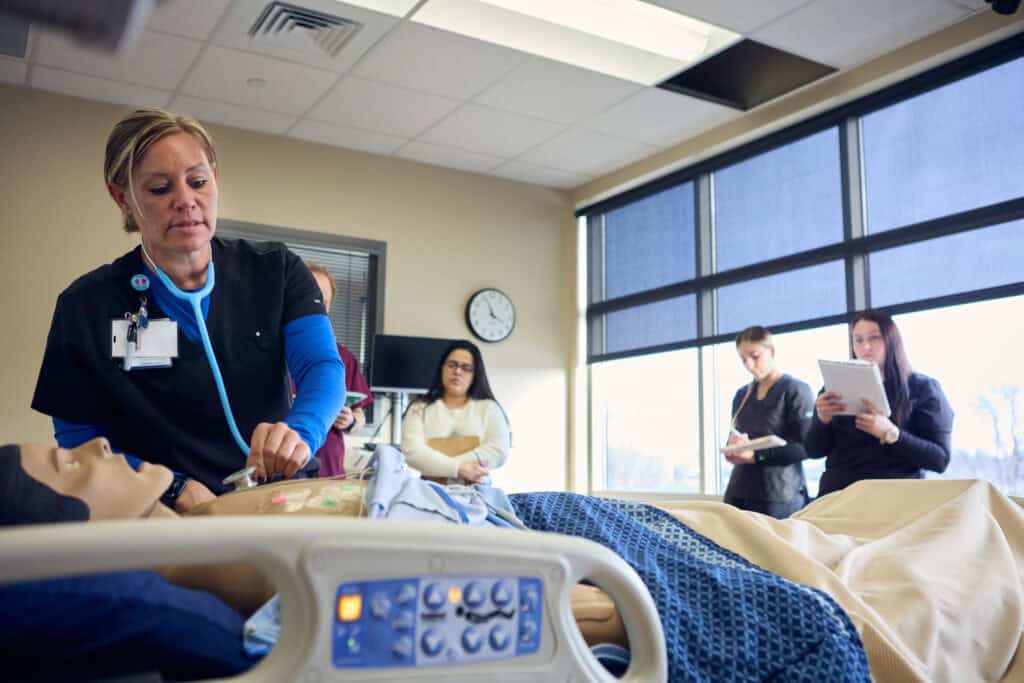
High-demand programs offered at colleges throughout the WTCS, Raney said, are also at capacity, creating a bottleneck between interested talent and the education they need to be qualified.
“When you look at a lot of our programs – take healthcare, for example – our health and nursing programs are high-wage, high-demand,” she said. “Our radiography program, our sonography program, surgical technology, our dental hygienist program – most of these have wait lists.”
This perspective is important, Raney said, because it demonstrates Wisconsin doesn’t need more people to train; it needs more opportunities to train them.
“We don’t have a talent issue per se – these are smart, capable people,” she said. “We have a capacity issue.”
Statewide ROI
In both proposals, the UW and WTCS make several promises to the state of Wisconsin – outlining their desired results if the budget requests were to be granted in full.
As part of its budget proposal, Rai said the UW is promising to add 300,000 career-ready graduates, upskill 1 million workers, and help create 2,500 new businesses over a decade.
“Those are things the universities can do – graduate the next entrepreneur and show them a path to business; help that person who’s been in the workforce for 15 years get that next promotion through their upskilling, and be a valuable member to their organization [while] staying in that company [and] going to school,” he said. “So, this budget really tries to account for so much more than I’d say a typical budget has by really setting these targets out there.”
UW chancellors and system staff, Rai said, were also crucial in forecasting the possibilities outlined in the budget proposal.
“Sitting down with the finance teams and with the chancellors, and really putting outcomes to dollars, and really making sure they felt like those dollars could directly lead to those outcomes – that was a lot of what we did this summer before it even got in front of the regents,” he said. “We wanted to make sure the chancellors, their budget teams, and the system budget team were all on the same page when it came to those metrics.”
Rai said the UW is especially hoping to support the state’s healthcare workforce and infrastructure with the promise of 35,000 new providers and the commitment of five universities to advance new cures and treatments for illnesses and diseases such as cancer, Alzheimer’s, and Parkinson’s.
“The Universities of Wisconsin can do its part with this budget to slow down that hole that’s being dug right now of a shortage of employees and sicker patients,” he said. “We can also help cure diseases the whole world needs us to, if we had the research funding to do so. So, that’s why this budget was structured in the way it’s structured.”
Raney said the WTCS’s employer network, fostered directly in and by each of the individual colleges’ communities, offers the system a unique strength in helping combat workforce shortages across healthcare and other industries.
“It’s kind of a closed-loop system,” she said. “At NWTC, our employers are talking to us about our programs, what they need for our graduates to be able to know and to do. We respond to that. … It is designed to create graduates who go to work here, and I think the fact that 93% of graduates stay tells us the design works, and that we are really shoring up the workforce talent our employers across the state need.”
The preservation of that network and its continued support, Raney said, is one of WTCS’s promises made in its budget proposal, accompanied by expanding access, affordability, and increasing economic opportunity for Wisconsin-based talent through things like state-supported dual-enrollment opportunities.
“Wisconsin is one of three states in this country that does not have a dual-enrollment funding model at the state level,” she said. “In 2024–25, we served almost 68,000 [high school] students in Wisconsin. They earned nearly 330,000 college credits, and it saved nearly $50 million in tuition, but that was absorbed [by the WTCS].”
Though a steep cost, Raney said it’s worth Wisconsin’s time and investment to “be different by design.”
“The return on that investment is immediate, and it increases year after year,” she said. “As their salaries increase, they pay more taxes, our communities benefit, they enroll their children in our schools, and they put down roots.”
Serving more than 293,000 students annually, Raney said the WTCS directly contributes to the prosperity of Wisconsin.
“It just becomes sort of this closed-loop system, if you will, of improving lives for students, strengthening our employers, and then improving our communities which are stronger as a result of it,” she said. “We really are the workforce solution. The investment is small, but the return is huge.”
Rai said the same of the UW – offering that its proposal isn’t for the betterment of the system, but for Wisconsin.
“You don’t need to go to one of our universities to feel its impact,” he said. “This is a budget for the entire state.”