Inthewoods Sugar Bush gets ‘sappy’ with maple syrup
 80 years, five generations, two families, same recipes


February 2, 2026
MOSINEE – Central Wisconsin Airport (CWA) is cleared for takeoff, as a recently announced reunion with United Airlines has airport officials anticipating record passengers in the coming years.
Airport Director Brian Grefe said it’s been four years since United had to cancel its service to CWA due to a shortage of pilots, leaving Delta and American Airlines as the regional airport’s only carriers.
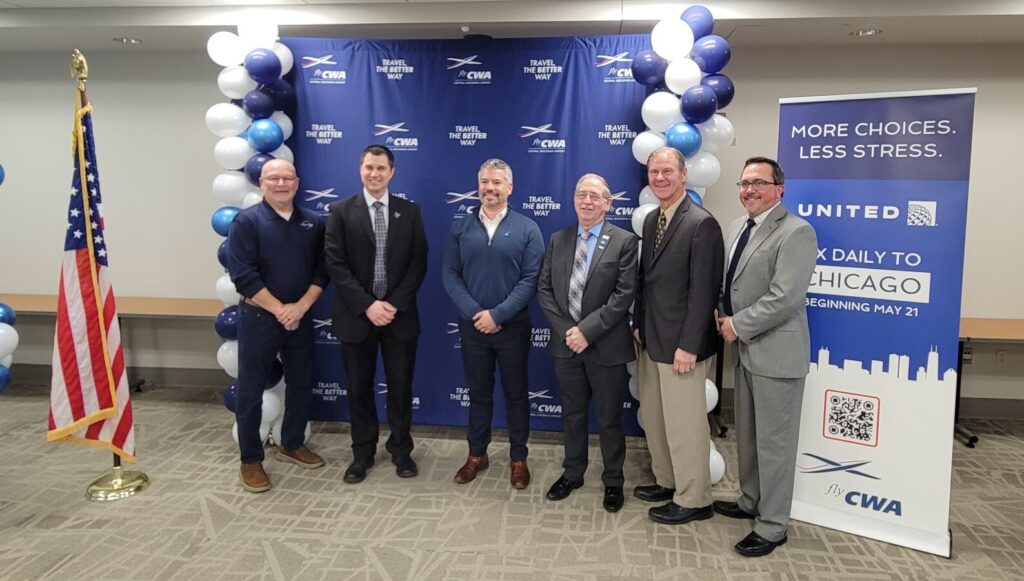
However, beginning May 21, United will resume service at CWA, offering three daily flights to Chicago O’Hare International Airport, a move Grefe called “huge” for area travelers.
“[Adding] three daily flights on United adds a huge amount of capacity into our market,” he said. “Capacity will make for additional competition and, quite honestly, [ticket] prices are going to come down.”
Grefe said he’s been at CWA – informally referred to as “C-way” – since 2016, and witnessed a record number of annual passengers in 2019, as well as record monthly passengers in January and February of 2020.
With United returning to its runways, he said internal expectations see CWA surpassing previous highs as early as 2027.
Grefe said the development provides more options for both business and leisure passengers who might otherwise have to drive a significant distance to catch a flight.
“We’re not only getting the word out about United, but all of our air service options,” he said.
Three ways for CWA

Until four years ago, Grefe said CWA offered service from three legacy carriers: United, Delta and American Airlines.
“All the airlines fared reasonably comparably through COVID[-19],” he said, “but then the phenomena we and all regional airports saw coming out of COVID – as the airlines and industry had these retirement buy-out packages to reduce their workforce – [was that] they learned very quickly they had a[n overly] reduced workforce.”
Grefe said this essentially led to a nationwide shortage of pilots, which outpaced efforts to replenish the ranks.
“As you might suspect, it takes a while to train up a pilot to be a captain on an airline,” he said.
Eventually, the shortage worked its way to Central Wisconsin, and Grefe said he was informed of United’s decision to cancel its service to CWA, as well as numerous other airports.
Though it took several years, Grefe – who personally works with area schools to teach aviation concepts in STEM classes – said a rebuilt workforce has finally cleared the way for the legacy carrier’s return.
“Now, they’re in a position where they can back-fill and are healthy enough to start serving a very good market for them in Central Wisconsin Airport,” he said.
Keeping it Central
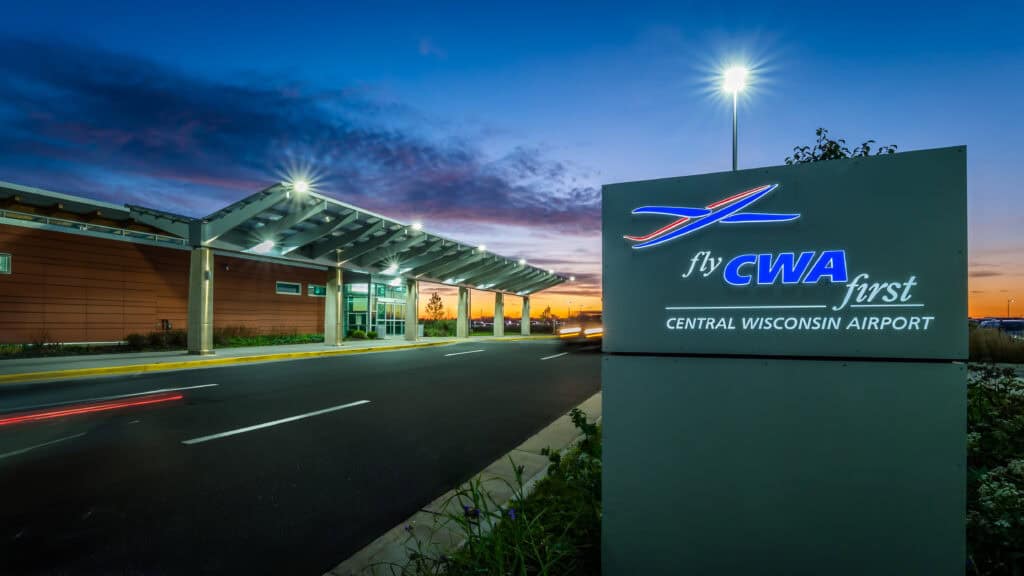
Established in 1969, Grefe said CWA has maintained a focus on “a very friendly and family-focused experience,” with cleanliness at the forefront of everything they do.
“It’s a hometown airport for citizens of Central and northern Wisconsin, [for whom] Central Wisconsin Airport is the closest airport,” he said. “We try to ingrain that mentality in everything we do. We’re close to home. We’re involved in your community.”
CWA was removed from the Marathon County tax levy in 1990 and, aside from “some subsidies” in 2001, Grefe said the airport has been self-sufficient for the past 36 years.
“Financially, we’re diversified,” he said. “We don’t put all of our revenue in the airline bucket.”
Outside of commercial service, Grefe said general aviation (GA) – defined by the International Civil Aviation Organization as “all civil aviation operations other than scheduled air services and nonscheduled air transport operations for remuneration or hire” – is another such bucket.
To keep CWA operational, Grefe said the airport will deficit-spend when necessary, while always ensuring vehicles and equipment are maintained to the utmost extent.
He said these responsible efforts are vital to sustaining air travel to/from Central Wisconsin.
This availability, Grefe said, is as much a boon to the business community as it is to leisure and VFR (visiting friends and relatives) passengers.
Other than essential air service airports in Rhinelander and Eau Claire “an hour to 90 minutes away” by car, Grefe said the nearest comparable commercial airports are in Green Bay and Appleton – requiring drives “between 90 minutes and two hours away” – with Minneapolis, Milwaukee and Chicago further still.
Travelers opting to make these drives, he said, often overlook several factors, amounting to “an education piece” on his behalf.
“[I find myself] telling that story over and over again, trying to make people understand a three-hour drive is not a nonstop flight – that’s your first connection,” he said. “And you [may] have to drive through bad weather and carry your own bag.”
Grefe said travelers from the region who fly into/out of CWA enjoy shorter commutes and minimal congestion.
“That’s especially noticeable coming back,” he said. “You can go on a long vacation or business trip, and you’ve only got 15 minutes [in some cases] from when you’re tired and get off the plane to [being] home.”
Beyond convenience, Grefe said regional airports play an even greater role.
“We not only are closer to your home – and there’s the value associated with that and what your time is worth – but we also are a large employer,” he said. “We contribute to the economy by giving people jobs in addition to the other economic stimulus items all businesses have.”
If more travelers thought regionally, Grefe said, Wisconsin would see substantial benefits.
“If every person flew out of their hometown airport – that is, whichever airport they live and work closest to in the state – our state would be a lot better off…,” he said. “We lose so many passengers and so much economic impact to Minnesota through MSP (Minneapolis-St. Paul International Airport) and Illinois through Chicago O’Hare, that our state would be much better off if everybody just flew out of their local airport.”
Grefe said there’s also a communal incentive to this principle.
“When you live closest to Central Wisconsin [Airport, for example], when you fly out, you can talk to people who are, if not your neighbors, [live] right down the street, and you’ve got that connection,” he said.
Grefe said his request to the region is simple.
“All I ask is that people certainly check Central Wisconsin [Airport] when they’re planning to travel,” he said, “just to see if it makes sense from a financial standpoint, and then also keep in mind that your time is worth something, too.”
Ready to soar
Grefe said Central Wisconsin loses “about 75% of our travelers to other airports,” with Minneapolis-St. Paul its “No. 1 leakage market.”
Re-adding United as a third airline, he said, doesn’t just help Central Wisconsin keep its only airport – it sets up CWA for unprecedented utilization.
Following a record number of passengers in 2019 – upward of 250,000 – Grefe said preliminary estimates for 2025 show utilization of about 200,000 passengers, “so we know our community can support significantly more air travel.”
By 2027, Grefe said 300,000 total passengers is “a very realistic goal,” and recent renovations make CWA fully capable of handling the higher volume.
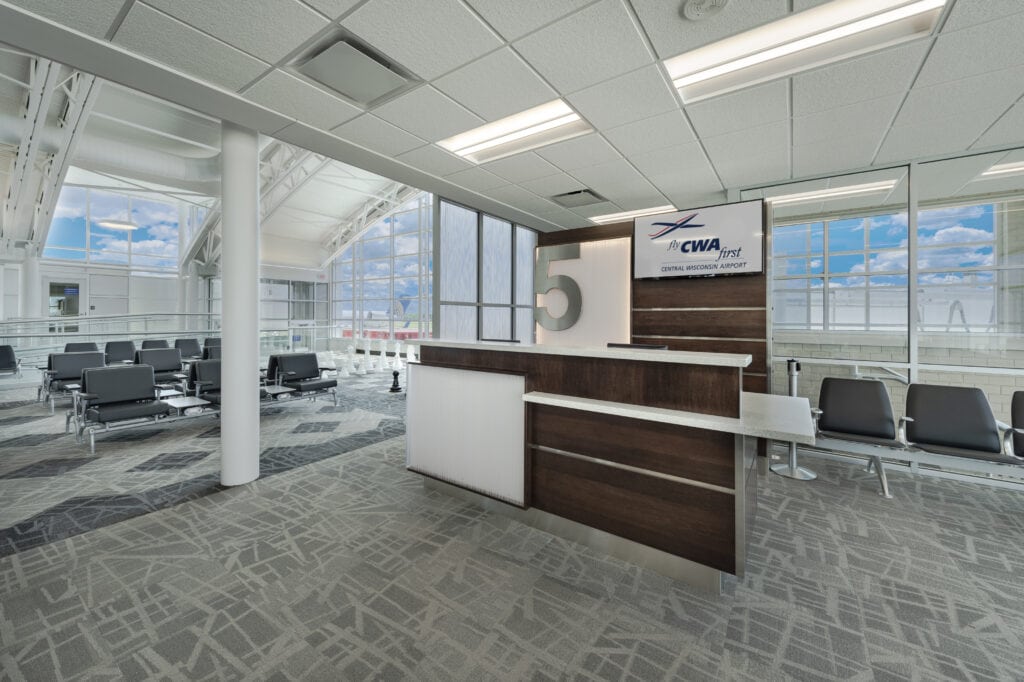
“The terminal’s still in great shape – that was completely redone about 10 years ago,” he said. “The airfield is one of the best airfields, if not the best airfield in the country. Over the last four years, we completely rebuilt that, including a lot of new pavement, all new electrical infrastructure, all new nav[igational] aids – all LED-lit, very efficient – so that’s in great shape.”
Grefe said with increased utilization, more airlines – from legacy carriers to low-cost carriers (such as Avelo Airlines, Breeze Airways, Allegiant Air, etc.) – will size up CWA’s profitability potential.
The return of United, he said, presents a valuable case study for interested carriers, “showing [them] our community is supportive of United” and that this can also work for others.
“The more people who use Central Wisconsin Airport, the airlines will see it’s profitable,” he said. “The more we can grow, the more nonstop options we [can] get. It’s kind of a self-generating storm.”
Further stability is on the horizon for CWA, Grefe said, as Federal Aviation Administration grants have funded new GA terminal and transient hangars.
These new GA buildings, he said, are on track to be completed this year.
Having been in the industry for 21 years, Grefe said he looks forward to aviation innovations in the not-so-distant future, including the modernization of air traffic control as well as the “‘Jetsons’ technology” of Advanced Air Mobility.
Whatever changes await the broader industry, Grefe said he’s primarily looking forward to a positive year for CWA, starting with the return of United this spring.
Since airlines focused their initial post-COVID efforts on rebuilding their larger markets, he said it’s encouraging as the support makes its way to regional airports.
“We’re starting to see that benefit now,” he said. “You saw Appleton [International Airport] grow significantly after, but not immediately. [The airlines] certainly stood up Milwaukee and Madison[’s airports] first. You see Green Bay [Austin Straubel International Airport] is growing now again, too. Now it’s trickling down to Central Wisconsin Airport, and we’re starting to see some pretty significant growth. I think 2026 is going to be a great year for us.”