The Bassball Cages is ready to rock in Ashwaubenon
 ‘Eat, drink, live’ – a toast to new beginnings for The Blind Horse


February 23, 2026
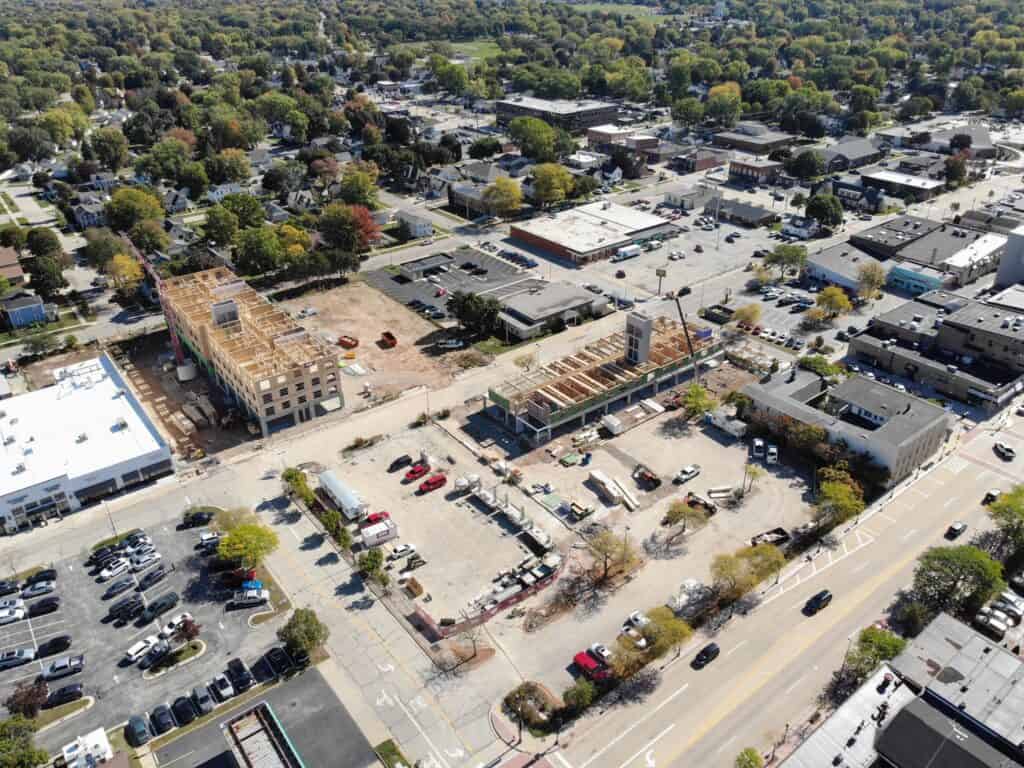
DE PERE – Construction is underway on a new 240-stall parking garage in downtown De Pere at the former Shopko site, 224 N. Wisconsin St.
City leaders said the project – which officially broke ground late last month – aims to help drive downtown redevelopment and boost economic growth in the area.
After the former retailer closed, Daniel J. Lindstrom – City of De Pere director of development services – said the city was left with a several-acre site in the heart of downtown.
“[The property] was purchased by a group of local investors who are attempting to bring life back into the downtown and renovate it into a mixed-use area,” he said.
Lindstrom said the new structure is part of a larger redevelopment plan for the former Shopko site, which also includes a new Marriott-owned hotel property and apartment units.
A parking analysis conducted about a decade ago – which was updated in 2022-23 – he said, revealed practical challenges to the downtown parking system as it relates to the city’s future development, and the parking network as it is now in downtown De Pere.
Lindstrom said part of the challenge of any mixed-use development in a downtown area is parking, and it’s also one of the highest costs.
As city leaders worked through this first phase of redevelopment with the new hotel set to open later this fall, as well as with the mixed-use project 550 William immediately to the north of the ramp, Lindstrom said the old Shopko site was identified as an area for a public parking structure.
He said there will also be leasing availability for the hotel and the mixed-use development.

“The hotel, as well as the apartment complex, will be using the parking ramp and leasing spaces out of that ramp, helping with the cash flow of the ramp but also helping reduce the overall development cost on the front end for them,” he said.
With nearly 27 acres of surface parking downtown on both sides of the river, Lindstrom said significant developable land is currently devoted to surface lots.
By consolidating some of that parking into a single east-side structure, he said, the city could free up several smaller satellite lots for redevelopment.
“It is kind of a resurgence of… and a growth of the downtown, but it does have to be accompanied with parking infrastructure, and that’s what the parking ramp does at this time,” he said.
Technology = seamless user experience
Lindstrom said today’s parking ramps have evolved into modern, multi-use structures.
The ramp in downtown De Pere, he said, will feature multiple high-tech capabilities, including real-time tracking of available spaces and monitoring to ensure spots remain open for permit holders tied to the mixed-use development and hotel.
Though parking ramps serve a great benefit to the community, Lindstrom said they can be costly, with construction typically ranging from $30,000 to $60,000 per stall, depending on how much of the structure is built underground versus above ground.
“Parking ramps are very expensive, but they are a dire need to make sure your downtown is functional,” he said, “so there is that delicate balance between parking and ramp usage daily and parking ramp usage from a monthly parking pass structure.”
Using the 60-unit multi-family development as his example, Lindstrom said though it may have a leased space of 60 units, those spaces will not be reserved for those users at all times.
With the significant amount of turnover traffic that a parking ramp experiences, Lindstrom said those stalls can be used during the day by the general public or by commuters, and then at night, the residents of those buildings will have parking spaces available.
“The technology on the back end, behind the [parking ramp] software, does allow for that real-time tracking, so the parking ramp will stay full or not full depending on the needs and when those timeframes hit for… when parking still has to be available for the tenants,” he said. “And it will track the tenants who are there through a system of passes.”
Lindstrom said the ramp will feature license plate readers integrated with a parking app to streamline access for pass holders.
Smart lighting will also be installed, he said, with motion sensors dimming lights in unused areas, while keeping them illuminated.
Lindstrom said the ramp will also be dark-sky compliant, using cut-off lighting designed to minimize spillover into the neighborhood.
The lights, he said, are focused on the ramp itself, ensuring illumination at the property line is no brighter than what’s typical from other downtown buildings.
“Parking ramps tend to be very bright because they are open and they need it,” he said. “But with the technology of smart equipment, it is not only cost efficient from an energy standpoint but [also from] a light-spillover standpoint.”
Local subcontractors make an impact
Lindstrom said local firms, including Miron, GRAEF and Berners Schober, together with City of De Pere staff, are helping drive the project forward.
The public bidding process, he said, puts the onus on the construction manager to pick the best contractors – and that often means hiring locally.
“[They] know the area, they know the market, they have the network relationships,” he said. “So, the majority of the subcontractors in this process are contractors from Northeast Wisconsin or Wisconsin in general, and that’s a great asset to have.”
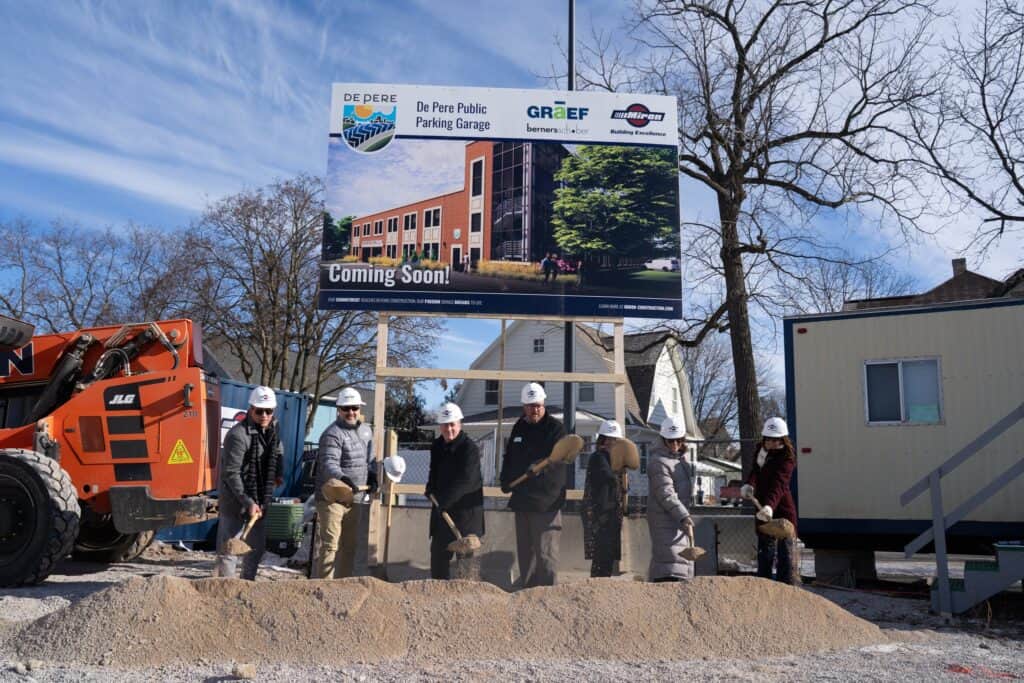
Lindstrom said the project benefits not only from the construction expertise of Miron, GRAEF (out of Milwaukee and Green Bay, respectively) and Berners Schober, but also from the institutional knowledge and guidance these consultants provide throughout the process.
The parking ramp, itself, he said, is a precast system from Wells concrete, another company with a footprint in Wisconsin.
Once the majority of the structure is underway from a footing standpoint, Lindstrom said the precast panels will be put into place, and the ramp will begin to quickly take shape.
“One of our core targets was… to design for the time but also be cognizant of De Pere’s history,” he said. “De Pere has a lot of brick buildings, so we wanted to make sure there was [that] component to it.”
Lindstrom said modern parking ramp technology allows precast systems to come with face brick already built in.
“At a nominal price increase, you can get a much higher quality product than you may have been able to 10-15 years ago, with just a straight, flat concrete panel with maybe some textures into it,” he said.
Lindstrom said the parking garage will complement the surrounding developments, including the hotel and the mixed-use project to the north – both of which feature brick – and blend seamlessly with these projects and the existing downtown fabric.
“I think the general public will be happy to see that additional time and energy and slight expense went into ensuring the ramp is designed in a way that fits into the character of the community,” he said.
Lindstrom said the ramp is funded through the tax increment district, meaning the increased tax revenue from the parking garage, hotel and other nearby developments will help cover its construction costs.
“From an operational standpoint, we will be using the tax incremental financing, plus the revenue generated from the users to help operate the ramp and the long-term debt being used is against the tax increment district,” he said.
Future economic development
Lindstrom said construction on the ramp is expected to be complete by July 2026, weather permitting.
Its short-term success, he said, will rely on strong use by both the public and the hotel once that project opens later this fall.
Looking beyond the short term, Lindstrom said the long-term impact of the ramp will depend partly on shifting the mindset of downtown visitors, who are used to surface-level parking near their destinations.
The parking study, he said, highlighted these expectations, showing the downtown parking challenge is less about availability and more about how far users are willing to walk from their vehicles.
“By changing the mindset of individuals and having a centralized parking location where people can then park and visit retailers that are around a two- or three-block radius, we then better ourselves in the span of better space utilization,” he said.
Long-term success, Lindstrom said, will come from converting smaller 20-30 stall parking lots into new developments, creating additional tax revenue, adding multi-family housing and incorporating ground-floor retail.
“It’s taking those pocket parking lots, which are sort of satellite lots all over the downtown and turning them into a much more… beneficial [space] from a use standpoint,” he said.
Navigate to the City of De Pere’s Facebook page for updates on the progress of the project.