New owners at the helm of Tribute Brewing Company
 Grown Climate Smart, Township 23 Distillery announce partnership



March 23, 2026
CHILTON – Whether or not craft-beer enthusiasts know the Briess name, they’ve likely come to rely on the family-owned company’s primary product: specialty malt.
“It would be really hard to find a brewer in Wisconsin that does not use Briess malt,” Ron Schroder, director of marketing at Briess Malt & Ingredients Co., said.
Headquartered in Chilton, with its malthouse located in Manitowoc, Schroder said Briess is “the leading supplier of roasted malt to craft brewers in the U.S.”
Malt, he said, can be considered the “backbone” or even “soul of beer,” as it creates the sugars used by the yeast in the brewing process that yield alcohol.
“There are all kinds of different beers – everything from the lighter ends, like pilsners or lagers, to darker styles, like stouts, porters, ambers and bocks – and malt is an essential ingredient in brewing those beers,” he said. “There are really four ingredients you could say are always used in brewing beer: malt, hops, yeast and water.”
Schroder said Briess focuses on specialty malts – such as dark-roasted, caramel or the proprietary Carapils® – to add flavor, color and foam to beer.
Briess malt, he said, is used by craft breweries across the state, including:
- 3 Sheeps Brewing
- Badger State Brewing
- Central Waters Brewing
- Copper State Brewing Co.
- Great Dane Pub & Brewing
- New Glarus Brewing Company
- PetSkull Brewing Company
- Stillmank Brewing Company
- Titletown Brewing Company
- Zambaldi Beer
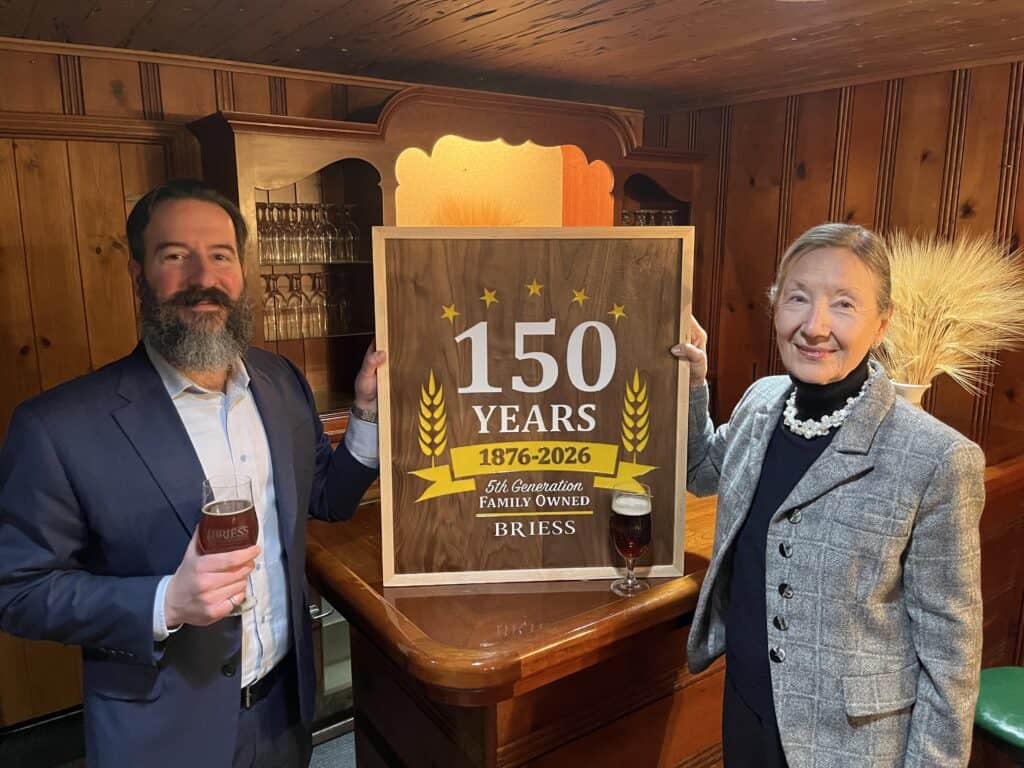
Schroder said Briess’s brewing clientele – as well as the company’s longevity, celebrating 150 years of operation this year – are testaments to the quality of its products more so than name recognition.

“We’re not well known, perhaps, by people who are not in the industry of craft brewing,” he said, “but we really do have a great history.”
Since 1876
Schroder said the story starts in the Moravia region of the Czech Republic (Czechoslovakia, at the time).
“When the first generation – Ignatius Briess – started the company, that region of Moravia was already known as having some of the highest-quality malting barley in the world,” he said.
It was there that Schroder said Ignatius established a malthouse and started selling grain in Europe and around the world.
According to the company’s website (brewingwithbriess.com), Rudolf Briess – representing the second generation – continued to build the business, exporting to Germany, Belgium, the U.S. and Latin America, gaining “worldwide recognition as a reputable supplier of high-quality malt” in the process.
Schroder said it was with the third generation – Eric Briess – that the family business crossed the Atlantic and set up shop in the U.S.
“[Eric] worked as a global grain trader out of the U.S., and then for his supply of barley, he established a relationship with Chilton Malting Company…, working as a trader of the product that was being made there in Chilton,” he said.
In 1950, Schroder said Chilton Malting Company adopted the then-new K-Ball Roasters, an efficient, German product which would enable the company’s malt production to triple by the 1970s.
Per the website, 1971 saw fourth-generation maltster/brewer Roger Briess – who had trained at Weihenstephan University in Germany – succeed Eric following his passing, and eventually acquire Chilton Malting Company in 1978, adding modern drum roasters to the production.
“1978 was really a pivotal year, because that was the year when President Jimmy Carter authorized home brewing,” Schroder said. “That was transformational in terms of allowing craft beer to happen, because a lot of guys and gals started home brewing, and then found out they loved it so much that they established professional craft breweries.”
At the time, Schroder said there were perhaps 100 breweries across the country – large operations that would’ve been ordering malt by the truckload.
“What Roger did that really made a difference is he introduced 50-pound bags of pre-ground malt – and that’s what enabled those small craft brewers to make beer…,” he said. “During the 1980s, Briess was literally the only malting company supplying malt to craft brewers.”
Though several competitors would arise in the ’90s, Schroder said by then, Briess had established a legacy of using cutting-edge technology to accommodate specialized orders and was serving brewers far and wide.
Schroder said David Grinnell – vice president of brewing and quality at Boston Beer, makers of Samuel Adams beer – credits not only his company’s genesis to Briess but also feels “the craft brewing revolution went on as long as it did because of Roger Briess.”
“We were there at the start, when it was just single-digit numbers of craft brewers, and we have been integrally involved in supporting and advocating for craft beer and brewing during that time,” he said. “Now, there are more than 9,000 craft breweries in the country, including many in Wisconsin.”
Specialty Malt Capital of the World
Going back to the K-Ball roasters, Schroder said Briess has always been at the forefront of innovation for specialty malt – a trend that has continued into the 21st century.
Per the Briess website, Roger passed away in 2001, succeeded by Monica Briess.
Schroder said Craig Briess then became CEO in 2021, representing a fifth generation and a new progression for the company.
“Since becoming CEO, [Craig] has invested in the Manitowoc plant in safety, malting and packaging,” he said.
Currently, Schroder said the Briess product line has expanded to 55 different malts – with recent additions like crystal red and blonde roast oat – catering to the unique requests of brewers throughout the U.S., Latin America and Asia.
“Our malt is in breweries in all 50 states and in multiple countries around the world,” he said. “In fact, as part of our success, Briess malt is in more than half of craft breweries in the [U.S.].”

Schroder said Briess’s ongoing industry leadership – including producing the largest product line and volume of specialty malt – and its history as “the first supplier of malt to craft brewers,” helped earn the City of Manitowoc the designation of Specialty Malt Capital of the World in 2024.
The Manitowoc plant, he said, also features the Center of Malting Excellence, which focuses on barley varieties and how those change year to year, on the malting process and on quality control, “which is really important, because brewers and consumers want the malt and beer to perform the same every time.”
Quality and consistency, Schroder said, are the two primary reasons brewers continue to brew with Briess malt.
He said the company’s technical support – likewise based in Manitowoc – is another vital ingredient.
“We have technical experts who can support brewers and help them address opportunities or problems in the brewing process and help them to brew those new and innovative beers that keep craft beer interesting,” he said.
Celebrations, giving back and goals
Schroder said Briess began celebrating its 150th birthday in January, with an employee holiday party held at Lambeau Field and a commemorative logo added to product packaging.
He said the public will be invited to celebrate at the company’s fifth annual Malt City Brewfest Aug. 1 in downtown Manitowoc.
At the event, Schroder said 30 Wisconsin craft brewers will each serve four of their beers – all brewed with Briess malt, but with a flavorful range from cinnamon-crunch brown ale, blueberry wheat, cherry-apple ale, Märzen to fruited sour and beyond.
He said Malt City Brewfest annually partners with two charities for the event: Pink Heels of Manitowoc (providing support for those battling cancer) and Lakeshore Humane Society in Manitowoc.
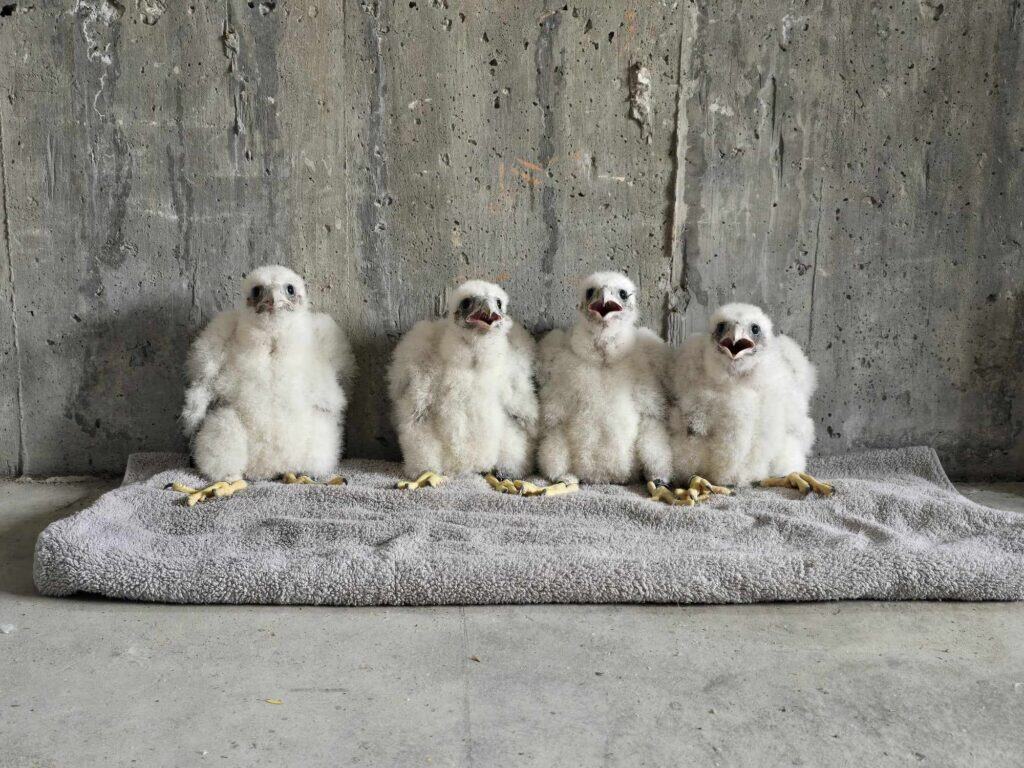
Meanwhile, Schroder said Briess’s environmental give-back efforts have been soaring for more than a decade, as the company participates in the Wisconsin Peregrine Falcon Recovery Program.
Per briess.com, the program was developed to re-populate peregrine falcons – the world’s fastest animal – which were added to the U.S. Endangered Species list in 1969 after near eradication due to the pesticide DDT.
“Falcons like to nest in high locations, like grain elevators or power plants,” Schroder said. “One of the highest points in Manitowoc is the grain tower we have at the malt plant.”
There, he said, in a nesting box on the 11th floor – 244 feet up – more than 90 baby falcons (“eyasses”) have been born since 1998.
“The nesting pair has already returned to the nesting box this year, and the eggs are normally laid in March, then hatch around Mother’s Day, appropriately,” he said, adding that those interested can view the live stream of the nesting box on the website.
Meanwhile, Schroder said Briess will continue hatching its own plans for the malt industry.
“Consistent with our history as a company, we will continue to innovate,” he said. “We know craft brewers and craft-brew consumers are always looking for new and interesting beers to try, so we will continue innovating to provide the malts so that they can produce those beers.”