 A bumper crop of business: The economic impact of pumpkins
 CWIMA Summit & Expo: ‘A new adventure every year’




November 16, 2026
GREEN BAY – No one person uses a chair in the same way – that’s the philosophy Bryan Ballegeer, Vice President of Education Markets, said has led contract furniture manufacturer KI to innovate spaces across industries; most recently, in education.
“One of the things we test ourselves on more and more each and every year is having a solution do more than just one thing,” Ballegeer said. “A chair is not just a place for your body to rest.”
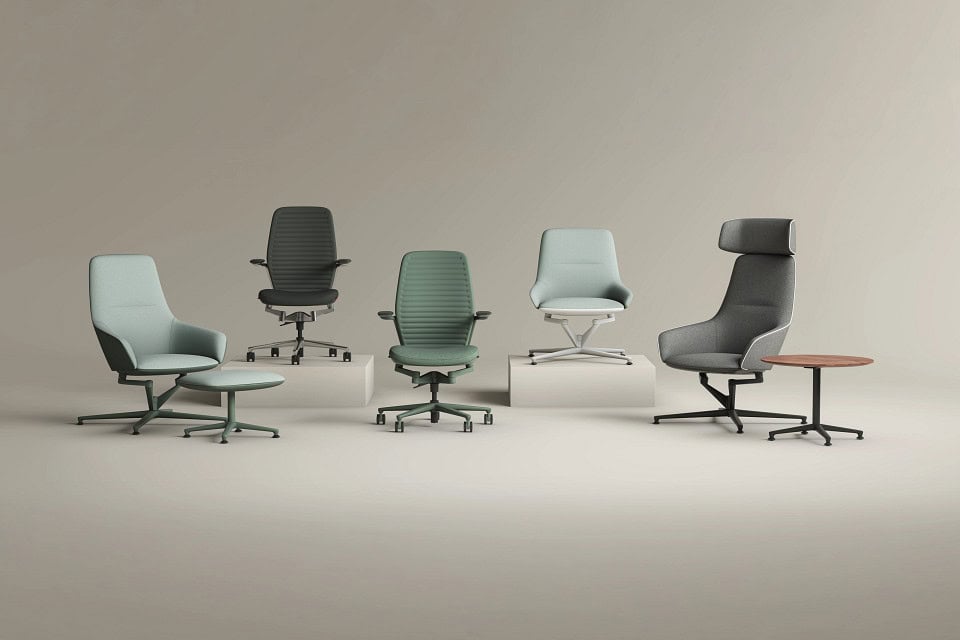
At the recent EDspaces 2026 conference, held in Kansas City, Mo., Ballegeer said Green Bay-based KI debuted two new collections and a seating solution designed to support both students and educators.
“Students should always come first [and] they [do] always come first, but no one thinks of the teacher,” he said. “Teachers are selfless.”
The Neara Collection, Foray Collection and Havara Lounge Seating products were introduced to educators and administrators alike at the event in late October, Ballegeer said, alongside KI’s Kiaura Collection – another recently revealed offering by Industrial Designer Aaron DeJule.
After a car wreck, Ballegeer said DeJule couldn’t sit comfortably due to “severe back pain,” leading him to design a chair that could relieve his symptoms.
“He challenged himself [to sit] on a soft sofa, a hard chair, or this or that, [and] nothing was comfortable,” Ballegeer said. “So, he started tinkering, and kept tinkering over an 11-year period. Three years ago, he brought it to us, and we’ve helped refine it and bring it to market.”
Now, Ballegeer said Kiaura is set to make a difference in the function and well-being of professionals across industries, while Neara, Foray, and Havara are specifically supporting both students’ education and their educators.
“[There’s] a huge amount of interest in the chair and the research we’re getting with it [shows] this can help on a neurological, physiological, and soulful level,” he said. “Principals, superintendents, designers, dealers, everyone – when you experience it, people can’t help but smile, and they want it for themselves, their staff, and whatnot…. Then, they’d point over to… Neara and [say], ‘but that solves problems my teachers didn’t even know they had.’”

From Neara to far
A key element to KI’s design work, Ballegeer said, is observation of the environment in which its pieces will be used.
“Neara comes from about three years of us doing observational research, where we just (in a non-creepy way) sit and observe classrooms,” he said. “[From] kindergarten through 12th grade, we observed about 30 different classrooms.”
Ballegeer said this is the same method that brought about KI’s Ruckus chair – designed to be non-directional and amenable to any which way a student chooses to sit.
However, this time around, he noted the focus was put on teachers and how to help them be successful in modern education environments.
“In a team meeting four years ago, [we were] looking at desking solutions for teachers, and they all look the exact same,” he said. “What we came down to is teachers need access, [but] what do they need access to?”
During observations, Ballegeer said KI’s researchers discovered teachers need access to “three primary things” – storage, power, and their students.
“Neara has three different kinds of storage elements to it [that can be arranged] in different configurations, really any configuration.”
With the Neara Collection, Ballegeer said teachers simultaneously have access to storage for school supplies; a place to lock and secure important or private materials; and personal storage for their belongings that support them throughout the day on “all in one chassis that can be manipulated” to whatever arrangement is best suited to the room.
Though some teachers prefer to move about the room, not needing to settle at a specific desk, Ballegeer said researchers still found during their observations that a desk is useful regardless of how teachers may choose to use it.
“When we observed teachers with desks in their rooms…, maybe 50% of teachers still [said], ‘I need that traditional desk,’ [because], even if it just sits in the corner and collects stuff, it’s part of how they think of teaching,” he said. “The other half [said], ‘I don’t need a desk at all. I work with the kids, I’m around the space, and when the kids aren’t here, I’ll sit at one of their desks or at a kidney table.’”
Regardless, Ballegeer said everyone needs some sort of technology, be it students or teachers, so they also need access to power.
“And it was a mess,” he said. “I’m sitting in my home office, I work in this industry, I’ve got cords running everywhere, and I don’t have 30 kids to manage in this space.”
That’s why the Neara desk, Ballegeer said, is designed with simple cord management in mind – offering teachers thoughtful spaces to plug in both personal and administrative devices as well as their students’ devices.
“We routed power in a very simple, seamless way: one feed that can get fed out of the left or right side, depending on where you put it or where your outlet is, and it routes up in easy places for you or the student to plug into built into the tabletop,” he said. “Not overthinking it, not overengineering it. Just getting you the power in one solution with one cord that’s tied right to the leg, so you’re not tripping over it [or] dealing with the [cord] mayhem.”
Fulfilling teachers’ need to easily access storage and power, Ballegeer said the third and most important objective was easy access to their students, aided by the desk’s shape as well as the mobile lectern and pedestal that help complete the collection.
“Instead of a traditional rectangle desk that sits in a corner, it has a kidney shape, like a [bent] table, which a lot of teachers – especially kindergarten through 6th grade, but even the older grades – [use] as their primary surface,” he said. “I can use [the] height-adjustable lectern to access and move around the classroom…, so I can access my students or they can access me. Then it has another pedestal, but both the pedestal and the height-adjustable lectern abut up to that larger work surface.”
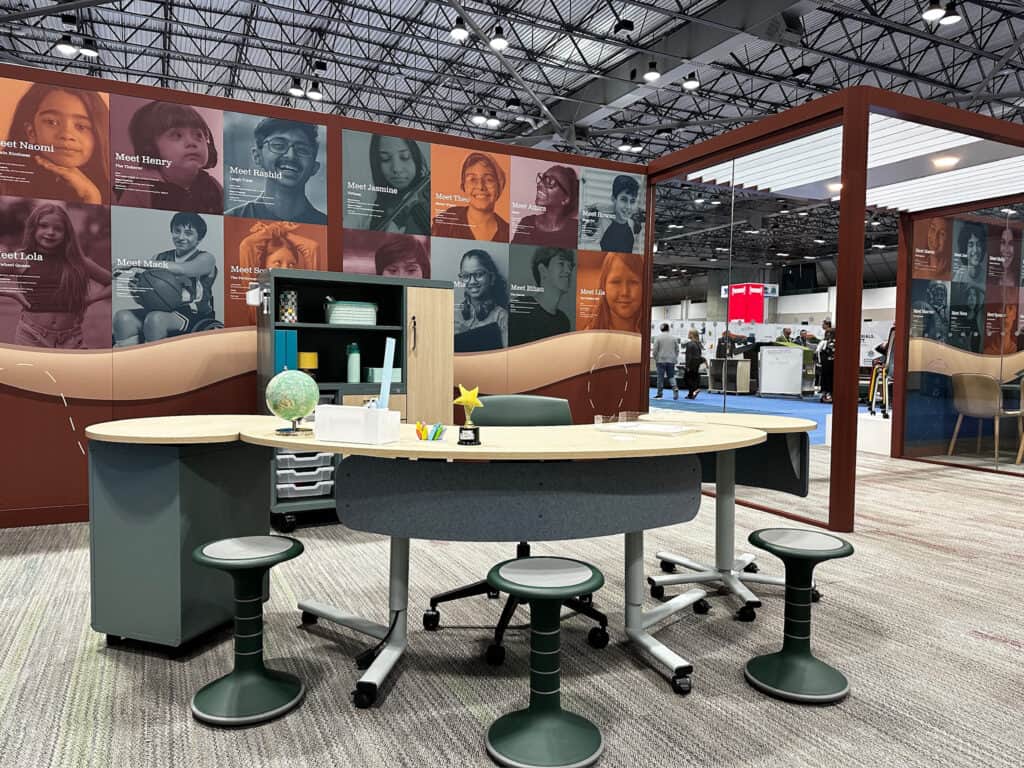
The Neara design’s flexibility in movement and utility, Ballegeer said, gives both the educators more opportunity to connect with their students and the students more opportunity to connect with each other.
“If I put the other pieces next to my table, and have eight-plus of them come to me, we can have a small group where we’re kind of in a semicircle [which] allows them to not just access me in a closer physical way, it allows them to see each other,” he said. “They can see each other [and] can make connections that they otherwise couldn’t if they [were] all just facing one direction.”
Ballegeer said this function also provides strategy opportunities for teachers to put children in the type of environment most conducive to their particular learning style, whether it be independent, in need of oversight, or otherwise.
“Let’s accept that – let’s give the solution for the teacher who knows best how the students need to learn,” he said. “Let’s give them tools that they can pull out of their toolbox as they need to, and that’s what Neara is really all about.”
Aesthetically durable
Though seemingly simpler concepts, Ballegeer said both the Foray Collection and Havara Lounge Seating were designed with just as much intention and thought as the Neara Collection.
“Havara is very much all about comfort and lounge,” he said. “There’s this tension of aesthetic and comfort, and it has to last…. How do we do that? A lot of engineering. We’ve been working hard on upping our aesthetic so our furniture looks as comfortable as it is, but doesn’t look so institutional.”
Ballegeer said Havara is a good example of that hard work in action.
“It looks like something you might buy for your home [and] has that fall-into[-type of] comfort.”
To ensure the durability of any piece it manufactures, Ballegeer said KI will “test the hell out of it” at its lab in Green Bay.
“But there are no regulations in the country of, [for example], how much weight a chair or a lounge piece should be able to hold,” he said. “There is an industry association called BIFMA (Business and Institutional Furniture Manufacturers Association) that develops standards, but the federal or state governments are not requiring you to meet [them].”
Regardless of having no required standards to meet, Ballegeer said KI meets and exceeds those set by BIFMA – a practice that results in furniture so durable, the company promises 15–30-year warranties on most of its products.
“KI holds ourselves to that because we do so much in institutions, healthcare, education, etc.,” he said. “When we develop a Havara or any of our products, we will test to [those standards], and usually, we challenge ourselves to 10-times that amount, or further, until it fails.”
Prior to joining the company, Ballegeer said he was a client of KI’s, heading facilities and procurement for more than 50 campuses in a New York-based school district.
“We make sure the stuff we put out is going to withstand the tests of its lifetime, and that’s part of what brought me [to the company],” he said. “Back when I was a client of KI’s, I knew it was going to hold up. The very few times I had an issue, I’d call, and… the only questions they’d ask [were], ‘What happened, so we can re-engineer that same failure point,’ or ‘Let us come take that, so our engineers can study and make any improvements necessary.’”
The same thought process applied to Foray Collection – integrated, laminate storage solutions for classrooms and libraries, offering various shapes of shelving that help provide warmth and aesthetic to any space – Ballegeer said, because regardless of whether it’s a chair or a shelf, the state of the environment plays a role in students’ and teachers’ success.
“If it looks poor, doesn’t hold up, or after a year or two of use, you start seeing the plywood [chip], it makes you start thinking, ‘Man, this place isn’t designed too well,’ or maybe, ‘I’m not worth nice furniture.’”
The same can be true for any environment, Ballegeer said, regardless of industry or use case.
“[In] a doctor’s office, [for example], maybe they had waiting room furniture that was ratty and tattered and whatnot, and you probably, in the back of your mind, were [thinking], ‘Is this the best care?’” he said. “Versus when you go to a different doctor’s office and it smells nice, there’s nice lighting, and the chairs are a little bit more comfortable, it takes away your anxiety.”
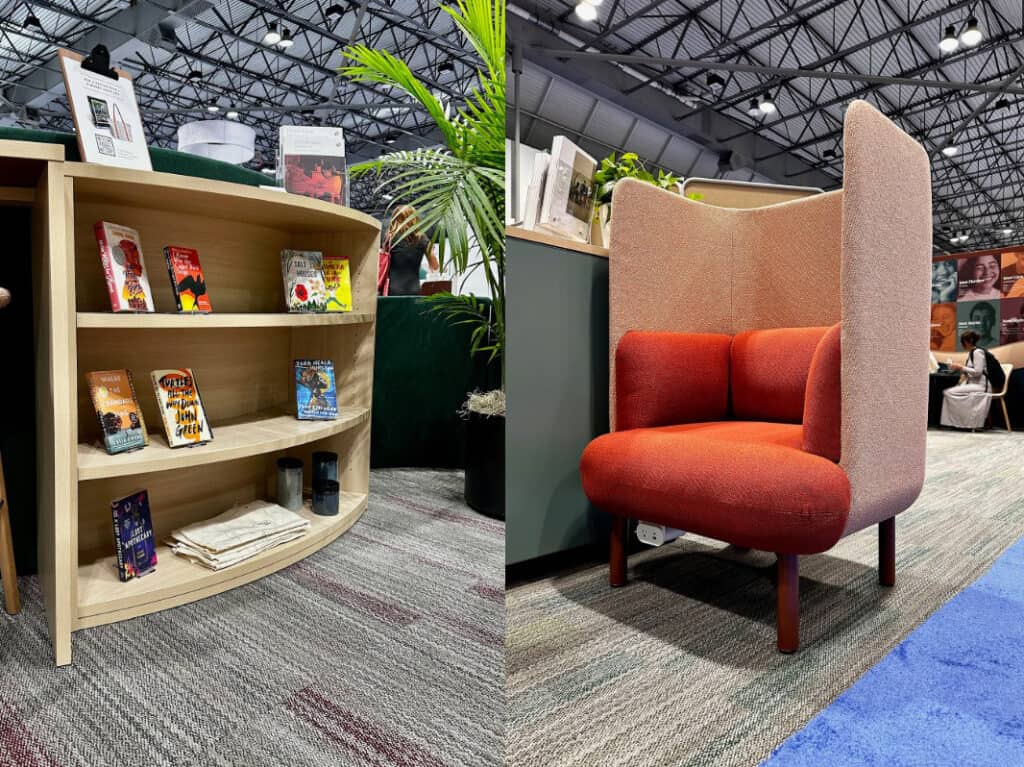
That’s why Ballegeer said aesthetics are an equal priority in the design of education furniture to encourage students, teachers, and faculty to associate the environment with comfort and positivity.
“If you walk into a school environment and it feels institutional, it feels like a prison, [or] it feels like no one really thought about this space, they just threw some stuff in there because ‘I’m just a kid and I just need to sit and do my homework,’ it colors how you think,” he said. “As a child, especially in the younger grades, they don’t know that, but they feel it.”
In children, Ballegeer said it’s especially important to communicate support and safety through the space in which they are expected to be open and learn.
“When you’re older and you have the agency and the awareness, you might actually voice it if you have the gumption to, but you might not because you’ve been told by the spaces your whole career that you don’t matter as much, [or] the adults who are supposed to take care of you don’t care as much about that,” he said. “It sounds small [because we’re] talking about bookshelves, but a broken bookshelf can break a heart.”
Better solutions, better outcomes
Supported by the company’s Cognetic Technology™, Ballegeer said the Kiaura Collection has emerged as a favorite of KI’s recently debuted products.
“We, as KI [and] the industry as a whole, continue to make chairs as comfortable as possible, but to keep you still,” he said. “What Aaron designed was driven by him seeking pain relief, but he found so much more.”
Ballegeer said Kiaura chairs are designed to help a person move in whatever way their body finds naturally soothing.
“You can almost think of it like a tire swing,” he said. “If you’re like sitting on a tire swing and you can move in any direction, it’s that same type of feeling.”
The fluidity of the chairs’ movement, Ballegeer said, puts one’s spine in a neutral, upright position that releases pressure and “frees you up to move, however much or little as you want.”
“But that benefit is [also] neurocognitive,” he said. “We know that movement is directly related to more synapse firing, a general [and], eventually, more neuroplastic mind which allows for more neural connections and absorption.”
Another compounding benefit is in the chairs’ ability to help ease peoples’ nervous, tense, or anxious energies, Ballegeer said.
“We did a couple studies two years ago with an occupational therapist group that gave us some good [results as it relates to] anxiety dropping, pain reduction, [and] cognitive benefit,” he said. “Right now, we’re eight months into a long study with Baylor University where they are doing cortisol testing, heart rate monitoring, [and] monitoring brainwave activity of treatment and control groups to give us true, hard, independently reviewed, peer-reviewed data on what this solution does.”
In addition to EDspaces, Ballegeer said the Kiaura chairs have also made appearances at conferences geared toward the corporate real estate, residential, healthcare, and law enforcement industries.
“We showed it at Healthcare Design [Conference + Expo], and got a lot of interest from that very specific group that designs hospitals, patient waiting rooms, patient rooms, chemotherapy labs, [etc.],” he said. “When we debuted it, I had the pleasure of showing it to the FBI, who had serious interest in studying this at their Quantico lab [to see] how it could help reduce anxiety for [people in high-stress jobs]…. It’s revolutionary technology, and you don’t think ‘revolutionary’ or really innovative, honestly, when you think of chairs.”
As an industry leader founded in the early 1940s, Ballegeer said KI’s idea of “giving choice” with how one engages with any of its furniture solutions is and has always been integral to its work.
“We were one of the first in contract furniture [manufacturing] to make a sit-stand desk 25, 30 years ago,” he said. “We weren’t the best at marketing back then, so we didn’t tell that story necessarily as best we could…. Historically, we haven’t pounded our chest in a marketing way, but that’s something we could have and should have [done].”
Ballegeer said the company’s long-time philosophy of choice benefits both the person using KI’s product, and the people charged with supplying KI’s product – offering solutions that provide schools with aesthetic, durable furniture designed for unique but universal support.
“I managed 50 different campus locations…, so I understand, and we understand the need for standardization,” he said. “There’s also plenty of research and data… that show how much the environment can and does play a role in how well students learn, how they show up, if they show up, etc. If it’s all just the same desk, same chair, focused in the same direction, we’re well past knowing that’s not the right solution. You have to find that balance, so the solutions we make have choice within themselves.”

This mindset has led KI to design and manufacture innovative, award-winning furniture solutions across its markets that, Ballegeer said, continue to make a positive impact on the environments they’re placed and the people they support.
However, he said KI isn’t done, as there’s more work in collecting enough “bona fide” evidence to convince decision makers that by investing in a chair, they’re investing in whoever uses it.
“We’re not just people who throw some chairs together and put it out there,” Ballegeer said. “We think deeply about what we’re putting out there. We’ve walked a mile in the shoes of our clients, or in fact were clients, and that comes to life in the products we build, why we build them, how we believe they can support folks, and how we get folks to be able to access better solutions for better student outcomes.”
For more, visit ki.com.