Making a difference
 Stevens Point business continues to evolve with changes


April 20, 2026
NORTHEAST WISCONSIN – For those seeking a simpler approach to lawn care, Co-owner Erik Cordier said Total Outdoor Automation has a “perfect set it and forget it” solution.
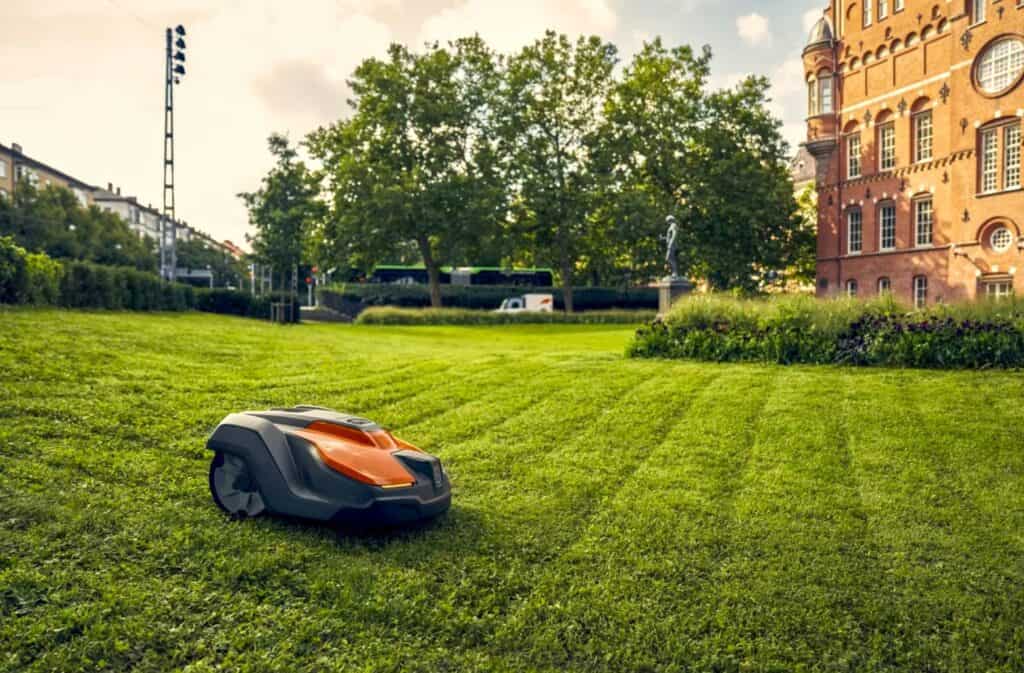
The extra time customers get back by focusing on something other than cutting their lawn, Cordier said, comes in the form of a Husqvarna robotic mower.
“Who likes cutting the grass?” he laughed. “Honestly, with how often people should cut their grass, compared to how often most people cut their grass, mowing is a huge time commitment. That’s where our robotic lawnmowers can help.”
Cordier, who co-owns the company with his brother, Andrew, said the robotic mowers have an outdoor base station (or charging port) that is connectable to a standard 120-volt outlet.
Some of the newer robotic mower technologies, he said, use LiDAR – where the mower will map itself based on what it sees in the yard – but Husqvarna doesn’t currently use the same technology.
With Husqvarna mowers, Cordier said an end user/installer sets the waypoints of the yard themselves.
“[It’s programmed] by walking around and setting the various points in the yard, and then the zone fills in,” he said. “You can program various zones where the mower will cut. You can also schedule the mower to cut in those zones at certain times of the day.”
Cordier said the Husqvarna-programmed zones offer accuracy within roughly two centimeters.
“If you want, you can sit on your deck and watch the mower cut while you relax,” he laughed. “You can compare it to a robotic vacuum for your house. One of the benefits is that it will cut, mark where it’s at when the battery is low, go charge up and then come back to the place that it marked [before recharging] and continue.”

Unlike traditional mowers, where you cut the whole lawn once a week, Cordier said Husqvarna’s robotic mowers are meant to basically cut nonstop, which is “much better for your lawn anyway.”
“You give access to the yard or green space you want to cut, and let the mower go,” he said. “It’s very quiet and eco-friendly, so there’s no gas, oil or exhaust fumes. It’s also very light at 30-40 pounds. It can cut grass earlier in the day [without the worry of waking up the neighbors], and it’s meant to stay out longer.”
Cordier said letting grass grow too long before cutting it can stress the lawn.
Husqvarna’s robotic mowers, he said, are meant for maintaining lawns – “not to cut two-foot-high grass down.”
“It’s meant to cut maybe a half inch at most – you should never cut more than one-third of the grass blade at a time,” he said. “That way, the grass clippings fall to the soil, which makes them more biodegradable.”
Cordier said cutting your grass the “Husqvarna way” is also more conducive to self-fertilization, making the grass more robust.
“On Facebook, we’ve posted pictures where you can see the difference in lawn colors based on the traditional method of cutting it every week or two compared to using a robotic mower,” he said. “Taking off only a half inch or so of grass encourages deep roots, which makes it more drought-tolerant. It also reduces the chances of weed growth in the yard because of the thriving grass root system.”
Why Husqvarna?
Cordier said Husqvarna is the longest-standing player in the wireless robotic mower market, though a growing number of smaller companies are making it more competitive.
“They are super popular overseas, with Europe being the biggest market,” he said. “Within Europe, Germany is the second-biggest market.”
In deciding which route and company to go with, Cordier said every one of their conversations led to the same conclusion – “the United States was the third-biggest market.”
“It was also, by far, the fastest growing market,” he said. “Americans love lines [when cutting grass], so this new, wireless technology that has come along allows for more of a systematic cut where the mower will cut in lines and patterns.”
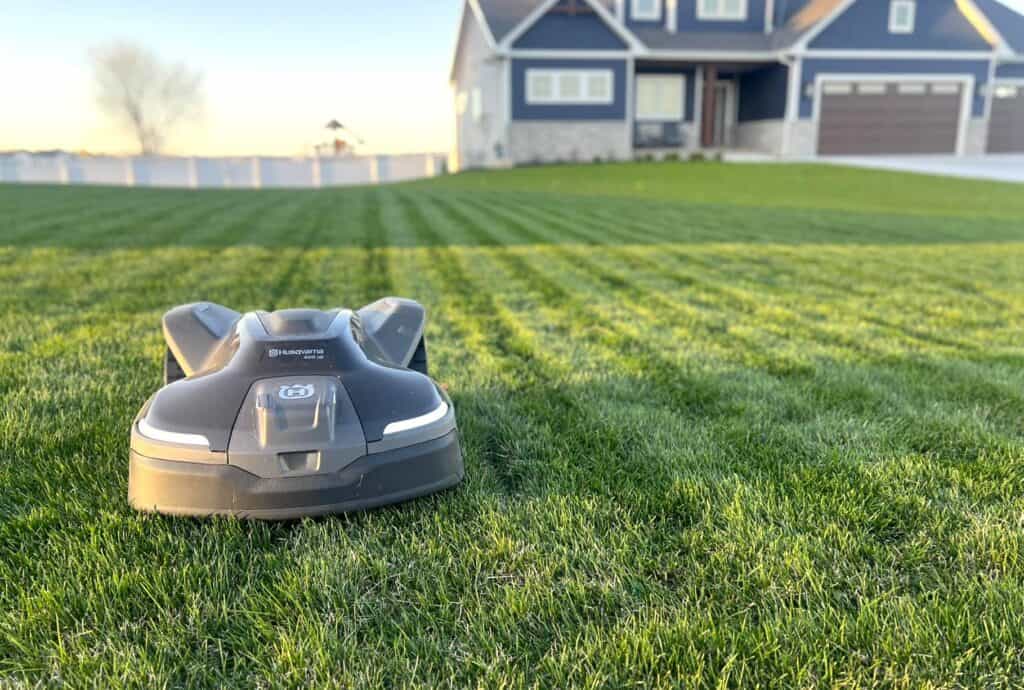
With the mowers being wireless, Cordier said it’s a less expensive and less invasive install because lawns don’t need to be dug up.
He said last year, Husqvarna unveiled a new residential wireless mower, with that being the company’s first real dive into wireless consumer products.
Compared to wireless residential mowers, Cordier said Husqvarna has been in the commercial market for “quite some time.”
“Husqvarna has the best dealer support and the best network support in the United States,” he said. “For us, we are just scratching the surface on the commercial side. I think there are a lot of applications [for commercial use], but Husqvarna’s most recent application is to address athletic fields, which is right up our alley.”
The domino effect
Cordier said he and Andrew have been working with the School District of West De Pere and area municipalities and hope to add more commercial clients.
He said residential users, school districts and municipalities are often hesitant to adopt new robotic mowing technology until others have proven its value.
“At times, nobody really wants to be the first to use new technology, but if it works, everyone wants to follow,” he said. “That’s what we’re seeing now – our growth is happening organically.”
Cordier said the district first installed robotic mowers at the WDP baseball field in fall 2024, then added two more for the soccer fields behind the high school, and expanded this year to the JV baseball and softball fields.
“The Howard-Suamico School District also dove into it after talking with West De Pere, so they are looking to potentially add more,” he said. “We’ve also had conversations with Neenah High School and the Pulaski and Peshtigo school districts. A fair number of school districts are really starting to show a lot of interest.”
Cordier said he expects more growth as school districts enter into their new fiscal years.
“Because fields being cut with our robotic mowers have a deeper root system, that also means they are more drought-resistant,” he said. “That’s good news for school districts and municipalities – they don’t have to rely so much on irrigation systems. It can save water, and ultimately, save money in the long run.”
Cordier said Total Outdoor Automation also conducted a pilot program with the City of De Pere.
“They’re expanding this spring to address some of their parks by using robotic mowers for their sports fields,” he said. “Because Andrew and I have full-time jobs and families, the organic growth we’re seeing is how we want to operate for now – slow growth over time.”
How it all began
Cordier said the LLC was officially formed in fall 2022, though it took time to determine the company’s direction.
He said he and his brother initially considered focusing on indoor automation.
“Our first LLC was called Total Home Automation,” he said. “That was our goal – total home automation – because there are so many options with indoor home automation, we weren’t sure that it was sustainable long-term. Then, we thought maybe we’d go into outdoor lighting.”
Cordier said it was around that time he began to realize how much of a pain cutting the grass was.
“I would come home from work to a yard that felt like it was always shin-high,” he laughed. “I knew at certain times of the year I’d have to cut it two or three times a week to make sure I didn’t have a hay field out there. Between my full-time job and having to always cut the grass, it seemed like I never had time for much else.”
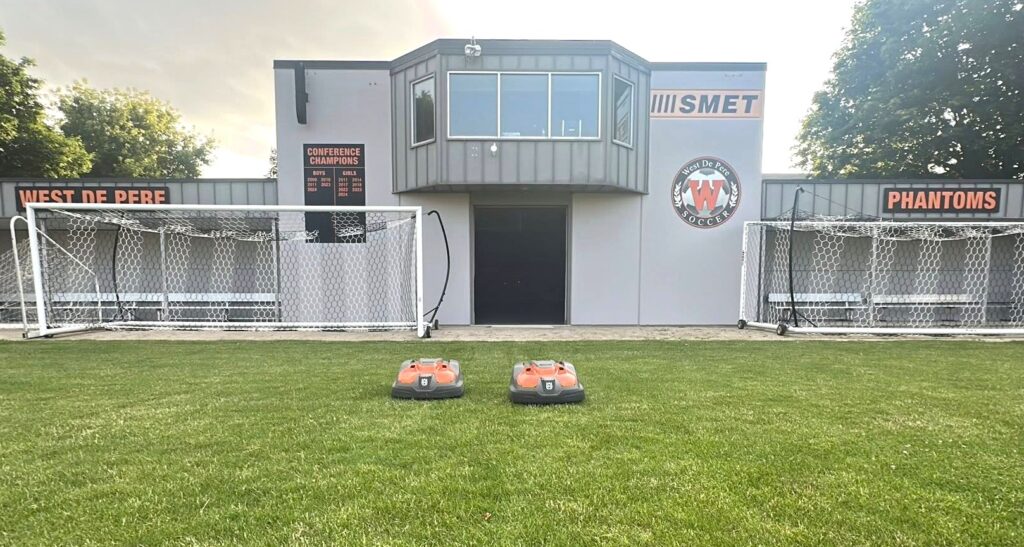
That’s when Cordier said he invested in a robotic mower for his personal use after a friend encouraged him to do so.
“I saw what a huge time saver it was,” he said. “After chatting with my brother about it, that’s when we decided to explore that route [for our business], so that’s when we applied for a DBA (doing business as) to our original LLC.”
Cordier said a DBA for an LLC is a registered name that the business uses to operate, which is different from its legal name.
He said it allows the LLC to conduct business under a name that may be more recognizable or marketable.
For more information on Total Outdoor Automation and its offerings, visit totaloutdoorautomation.com or find it on Facebook.
A baseball connection
Cordier said Total Outdoor Automation’s work on local sports fields ties back to his own sports background, from childhood through young adulthood and now into his professional life.
After graduating from Southern Door High School, Cordier – a right-handed relief pitcher – said the Kansas City Royals drafted him in the second round of the 2004 Major League Baseball draft.
“I passed on going to college right out of high school, instead going straight to the professional ranks,” he said. “I played in the minor leagues for 10 years before I got my first shot to play in the big leagues with the San Francisco Giants in 2014.”
In 2016, Cordier said he played a season in Japan before deciding to hang up his professional baseball cleats.
“Around that same time, one of my friends, Jason Berken, [a WDP graduate who pitched in the Majors with the Baltimore Orioles and the Chicago Cubs], had also decided to stop playing,” he said.
That connection, Cordier said, led to his current role as director of baseball operations at Impact Sports Academy (ISA) in De Pere.
“[When he stopped playing professional baseball], Jason was thinking about coming home and creating a baseball/softball academy, so that’s how I became a part of that,” he said.