Getting modern tools into the hands of today’s learners
 Where food tells a story and farmers are rock stars



August 10, 2026
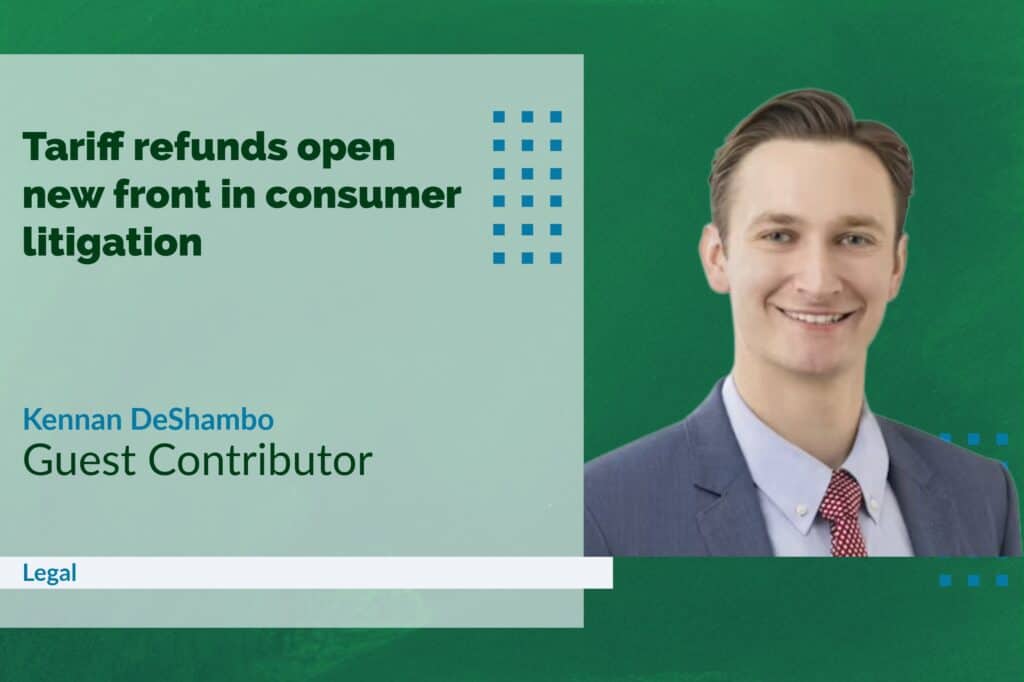
A tariff refund process intended to return money to importers has sparked a new legal battle over who ultimately benefits from those funds: businesses, consumers or both.
In February 2026, the U.S. Supreme Court invalidated President Donald Trump’s use of the International Emergency Economic Powers Act (IEEPA) to unilaterally impose tariffs in Learning Resources, Inc. v. Trump.
As a result, the Court of International Trade ordered refunds, and U.S. Customs and Border Protection (CBP) has implemented processes for importers to recover them.
This caused a barrage of class action lawsuits filed by plaintiffs’ firms – which allege, in essence, the companies passed tariff-related costs to the consumers and now are eligible to retain government refunds, which would constitute improper “double recovery.”
The ruling
In Learning Resources, Inc. v. Trump, the U.S. Supreme Court ruled that the IEEPA does not give the president unilateral authority to impose tariffs.
The court determined the power to impose tariffs falls within Congress’s taxing authority and IEEPA’s language that permits the president to “regulate… importation” lacked the clear statutory text needed to delegate that power to the executive.
Subsequently, the Court of International Trade entered a nationwide “Refund Order” requiring CBP to refund IEEPA duties to importers of record.
Although the order is currently on appeal before the Federal Circuit, CBP has implemented an administrative refund process aimed at issuing repayments to qualified importers.

Notably, only importers of record have a right to recover tariff payments from the government – downstream distributors, retailers and consumers are not entitled.
Consumer class actions, claims asserted
As a result of the decision, more than 100 putative class action lawsuits have been filed by plaintiffs’ firms in more than 30 federal districts.
At a high level, these lawsuits allege the companies will be unjustly enriched by retaining the tariff-related price increases charged to consumers and the ordered government refunds for the same tariffs.
Plaintiffs have asserted additional legal theories including breach of contract; breach of implied covenant of good faith and fair dealing; state consumer protection and unfair business practices statutes; false advertising; contract unconscionability; and breach of fiduciary duty.
Early defense landscape
Hoffert et al v. Nintendo of America Inc., which is pending in the Western District of Washington, offers helpful insight into how companies are defending these cases.
The complaint alleges causes of action for unjust enrichment, money had and money received, violation of the Washington Consumer Protection Act and declaratory relief.
In response, Nintendo has filed a motion to dismiss, attacking each claim on its face.
By way of example, plaintiffs allege that Nintendo raised prices of the Nintendo Switch 2 accessories by approximately $1-10 depending on the product, and consumers consequently bore the cost due to Nintendo’s “pass-through” of those tariffs to consumers.
Nintendo seeks dismissal of all claims by arguing, in pertinent part:
- Consumers received exactly what they bargained and paid for
- Plaintiffs failed to identify a single unlawful or fraudulent act
- Plaintiffs cannot establish substantial injury by alleging they paid a higher price due to tariffs
In a separate motion, Nintendo additionally defends against plaintiffs’ allegations by seeking to compel arbitration under the User Agreement and End User License Agreement consumers entered into.
Nintendo argues that consumers cannot purchase products from the manufacturer or access its services without contracting with Nintendo.
As such, Nintendo requests the court stay the lawsuit’s claims pending mandatory arbitration.
Likewise, Stockov v. Costco Wholesale Corp. is pending in the Northern District of Illinois and includes claims such as quasi-contract/unjust enrichment; money had and money received; and violation of state consumer fraud and unfair trade practices.
The plaintiff alleges that Costco sold products at prices “inflated by Costco’s pass-through of IEEPA tariff costs.”
It is further alleged that Costco’s publicly stated commitment to return any potential refund to members through “lower prices and better values” fails to adequately compensate members and fails to “make the class whole.”
Costco moved to dismiss, arguing:
- There is no cognizable injury because the plaintiff voluntarily paid the posted price and received what they bargained for
- Consumer protection laws do not prevent price increases and do not require refunds to consumers.
Notably, Costco’s motion to dismiss relies heavily on a ripeness defense.
Costco argues the plaintiff’s lawsuit is speculative and premature because it has not received any tariff refund, so the plaintiff’s injury thereby rests on a hypothetical scenario.
The courts have not ruled on the merits or success of these arguments.
Mitigating risk, actionable strategy
Companies that may be exposed to consumer litigation have been advised to consider the following practical defensive steps:
- Review consumer agreements – Review terms of sale, terms containing mandatory arbitration clauses, class action waivers, pricing adjustment mechanisms and choice-of-law provisions.
- Audit public messages – Review press releases, marketing materials, investor materials, earnings call transcripts and other consumer-facing communications that tied pricing to tariffs or referenced tariff-driven pricing increases.
- Exercise caution on premature commitments – Avoid public comment on how the refunds may be shared with customers until the refund process is resolved.
Going forward, exercise strict caution when discussing tariff refunds and pricing decisions in any public/consumer communications.