 FifthColor helping celebrate Special Olympics “champions” in 2026
 Making a Difference: NFL Fan of the Year Tom Grossi uses platform to give back


October 12, 2026
WAUPACA – The breathtaking views, the adrenaline, the freedom – Noah Lencki said there are many thrills to enjoy on the path to becoming a pilot.
For many, though, the necessary record-keeping and paperwork are not quite as thrilling.
However, with these compliance-based components being vital to flight instruction, Lencki – an instructor at/co-owner of Celestial Kinetics in Waupaca, first introduced to The Business News’ readers in its April 13, 2026 issue – said he sought to make these steps easier for instructors.
His solution – Maverick – launched last month.
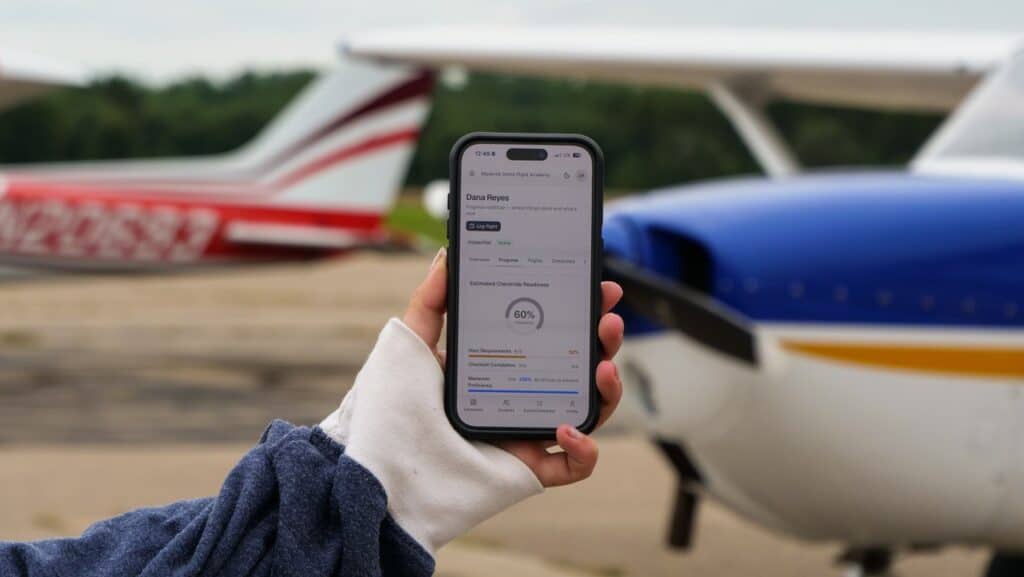
The software, Lencki said, gives small flight schools a single system to “stay audit-ready, track student progress against FAA requirements and record the weather every training flight was actually flown in.”
“Compliance and record-keeping are critical for flight schools and cannot be overlooked,” he said. “My intention with Maverick is to simplify that process for CFIs (certified flight instructors) and school administrators while providing robust tools to run the school, measure success and support student progress across the whole training organization.”
Compliance, convenience, capabilities
Lencki said he developed Maverick with his brother, Owen Lencki, under the company they founded, Genoa Labs.
Its target market, he said, is Part 61 flight schools, which are typically smaller and less rigid than their counterpart – Part 141 schools, such as Embry-Riddle Aeronautical University and the University of North Dakota – which typically have more infrastructure and resources for tracking students’ progress.
Lencki said the software’s capabilities include:
- Part 61 compliance tracking: Live progress against FAA regulatory minimums for each certificate track, so instructors can see exactly what remains before a student is eligible for a practical test.
- Student records and flight logging: Every flight in one place, with times, maneuvers, takeoffs, landings and regulation tags, structured to the certificate the student is pursuing.
- Digital endorsements: Issued from current AC 61-65K templates with instructor credentials auto-filled, and alerts before 90-day solo endorsements, medicals and knowledge-test windows lapse.
- Prospective student CRM: Inbound leads tracked from first inquiry through enrollment.
- Student accounts: Each student can view what’s left to accomplish, assigned lessons with study material and post-lesson debriefs from instructors.
- Record import: Transfer students onboard by importing flight history from CSV exports and logbook totals, with imported time flagged as prior experience and folded into Part 61 progress.
- Schools can also build custom checklists for onboarding and stage checks, upload custom syllabus lessons, collect anonymous safety reports (such as birds on the runway, or a malfunctioning taxiway light) and generate downloadable progress and compliance reports.
Maverick’s most distinctive feature, Lencki said, is its ability to record the weather conditions during each training flight.
Without such software, he said weather conditions were simply based upon instructors’ recollections from flights.
With Maverick, though, Lencki said every flight log automatically captures the official aviationweather.gov observation for the airport and hour of the lesson, including the crosswind component resolved against the runway used, at every airport on a cross-country route.
“[This ability] is something I haven’t seen before, and the people I’ve talked to haven’t seen before,” he said.
Across a student’s training experience, Lencki said Maverick builds a factual picture of the conditions they have experienced: the running averages, the strongest crosswind, the lowest ceiling, the most demanding day in each category, etc.
Another benefit, he said, regards the creation of “personal minimums” – highly recommended by the FAA prior to students’ first solo flights.
“They want to create these personal limitations on [students’] experience so far – what they’re comfortable flying with – so when they go out and do fly solo, everybody knows they’re not going to exceed what they’re capable of,” he said. “The beauty about Maverick is it integrates [personal minimums] and actually uses live data to be able to make that determination.”
In essence, he said he wishes he’d always had a tool like Maverick for his early years as an instructor at Celestial Kinetics.
Lencki said he was able to fine-tune the software at his flight school – which has now fully adopted its use – before offering it to the aviation world at large.
Previously available enterprise solutions for flight schools, he said, are typically cost-prohibitive for Part 61 schools.
Further, Lencki said those enterprise options aren’t nearly as customizable as Maverick, which he developed with an understanding of the relative uniqueness of Part 61 schools.
“These are mom-and-pop shops,” he said. “A lot of them provide really quite fantastic training, but the record keeping might be lacking a little bit; it might still be on paper spreadsheets or paper syllabi. So, that’s the issue we’re looking to solve.”
The making of Maverick
Lencki said his interest in aviation was piqued at nine years old, when he first began attending the EAA AirVenture convention in Oshkosh, as well as the EAA’s Young Eagles events.
“My grandpa would take me to those,” he said. “[I’d] get kind of a flight lesson out of it, take to the sky and just really fell in love with it from there.”
True flight lessons cannot begin until age 16, but Lencki said he became increasingly involved with aviation via EAA chapters and talking with pilots.
“I also jumped on the drone bandwagon around that time, as that technology was emerging, so that was kind of an interesting way to stay engaged with a facet of aviation,” he said. “Not exactly airplanes, but nonetheless, you’re having to deal with airspace and weather and things like that.”
Fortunately, Lencki said, the test for drone certification – Part 107 – “is very similar to a private pilot written test, so that kind of gave me the opportunity to study some pilot things.”
Lencki said his then-newly acquired drone hobby would lead to his first taste of entrepreneurship, as he began incorporating photography and quickly found demand for his services in the Waupaca area.
He said he founded his media company – Noah Lencki Design – in 2016, and has since gained clientele across the state and country, from local real estate brokers to national, Fortune 500 companies.
“Aviation was always still my passion, but the media company helped provide a little bit of a springboard from a connection standpoint [and] from a financial standpoint, to be able to roll into that flight training,” he said.

In May 2019, as a junior in high school, Lencki said he was finally able to start his flight training in earnest, beginning what would be about a year of aviation education at the Waupaca Municipal Airport.
“I earned my private pilot certificate in May of 2020,” he said. “Interestingly enough, it was actually the same day I graduated high school.”
Lencki said he then enrolled at Fox Valley Technical College (FVTC) to earn the remainder of his pilot licenses.
In 2022, about nine months before graduating from FVTC, he said he met Kent Sykes, principal owner of Celestial Kinetics, the flight school he had only just founded.
Once he earned his initial flight instructor certificate, Lencki said he began working with Sykes.
“Kent was flying charter at the time, so he was kind of in and out a little bit, so it was really kind of up to me to help get the school off its feet, help get it going and operating to what it is today,” he said.
In the years that followed, Lencki said he not only became the school’s chief flight instructor, but his administrative experience – “getting all the documentation, all the policies, all the procedures into place” – also led to him becoming a part owner of the organization.
With his entrepreneurial background, he said he couldn’t help but think about ways to improve the school’s processes for instructors and students alike.
Fortuitously, Lencki said, this was around the time Owen had begun to learn software development.
“That’s kind of where Maverick was born, as it’s really my vision, and then my younger brother had the ability to be able to execute and bring the platform [to life],” he said. “We spent the next seven to eight months really working on the tool, honing the product, working all the logic into it.”
Lencki said he started using a “demo” version of the software earlier this year, with Owen helping him modify, improve and add to it throughout the process.
“Then, in about the middle of July or so, we started doing beta testing with it at Celestial with instructors, and getting their feedback on it and seeing how we can implement it into what we do,” he said. “So far, it’s been very successful.”
Ready for takeoff
As of last month’s official launch, Lencki said he’s begun discussing Maverick with Part 61 schools across the country.
The software is available at $49 per month for a single airplane – with additional aircraft at $15 per month each – for unlimited students and instructors, with every feature included at every fleet size.
Lencki said these fees also include his “white glove support,” as he’s eager to help flight schools make the most of Maverick.
“Part of my goal as well is to help with the implementation of some of these schools, help with some data migration, help get the school off on the right foot with utilizing the software to its fullest capability,” he said.
Early responses, Lencki said, have reciprocated his enthusiasm.
As a “holistic solution,” he said Maverick can ultimately be a benefit to the aviation industry itself, which continues to work through pilot shortages.
“I’m really excited to see this tool be put into work and really help the training and aviation industry,” he said.
As an instructor himself, though, Lencki said what may be most exciting is knowing what Maverick can do for other instructors and independent schools.
“You’ll find that, sure, a lot of the instructors are passionate about flying – but they may not be as passionate about some of the office work, the administrative work, the record-keeping side of things,” he said. “Maverick is a way they’re able to simplify that process, make everything a little bit easier to be able to give instructors more time to do what they truly love – and that’s flying.”
Soar over to maverickfs.app for more information.