 NE Wisconsin gets first dual-branded ARCpoint Labs, Any Lab Test Now
 Talent, businesses join Croux for new staffing solutions


October 12, 2026
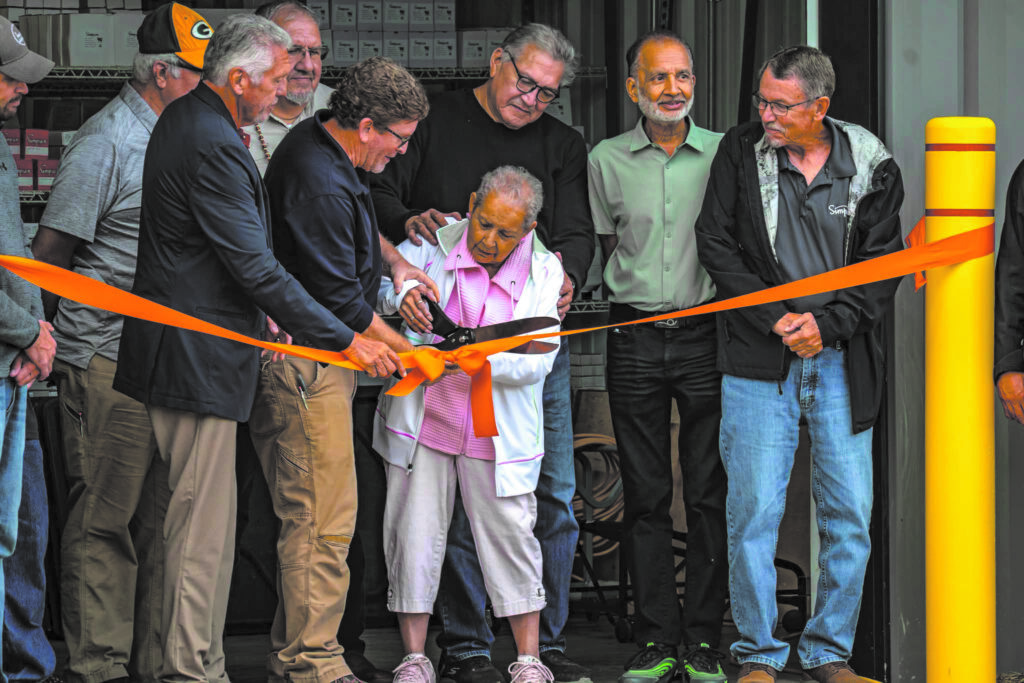
LAC DU FLAMBEAU – Simpson Electric Company, Inc. – a long-standing business in the Lac du Flambeau community – recently opened a new, 20,000-square-foot manufacturing facility.
Founded in 1936, Simpson has manufactured electronic meters and other electrical accessories in Lac du Flambeau since 1950.
Kevin Deckard, Simpson’s general manager, said several factors led to building a new facility, with improved efficiency being a top priority.
“We had two separate manufacturing facilities: we had our plastics facility and then our main plant,” he said. “In the plastics facility, we did injection and compression molding and some painting of parts. Because we had two buildings, we’d run a van back and forth all day bringing the parts to the main building for assembly.”
Additionally, Deckard said there was a lot of wasted space and excess equipment in the buildings.
“Over time, we’ve downsized a bit, but we never threw anything out,” he said. “It was a cluttered work environment and not laid out well. The [molding] building was originally an old schoolhouse built in 1932 and added onto over the years. It didn’t facilitate good flow of product.”
With a background in Lean manufacturing, Deckard said he came aboard Simpson when the new building was in the design phase.
“Based on where the building was at that point, we were able to put in place some of those [Lean] principles with layout and design of the new building,” he said. “Both buildings are now co-located in one building, so that will help tremendously with efficiency and productivity and being able to flow product properly. We were very inhibited before with the layout of the two buildings.”
According to Deckard, Lean manufacturing is a management system built on three principles: produce only what is needed, when it is needed; correct abnormalities as soon as they occur; and empower workers to improve the process themselves.

At its core, Lean eliminates activities that do not add value for the customer.
With Simpson settled into the new manufacturing space about two miles away from the original two buildings, Larry Turner – CEO of the Lac du Flambeau Business Development Corporation (BDC) – said the old plastics facility “was kind of scary to walk through,” with portions of that building dating back to the early 1900s or earlier.
“If you could imagine a building you could use to shoot a horror film, it would be that building,” he laughed. “The plastics building originally created [the need for] a grant for the new building, then the BDC supplemented those funds. That allowed us to put all operations under one roof instead of having a separate molding building.”
Besides added efficiency and production, Turner said housing all operations under one roof has other added benefits.
“There is also better camaraderie and motivation from a morale standpoint,” he said.
Turner said the $2.4-million grant, combined with the BDC dollars, made the 20,000-square-foot facility possible.
“I believe the grant was awarded about three and a half years ago, but talks of a new building go back even a couple of years before that,” he said. “A lot of work went into getting the grant. Our planning department is good at pulling these sorts of things together.”
Future growth?
Despite only recently moving into its new building along Thoroughfare Road just outside of downtown, Deckard said it’s never too early to think about future expansion/growth.
“On one end of the building, the walls were designed differently, so it’s basically a knockout building,” he said. “If we ever wanted to add on, it would be an easy thing to knock the one wall out and build on.”
To grow even more, Deckard said the company developed a full business plan on how future growth will come about.
With a lot of older legacy products, he said Simpson must develop new products and innovate.
“Our past is amazing, but we can’t just rely on our past and what we’ve done,” Deckard said. “Moving more into Lean manufacturing, upgrading the facilities and achieving ISO 9001 certification by December of this year are all things helping.”
According to Deckard, ISO 9001 is the world’s most widely used quality management system (QMS) standard, applicable to any organization regardless of size or industry.
He said certification confirms that a QMS consistently meets customer requirements, regulatory obligations and follows a process‑based, continual‑improvement approach.
The certification, Deckard said, will open new doors for Simpson.
“I think it’s going to take a little bit of time to grow and innovate more…, [as] it’s usually a good two-year process to get a new product developed,” he said. “We plan to grow, but we first have to innovate to get there.”
The future of the two buildings Simpson once occupied, Turner said, is too early to determine.
“We’re still working on that with the tribe,” he said. “I can’t say for sure, but I believe the plastics molding facility could be a teardown. As we mentioned, it’s in really rough shape. With the other facility, we’re considering some other business in there.”
Though the old main building perhaps could house another business, Turner said it will still take substantial investment to bring it to fruition.
“Potentially, maybe it could be a hardware store, etc.,” he said. “It’s situated perfectly, adjacent to our market grocery store, so it’s right downtown. It would make a lot of sense to do something from a retail point in that space, but that’s still all being evaluated.”
Lac du Flambeau BDC
Turner said the Lac du Flambeau BDC has roughly 16 businesses it has built – or has acquired – with Simpson Electric being one.
He said other examples include a market, a bar/restaurant, a radio station and a CBD dispensary.
“We’re setting up a CBD-cultivation facility,” he said. “We’ve got plants in the ground right now. We’ve also got the only Native American-owned Popeyes franchise, just off the reservation [in Minocqua].”
Turner said the BDC’s role is to put a minimum of 40% of its profits back to the tribe in their general fund.
Over the last three years, he said, the BDC has averaged closer to 75-80% of that number.
“The other part of our direction, from a bylaw standpoint, is to grow jobs for the community and for the tribe,” he said. “When I got here two years ago, we had 105 employees. Today, we have 285. We went from 51% tribal members to about 58% tribal members of our population. We’ve almost tripled the size of our employee base, and at the same time, increased the participation of tribal members.”
Turner said of the 16 businesses under BDC’s arm, 10 of those are new in the last 18-20 months.
“The other six were already here when I came aboard,” he said. “The growth is impressive.”
More on Simpson
Making a variety of different analog and digital products for the electronics industry, Deckard said Simpson is known for its “260 meter,” which is a volt-amperage meter that put Simpson on the map decades ago.
“We’re now on version nine of that 260 meter,” he said. “There are niche industries that continue to utilize that, so we still manufacture it here. Our meters are used in the well-drilling, transportation, railroad, aeronautics, mining industries, etc.”
Deckard said the meters are built robustly and built to last.
“It’s not going to be your typical plastic-type thing you find at [a big-box retailer],” he said. “These meters take a lot of abuse, but are built to last.”
In industries that require precise measurements, Deckard said companies want something “ironclad,” where they can see the small movements.
“They want to see small blips on a moving pointer, rather than having something digital that jumps around,” he said.
Company history
According to the company’s website (simpsonelectric.com), Simpson Electric’s prominence in the panel and test instrument industry dates back to 1927 when its founder, Ray Simpson, built the indicating mechanism for the earth inductor compass that Charles Lindbergh relied upon when he flew The Spirit of St. Louis on the first solo flight across the Atlantic Ocean.
For 33 hours, Lindbergh’s life and the success of his flight depended largely on this navigational instrument, while the world awaited his arrival in Paris.
According to the website, Simpson also manufactured the first compact “all-purpose” volt-ohm-milliammeter – the “260” – that thousands of military personnel used during World War II.
In 1946, Simpson purchased the old school in Lac du Flambeau and converted it into the company’s molding plant.
The 1960s saw Simpson contribute to the American space program by developing a special two-movement, cross-pointer instrument for the Apollo missions.
In all, 14 different types of “the NASA meter,” as they became known in Simpson plants, were built during the Apollo program.
The makers of the “Apollo 13” film, released in the summer of 1995, needed to replicate control rooms and training facility locations with historical accuracy, so they contacted Simpson and obtained permission to use its products.
Per the website, some controllers were shown in a panel, and an ammeter – whose readings were critical for the safe return of the Apollo 13 crew – was displayed in close-up.
In 1985, Deckard said Simpson Electric was purchased by the Lac du Flambeau Band of Lake Superior Chippewa Indians.
Today, he said Simpson has 48 employees, many of whom have been with the company for decades.
“At Simpson, we’ve had 258 employees who have worked 25 years or more,” he said. “We have Hall of Fame plaques displayed for our long-tenured employees. We just had someone retire with 62 years, and our current longest-tenured employee is 52 years.”