FVTC brings paramedic training to its surrounding communities
 Seeing is believing for one area doctor


August 24, 2026
APPLETON – Fox Valley Technical College’s (FVTC) Aircraft Rescue and Firefighting (ARFF) program is drawing international interest.
To help showcase the growing global demand for its ARFF training exercises, the college’s facility at Appleton International Airport (ATW) recently hosted a group of firefighters from Costa Rica.
Ben Sokol, FVTC’s lead ARFF instructor, said the Central American firefighters were in Appleton completing specialized airport emergency response training at FVTC’s ATW ARFF Training Center.
“The Costa Rican firefighters participated in ARFF training led by Spanish-speaking FVTC instructors, allowing students to receive instruction directly in their native language,” he said. “The partnership reflects the growing international reach of FVTC’s ARFF program.”
Sokol said the Costa Rican fire chief has expressed interest in bringing firefighters back to FVTC for additional training.
“They were all full-time firefighters in Costa Rica,” he said. “They don’t have a training center in their country and always have to travel.”
Sokol said the firefighters came to the area to inspect and demonstrate new ARFF vehicles purchased from Oshkosh Corp.
Because the manufacturer is only about 30 minutes from Appleton International Airport, he said they also took the opportunity to train at FVTC.
“A prior group from Jamaica started all of this a few years ago,” he said. “They were looking for a new training center – something new and different. We sat down with them and went through what we could build for them. Since then, they’ve been sending two or three groups a year for the last three years.”

Sokol said these trainings reflect the growing global demand for specialized airport firefighting expertise.
As aircraft technology, airport operations and emergency response requirements continue to evolve, Sokol said firefighters from around the world are seeking advanced ARFF training to prepare for increasingly complex aviation emergencies.
“We try to give as much hands-on experience as we can to make sure they can do the things we’re teaching,” he said. “We need to verify their skills before they go back home and say ‘I’m a trained firefighter.’ We’ve now become a really viable option for international groups.”
Various props used
Opening in 2020, Sokol said the ATW ARFF Training Center has served as a premier destination for airport firefighting training.
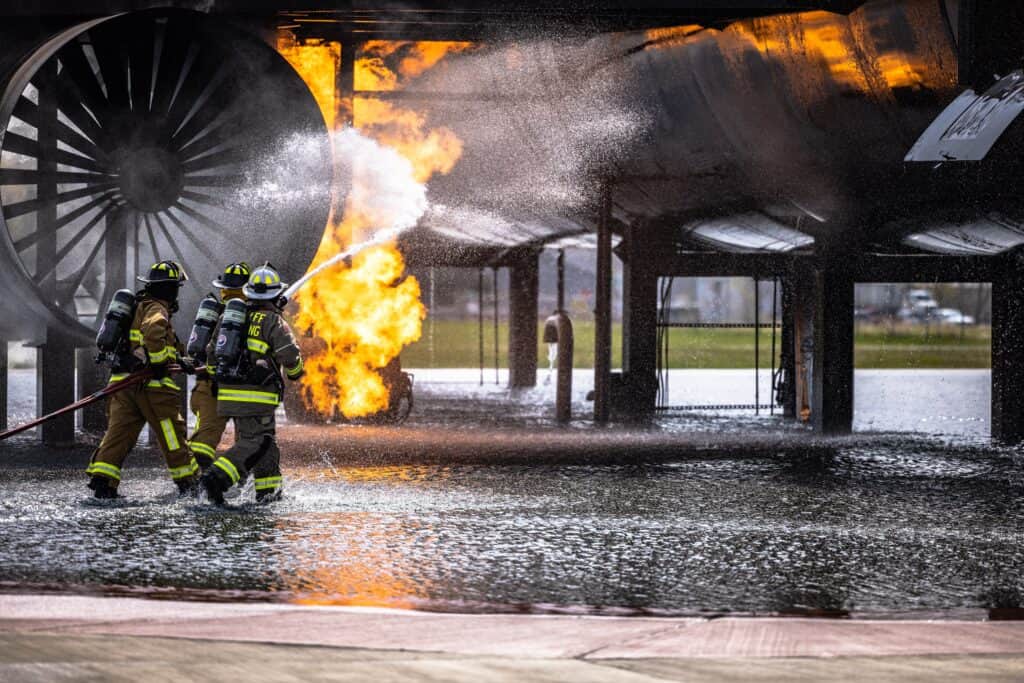
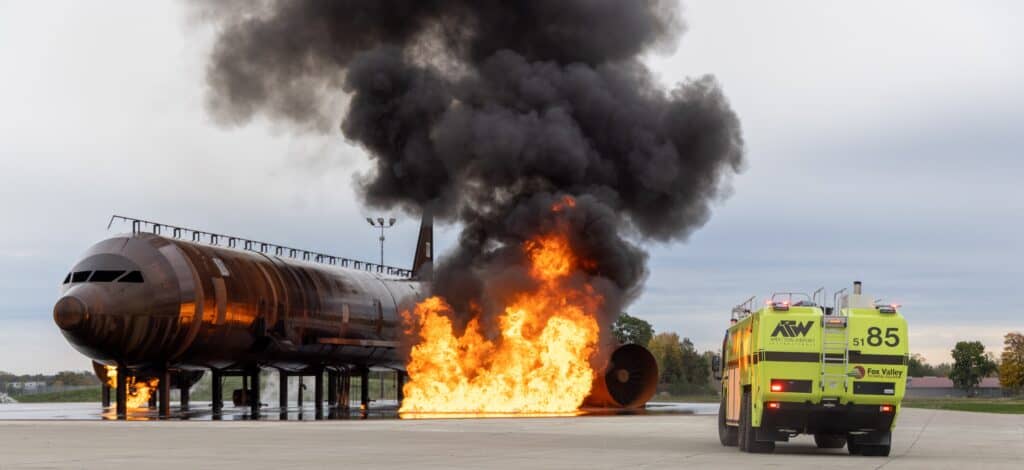
Situated on 25 acres adjacent to ATW, he said the facility features a one-of-a-kind Boeing 777 Specialized Aircraft Fire Trainer and the industry’s largest spill-fire area with 96 individually controlled fire zones.
“The props are designed for realistic emergency aircraft fire and rescue response with multiple scenarios to teach respondents the proper approach and attack techniques,” he said. “The aircraft itself has five different exterior fires we can light: three different engine fires, a wheel fire and cargo fires. There are also a dozen different fires we can light on the interior.”
Sokol said the props used are structured to withstand the intense heat.
“We have sprinklers built into the system, so when we light these large fires, it cascades water down to keep the steel cool,” he said. “To have a steel that resists the heat, it doesn’t bend as badly. We have policies we’ve written on how we light the fires and where we light the fires, depending on wind direction and the ambient temperature.”
Despite using the simulator planes for “years upon years,” Sokol said the structural life of the aircraft could last 50-100 years.
“Components have to be swapped out periodically, but the simulator itself – if you maintain it – can actually last for the lifetime of the program,” he said.
Just north of the Boeing 777, Sokol said the training center also uses a Cessna Skyhawk as a training prop.
“We call that one the ‘baby plane,’” he laughed. “It’s for dealing with smaller fires. General aviation aircraft have fires, too. They have different tactics when you’re dealing with those because they’re constructed differently and react differently to fires and crashes. The Cessna is used as a starting point for a lot of the firefighters who are newer to this.”
Once the proper training is completed on the Cessna, Sokol said that’s when participants can move on to the “777.”
“With the Cessna, it has a wheel fire, an engine fire and then the cabin can be set on fire,” he said. “It works really well, especially for the newer students who are coming through to get that training.”
Soon, Sokol said the center also plans to roll out a mobile assessment for training purposes.
“We just had it built,” he said. “We could use it at our training center or also put it on a trailer for onsite training with airports and municipal fire departments.”
More on the program
As part of his duties, Sokol said his job entails running the ARFF portion of the program, running the training center, setting up the classes, interfacing with all the different fire departments they work with and determining what level of training is needed and how to deliver it.
He said there are different levels of training offered through FVTC’s ATW ARFF Training Center.
“With the Federal Aviation Administration, it’s required for airport firefighters to be trained in various topics and have worked on a live fire in a simulated situation on the size of aircraft they would have to respond to – at a minimum,” he said. “Some students who come through and are just getting the training, we give them our own certification stating they met all the federal requirements to be an airport firefighter. They’ve completed all the skills, and they’re properly trained to do that job.”
Sokol said students who are already trained firefighters and have International Fire Service Accreditation Congress or Pro Board firefighter certifications can receive an airport firefighter certification or a driver-operator certification through the State of Wisconsin.
“There are prerequisites for that,” he said. “So, to be an airport firefighter, you don’t necessarily have to be certified like a traditional firefighter, but there is a certification process. We have to certify they completed the required training. Every year they continue to be an airport firefighter, they essentially have to retrain in those same topics and skills.”
Sokol said the ATW ARFF Training Center is accredited by the International Fire Service Accreditation Congress, ensuring its certification programs have been reviewed by fire service professionals and meet national and international standards.
“The center has welcomed firefighters from countries including Egypt, Canada, Jamaica, Suriname, Aruba and now Costa Rica,” he said. “During the 2025 training season, ARFF trained 168 students from 11 states and four countries.”
Demand growing
The timing was less than ideal when FVTC launched its ARFF program in 2020, Sokol said, as the COVID-19 pandemic disrupted travel and limited the program’s early reach.
“The first few months we were open, travel was really within our region – within Wisconsin and our neighboring states that knew who we were because the college and the airport had done a really good job of letting people know we were opening,” he said. “Once things started opening up in 2021-22, we started attending some of the national airport firefighting conferences and got to know a lot more people. Word has spread.”
Though the program has experienced significant growth over the past six years, Sokol said Wisconsin winters limit the number of students and firefighters it can train each year.
He said the Boeing 777 simulator cannot be operated during colder months, limiting the training season to roughly April through October.
“We have room to fit in more classes,” Sokol said. “We’re looking at new offerings for the future and during the down season over the winter. Maybe those classes won’t be centered around live fire, but they’ll be more about tactics and strategies – some of the classroom things we need to do are search and rescue. We’re looking at expanding this to being a year-round program.”
Five years from now, Sokol said he expects the core training offered at the center to remain much the same.
However, he said he does expect the demand for that training to continue growing.
“Especially over the last few years, a lot of departments are simply looking for additional training,” he said. “A lot of departments have to try to do it themselves, but they don’t have the capacity or the funding to do so. They’re looking for someone to put up something new and exciting for them.”
Sokol said the training center also developed an emergency vehicle operations and high-reach extendable turret course for a specific department within the past two years.
Word of the specialized course, he said, quickly spread.
“We’ve offered it to three or four other departments and are now putting it up as a standalone class,” he said. “We run that class two or three times a year. A lot of the advanced training in firefighting focuses around structural firefighting in the stuff we normally do in municipal fire departments. In the aircraft world, we’ve always had to reapply that to our environment.”
Not all of the center’s training, Sokol said, is geared toward firefighters.
Airport personnel, he said, may also receive training based on an A-to-E index that corresponds with the length of aircraft operating at the airport.
Sokol said at many smaller airports, employees have to “wear many hats.”
“With an Index A airport – the smaller airports – sometimes the aircraft rescue firefighting duties are actually assigned as a secondary duty for someone else on the airport staff,” he said.
For example, Sokol said an operations officer may spend most of the day performing their regular duties but must transition into an airport firefighter role when an aircraft lands or departs.
“They have to be in their truck and ready to act,” he said. “Coming from a firefighting background, I wasn’t truly aware that untrained people were going into this job role. We’ve tailored the training to make sure everyone who comes through is ready if called upon. If something happens, they have to be able to respond. It’s my responsibility to make sure they can do that.”