 New office, cohort for Appleton’s start-up ecosystem
 Bergstrom repeats as Automotive News’ No. 1 workplace



September 7, 2026
WISCONSIN – Aiming to keep higher education affordable and accessible, the Universities of Wisconsin recently announced its purist for state funding to support a new work-and-learn initiative, as well as a four-year tuition freeze.
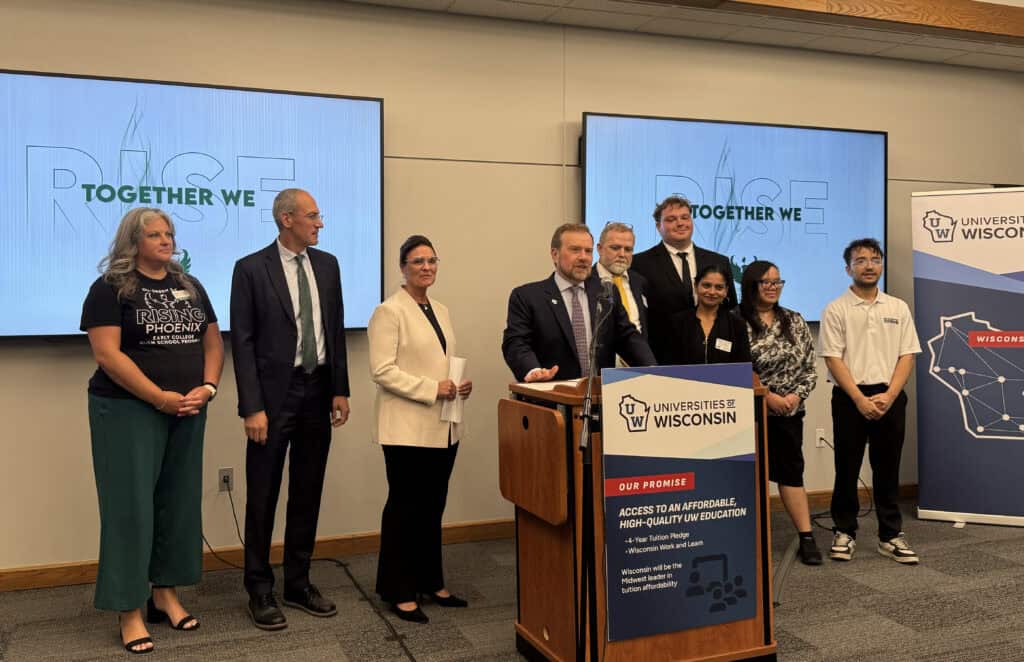
“Over the past six years, I’ve had the privilege of seeing firsthand how our universities change lives, strengthen communities and prepare Wisconsin’s workforce for the future,” Kyle Weatherly, president of the UW Board of Regents, said at a recent press conference hosted by the University of Wisconsin-Green Bay (UWGB).
Describing the announcement as the “centerpiece” of its 2027-29 budget proposal – recently approved by the regents – Weatherly said the Universities of Wisconsin is committed to making “high-quality education” affordable for families across the state.
“As part of that commitment, the Board of Regents is proposing a new four-year tuition pledge,” he said. “Under this pledge, tuition would remain frozen for two academic years, beginning in fall of ’27, provided that the state invests $190 million to support the cost of the freeze and other operational needs that preserve educational quality.”
Universities of Wisconsin President Renée Wachter was on hand to describe how – in addition to the tuition freeze – the new work and learn program aims to further support local students in their pursuit of higher education.
“We’re highlighting our signature affordability promise, ensuring that every Wisconsinite has access to a high-quality, affordable Universities of Wisconsin education,” she said. “The four-year tuition pledge is an important part of that commitment, but the second part is a new initiative called Wisconsin Work and Learn.”
With an additional $50 million investment, Wachter said Wisconsin Work and Learn would “eliminate tuition” for Wisconsin students whose families earn “at or below the state’s median household income” in exchange for their commitment to engage with local employers – be that “internships, apprenticeships or career preparation.”
“Students would gain a more affordable path to a degree, while Wisconsin gains the workforce our future depends on,” she said. “By combining last-dollar financial aid with career-connected learning, the program helps ensure the cost is not a barrier to opportunity while strengthening Wisconsin’s economy and workforce.”
Committed to lowering costs

Chancellor Mike Alexander, who attended the Aug. 5 announcement at Union Hall, said accessibility has long been a priority at UWGB.
“We’re completely supportive of what the Universities of Wisconsin is trying to do across the state to make the ability for students to have access to education,” he said. “Affordability actually creates access, so we’re really proud here to have been the first university to start direct admission… and now, direct admissions is across the state, after the model we set.”
However, Alexander said admission “is only as good as the ability to afford that opportunity” – emphasizing the need to ensure higher education remains affordable.
“As President Wachter mentioned, the affordability piece has a huge impact on our workforce,” he said. “So, as the Universities continue to think about how we are producing students who are able to be productive in the workforce, the ability to afford an education gets them into the workforce faster and helps to make sure they’re in fields that are going to help advance their lives and the economies of our regions.”
But University of Wisconsin-Oshkosh (UWO) Student Government President Matthew King said tuition isn’t the only financial hurdle students are facing.
At UWO, King said “food insecurity is on the rise” amid its student population – marking potentially chronic financial strain throughout campus.
“As president, I focus on… affordability for our students,” he said. “We have what’s called the UWO Go program, which is a free taxi service [to provide] our students… safe, dependable and affordable transportation around the City of Oshkosh.”
Other initiatives King shared include the UWO student-funded food pantry and an upcoming thrift store project to create more immediate access to basic needs on campus.
“This is the perfect way of having students get together as a community [to] provide some of those needs… [and], just in general, support,” he said.
UWO Provost Joshua Garrison – who was also in attendance at the announcement – said the university supports the Universities’ request, emphasizing that “affordability is incredibly important.”
“We at Oshkosh feel pleased our tuition remains in the lower quartile nationally,” he said. “On campus, we’ve been committed… to lowering costs in a variety of ways, including a commitment to open educational resources, where we’re hoping to drive down textbook prices for students. We [also] employ students in a variety of internships and cooperatives, [which] is significant and important work for us.”
However, as Weatherly previously mentioned, the new affordability proposals will not come to fruition without the state government’s support.
“These are, I think, incredible opportunities for every Wisconsinite and for the entire state, but absent funding, they won’t exist,” he said.
Addressing major issues
As the Universities of Wisconsin work to lower the financial barrier to higher education, Weatherly said the system also recognizes its evolving role in workforce development.
“One of the key things we want to accomplish is to upskill one million Wisconsinites over the next 10 years,” he said. “Giving every Wisconsinite the opportunity to upskill and go wherever they want… is something we are very much focused on. We want to meet people wherever they are in their life and try to add value.”
At UWGB, Alexander said the average student age is 25 – exemplifying that, especially on the Green Bay campus, learners of every age are welcome to enroll in the Universities of Wisconsin system.
“Someone who already has a job… can continue to advance their career by being able to have an affordable education,” he said.
Other demographics Alexander said UWGB supports include first-generation college students and veterans returning to civilian life.
“More than 52% [of students] here in Green Bay are first-generation college [students],” he said. “A student [can] feel confident to enter the higher education realm, knowing they’re going to be able to leave without it being a financial burden on them when they begin their career. The same is true for veterans, [and] we’re really proud to serve veterans here…, [making] sure we thank them for their service.”
These examples, Weatherly said, support the idea that when Wisconsin invests in its higher education system, the system invests back into its communities.
“A recent study put out by UW-Madison says that for every dollar Wisconsin taxpayers invest in the Universities of Wisconsin, there’s a 20-times return,” he said. “We are an incredible investment for Wisconsin taxpayers.”
Though Wisconsin Work and Learn, the four-year tuition freeze and other requests approved in the Regents 2027-29 budget proposal – including an additional $330 million to further support workforce training infrastructure – hinge on state funding, Watcher said the Universities of Wisconsin are confident in the value they could provide students and families across the Badger State.
“In developing these promises, we spent a lot of time talking to our stakeholders, talking to our communities, and the things that really emerged were issues with healthcare access, people worried about the economy and jobs and then affordability, I think, is on everybody’s minds these days,” she said “So, these proposals were specifically the promises were developed to address those major issues.”
For more on the UW Board of Regents budget proposal, visit wisconsin.edu.