 Ashwaubenon Bowling Alley installs Neoverse LED video wall
 World Snowshoe Championships coming to Ariens Nordic Center in Brillion



November 16, 2026
FOND DU LAC – SSM Health has modernized the arrival experience for patients at its Fond du Lac Regional Clinic at 420 E. Division St., transitioning from traditional registration cubicles to a concierge-led model featuring self-service kiosks.
The redesign, rolled out on Oct. 19, aims to provide patients with welcoming staff, consistent service, enhanced privacy, and multiple registration options.
While the clinic and hospital entrances remain separate, they are connected internally.
Kim Huffman, Regional Director-Revenue Cycle for Patient Access Services at SSM Health in Wisconsin, said the primary driver for the redesign was to resolve the dramatic aesthetic and functional disparity between the modern hospital entrance and the outdated clinic entrance.
“Just within the building, there was a dramatic difference between the hospital entrance – which is beautiful, modern, and welcoming – and the clinic entrance, which was really outdated and did not facilitate a great arrival experience,” she said. “[It] actually led to people queuing up in long lines, depending on the time of day.”
What clinic patients can now expect
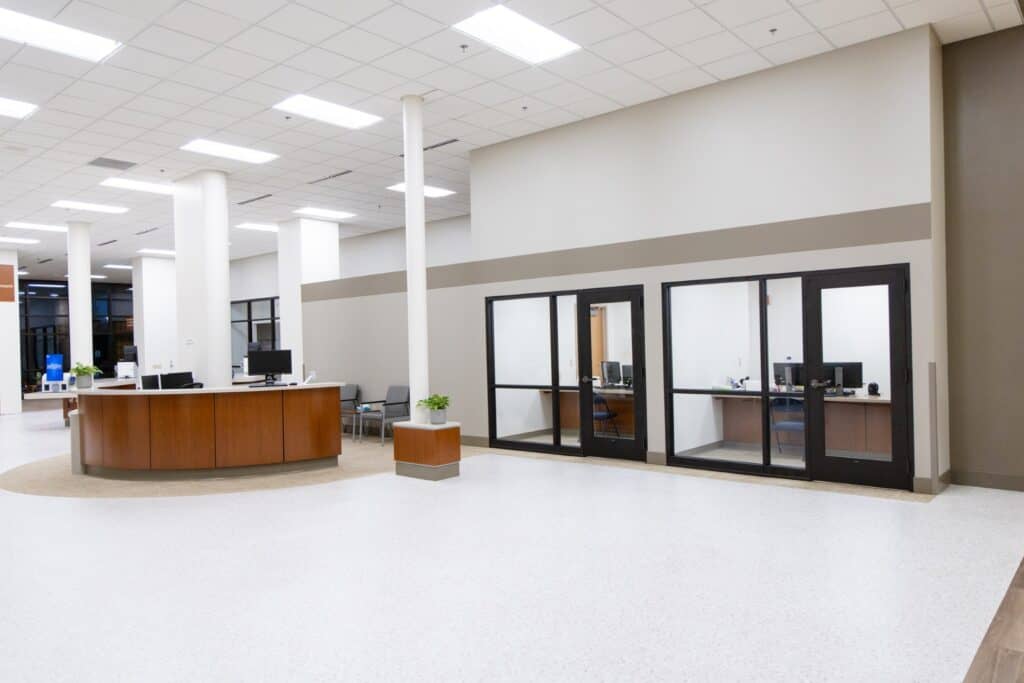
Besides what Huffman described as a warm and inviting lobby area, SSM Health’s Fond du Lac clinic now offers a concierge-type model where staff greets patients at the door rather than waiting behind a desk.
Staff are also present to facilitate patient check-ins, direct them to specific departments, and offer technical support where it may be needed.
Huffman said billing visibility is another area in which improvements have been made.

For example, she said while financial counseling and billing offices were previously located well within the confines of the building, they are now glass-fronted and prominently located in the clinic lobby to assist patients with billing questions and payment options in person.
“We have two employees who sit there now who can offer in-person billing support for patients,” Huffman said. “Not just patients who are coming in for care that day, but patients who have maybe received care in the past and have a bill they don’t quite understand, or want to ask us about payment options.”
She further remarked that by placing kiosks and financial counselors front and center, they aim to reduce wait times and remove barriers to navigating what can be, for some people, complex healthcare billing.
“Healthcare billing is complicated, and we had that service available with the old [design], but the individuals who provided that service were kind of buried within the building where people had to go down a long hallway to find them,” Huffman said. “We wanted to put it kind of front and center for our patients in the redesigned lobby space.”
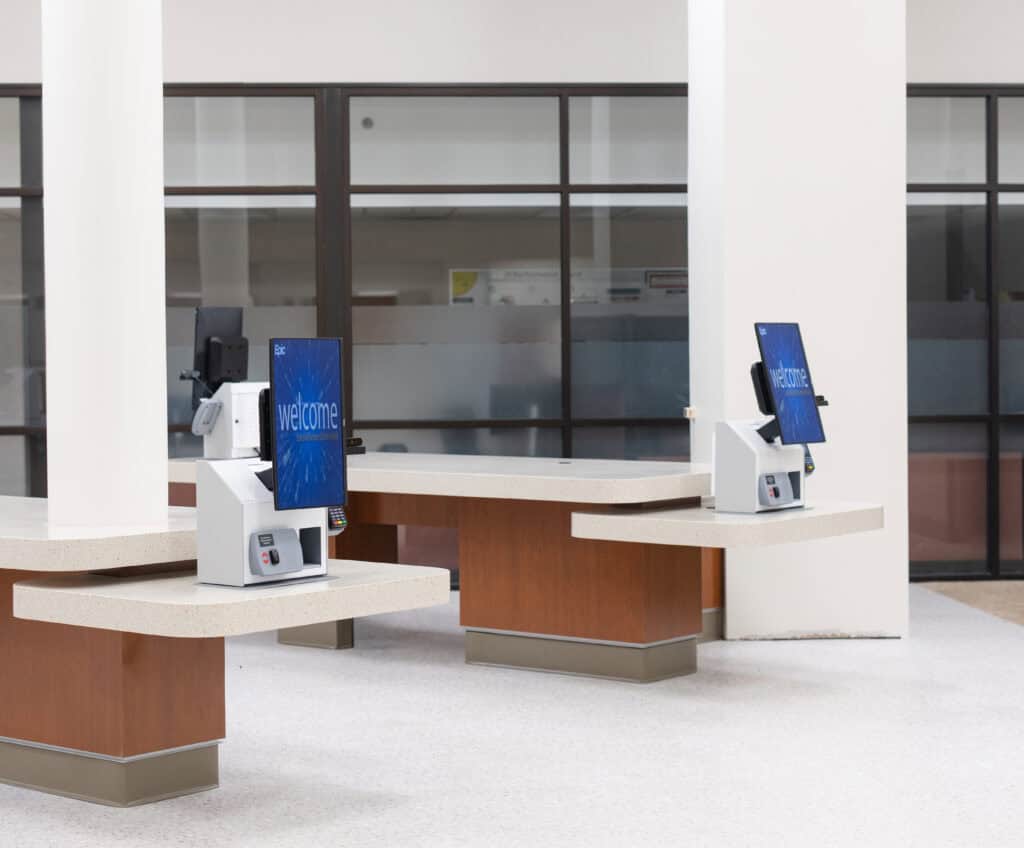
Patients coming to the clinic for office visits, tests, hospital outpatient services, or some other reason are now able to check themselves in at one of several self-registration kiosks in the lobby.
“My experience is that kiosks are more successful if they are human-facilitated,” Huffman said. “We have staff who can help patients navigate the kiosk until they build a comfort level with doing it themselves. If someone doesn’t want to interact with a machine by self-registering, we can either help them each time they come in, or we can do a completely people-powered registration – the way we used to do before we had the kiosks. So, our patients definitely have options.”
She said the kiosks are intended to provide a quick and seamless check-in experience, while reducing wait times and congestion, improving patient flow, and simplifying the clinic registration process, while preserving personal support for those who prefer or need assistance.
“The kiosks are programmed to facilitate an English-language self-registration, or a Spanish-language self-registration,” Huffman said. “If the patient needs language assistance beyond that, they would go to one of our patient access reps, and we have technology that can support registration conversations in many, many languages.”
Two of the kiosks are designed specifically to accommodate patients in wheelchairs, she noted, and all devices at the self-registration kiosks are equipped with privacy screens and automated timeouts.
This shift, Huffman said, reduces the need for patients to verbally state personal, potentially sensitive information in a public setting.
“When you’re interacting with the kiosk, you control all of that information yourself; you enter it, nobody’s hearing you state your name and date of birth, nobody’s hearing you mention why you’re there – so it is an enhancement, I think, to privacy and confidentiality,” she said. “We really take our patient privacy and confidentiality extremely seriously, and have layered that into the kiosk build.”
The Fond du Lac clinic is the first one to adopt kiosk technology, although Huffman said if it’s successful, the other SSM Health hospital ministries in Wisconsin will likely follow suit.
Aesthetically speaking, the new clinic lobby aligns with newer SSM Health builds, which Huffman said helps to provide a uniform patient experience across the region.
Shane Smith, SSM Health Fond du Lac Market President, stated that even when such updates seem simple, “they can make a meaningful difference for patients and visitors.”
“By improving wayfinding, reducing congestion, and creating more private spaces for important conversations, we’re helping ensure every patient feels respected, supported, and cared for from the moment they arrive.”