 Finding a niche steers 40 years of success for Rands Trucking
 Neapolitan pizza in the heart of Two Rivers


January 26, 2026
NORTHEAST WISCONSIN – With all the buzz around generative artificial intelligence (AI) and its potential capabilities, it’s no surprise that companies are quick to license the technology for their teams.
However, Amanda Van Den Elzen, founder of the training platform BetterWork Training, said these licenses often go underutilized – or even unused – leaving significant productivity and efficiency untapped.
That, Van Den Elzen said, is where BetterWork can help – particularly with companies’ non-technical teams.
“It really comes down to seeing the value in [AI] more so than the hype around it,” she said.
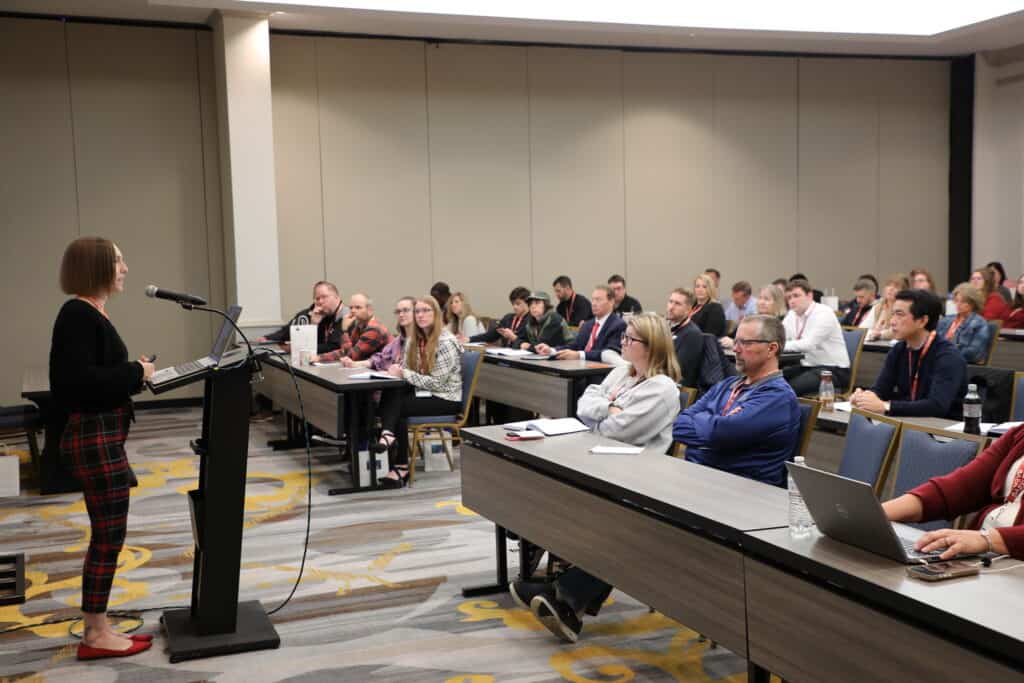
Describing herself as an early adopter of AI technology, Van Den Elzen said she often found herself excitedly teaching her corporate co-workers to maximize the tools.
Last September, she said her passion for AI skills training inspired her to launch BetterWork.
Operating from her home in Seymour, Van Den Elzen said she is able to provide training and consulting remotely and is willing to travel virtually anywhere.
“BetterWork Training is about bringing confidence to employees, to bring value to their work using generative AI,” she said. “I really want to make sure people are getting past the fear and the uneasiness and the hype of generative AI, and being able to really see how it fits into the work that they do.”
By way of various workshops, customized training sessions, ongoing consultation and more, Van Den Elzen said BetterWork bolsters companies that have invested or plan to invest in “an enterprise AI tool, like Microsoft Copilot or Gemini” for their teams.

Though many companies imagine AI as part of their future, she said “very few company strategies acknowledge what that future looks like for them.”
“So, that is where people get stuck,” she said.
With BetterWork, Van Den Elzen said she’s helping companies realize such goals.
“Maybe they have rolled [generative AI tools] out, but they haven’t seen the adoption they expected, especially in their non-technical teams like HR, legal, sales, operations – those kinds of folks,” she said. “Or, maybe they haven’t quite rolled that out yet – they’re trying to get ahead of that kind of change management – and I’m available to help them develop that plan and get that training in place before it’s even a problem.”
Getting the most out of AI
Van Den Elzen said the BetterWork process starts with a discovery phase and needs analysis – an approach she developed when she was in “the corporate world.”
“Just like any learning and development program, I walk into it to really figure out what the actual underlying issue we’re trying to solve [is],” she said.
This phase, Van Den Elzen said, defines where a given company is on its AI journey.
“Once I meet with the leader and get this broad vision of what the problem is and how we’re measuring success, then I like to meet with somebody on the team that will be training,” she said. “I tend to train really specific teams, more than a ‘peanut butter’ approach across an entire organization. I like to meet with the people who are doing really similar work.”
Examples of such teams, Van Den Elzen said, can include HR or finance, for which she customizes use cases to “give them that immediate value” as well as develops four weeks’ worth of follow-up trainings.
Though AI can provide similar benefits across roles in a company, Van Den Elzen said the use cases and terminology may differ.
“You might be describing the same thing – [such as] ‘here’s how you pull information out of a document,’” she said. “But, if you’re showing the HR person a policy and you’re showing the legal person a legal affidavit, they’re going to connect to it a lot better and be able to immediately see how that applies in their job.”
According to betterworktraining.com, BetterWork offers role-specific generative AI training as well as an all-encompassing workshop, “Generative AI at Work.”
Topics for upcoming BetterWork webinars and self-paced courses include:
- Building an international brand
- Using ChatGPT as a social media assistant
- “Firing yourself” from busy work with Google Gemini
Other service/training options listed on the website include 60-minute AI coaching sessions, with advanced AI prompts also available for purchase.
Van Den Elzen said her mindset is never to convince companies to purchase AI licenses, let alone additional training or services from her.
“BetterWork is not meant to sell them something – BetterWork is meant to create value from something they’re already buying,” she said. “If they’re not seeing the value in something they’re already buying, that’s [when] I want them to call me.”
Implementation, experimentation
Adoption of AI tools, Van Den Elzen said, often looks different between technical and non-technical teams.
“The IT team and the technical side of the world goes, ‘Yep, this is going to work out really well,’” she said. “[Then], they get some SOPs in place, and they roll it out to everybody – and nobody uses it.”
One such example, Van Den Elzen said, is a company paying for 3,000 generative AI licenses – at a monthly cost of $30 per license – only to achieve “a 5% adoption rate, and those 12 people who used it daily, they’re using it to summarize their inbox, and that’s it.”
She said there are several common reasons why non-technical teams neglect the AI tools at their disposal.
First, Van Den Elzen said many employees don’t understand why they should be using AI or how it could apply specifically to their own jobs.
BetterWork’s options provide suggestions for use, but Van Den Elzen said the larger explanation is general discomfort with the new technology, which often starts with company leadership.
“When generative AI first came out, a ton of companies locked everything down and said, ‘Holy cow, this is super risky – don’t touch it,’” she said.
Van Den Elzen said many people are still “stuck in that fear,” and that needs to be addressed before discussing how they can apply it.
“I have to show them it’s okay to fail; this is where your data is protected; this is what your company wants you to do – because sometimes companies haven’t communicated that clearly,” she said.
In this sense, Van Den Elzen said mindset cultivation becomes a primary goal of BetterWork.
“I truly think this is not a technology training – which sounds terrible, as I’m trying to sell generative AI training,” she laughed. “It’s about experimentation and the fear of failure and getting comfy being ‘uncomfy.’”
Van Den Elzen said early adopters have a natural willingness to “play around” with new tech.
For the more hesitant users, she said she provides reassurance, clarification and encouragement.
“When I walk into a company, I’m really giving somebody permission to press buttons and see what happens – but I’m doing it with a little bit of control and saying, ‘I know you won’t fail if you do something like this, but let’s try it,’” she said. “The skill gap that I see is truly the experimentation – the confidence building.”
Successful implementation, Van Den Elzen said, also requires varying degrees of creativity and critical thinking.
“Generative AI is wrong a lot, and you need to know enough about what you are asking it about, to know when it’s wrong and to know how to correct that instead of just walking away,” she said.
Van Den Elzen said some with access to generative AI will grapple with issues of authenticity.
“There is a certain stigma attached to AI as being kind of like ‘I’m cheating’ or ‘this is inauthentic, it’s not human, it’s not actually my work…,’” she said. “[It’s important to] give people the insight that AI isn’t about doing less work. It’s about getting a better output.”
Better and better
With just four months into the venture, Van Den Elzen said BetterWork has already scored “a couple of big wins” with clients and audiences – providing reassurance of her own for the self-described “serial entrepreneur.”
By going independent with her talents for training, Van Den Elzen said she’s able to share the benefits of generative AI with a much wider audience.
“It’s been so rewarding to be able to see that I’m making a bigger impact, because I get to touch more people,” she said.
Van Den Elzen said BetterWork is not about her “being the hero” for these companies, but about identifying and empowering the existing talent within each company.
“I get to promote what they’re doing and say, ‘See, look, people are already doing this in your industry and in your company, and it’s making their lives easier – and now I get to show and tell that you can be doing the exact same thing,’” she said. “That really gets people going.”
What gets and keeps her going, Van Den Elzen said, is the idea of BetterWork serving in an ongoing consultancy role as AI technology continues to evolve.
“I want to become valuable to a point where a company says, ‘You know, this tool is changing – let’s bring Amanda in again,’ or, ‘The HR team really got this down…, let’s bring her in for our operations team next…,’” she said. “If I can make a meaningful connection with a community, with the company and continue to provide value, that’s really my goal, long term.”