Vines & Rushes Winery: Wisconsin-grown wine with every sip
 AWI prepares welders for workforce – and the world



June 29, 2026
WASHINGTON ISLAND – The small chain of islands off Wisconsin’s Door County peninsula keeps the lights on through a uniquely local effort: the Washington Island Electrical Cooperative.
“In the ’20s and ’30s, the for-profit [electrical companies] were not interested in coming out to rural America,” Cooperative Manager Robert Cornell said. “When electricity was starting to come on big, the federal government started the REA (the Rural Electrification Administration), which then encouraged groups of people to get together and form cooperatives, where essentially it’s a self-governed utility.”
Cornell – a born-and-raised, multigenerational resident of the island – said the Washington Island Co-op’s history dates back almost 90 years, with efforts to establish beginning in 1938.
“[In] ’39, [we] got approval from REA, which is now part of the USDA and [is called the] Rural Utility Service (RUS),” he said.
Before the co-op took shape, one of its early founders, Ray Krause (per wiecoop.com), was already helping bring power to island homes through the sale and service of Delco-Light plants – gasoline- or kerosene-powered generator systems used in rural areas before connection to a central grid.
Per the website, he continued that work into the early ’30s, before deciding residents “should have something better.”
Once the co-op was established, Cornell said its board of directors bought a centralized diesel-powered generator for $4,000 from the Waushara Electric Co-op and began connecting it to paying members, according to the website.
“We were formally incorporated in 1940 and started the work to lay out the lines, [but] World War II came along, and everything stopped,” he said. “Nothing really started again until 1945 [with] the first electrical customer on Washington Island [being] the high school in December 1945.”
Repairs, investments, internet

For nearly four decades, Cornell said the Washington Island Co-op relied on generators for its power supply.
“My parents grew up here on the island without electricity,” he said. “We ran on generators up until 1981, and then a submarine cable was laid.”
Cornell said it took until the early ’80s to justify the cost of laying a submarine cable because until then, the price of fuel was low enough to make the cost of generators less than that of cable installation.
“Then, the price went from two cents a gallon for diesel fuel up to 60, 70, 80 cents and then to more than $1,” he said. “So, the cost of generation just went through the roof.”
However, Cornell said the co-op did install two diesel-powered generators in 1996 to take advantage of an interruptible rate from Wisconsin Public Service (WPS) and help control costs.
According to wisconsinpublicservice.com, WPS’s interruptible rate program is designed to help co-ops and businesses reduce costs by identifying load blocks of at least 200 kW that can be interrupted within one hour of notice.
Cornell said Washington Island residents pay for the generators’ use and maintenance, since they help ensure the island can maintain reliable power even if service from the mainland is disrupted.
“[The Washington Island Co-op] has the highest cost of capital per mile of line and the highest cost of capital per member of any cooperative in the United States,” he said. “The reason for that is because we maintain full generation capacity here. So, when we lose power from the mainland…, we have the capacity to start our diesel generators.”
Though it operates as a 501(c)(12) nonprofit organization, Cornell said the co-op has “all the same expenses of any other business or utility” – the difference being, as a cooperative, both its operational costs and profits are shared among each of its members.
He said the co-op does generate gains and losses, but refers to them as positive or negative margins.
“We take those positive margins, and we apply a dollar amount value to [a member’s] account that is proportional to their participation in the co-op,” he said.
Like any utility, Cornell said, the co-op has labor expenses, bucket trucks, materials and other standard operating costs.
“[But] we sell electricity at the lowest possible rate we can to try and keep ourselves at close to a zero margin,” he said.
Despite being the “smallest electrical cooperative in the State of Wisconsin – and one of the smallest in the country” – Cornell said Washington Island Co-op’s internal staff is responsible for the procurement, installation, maintenance and operation of its equipment in addition to customer outage and emergency service.
“For a long time, I only had four employees, and [at one point] I was down to three employees, [but] now we actually have a couple more [people who] have come on,” he said.
As a small team, Cornell said everyone is versed in each skill set required of an electrical lineperson – but the goal of keeping the power on and costs low is consistent throughout.
“[For example], I not only managed the co-op, but I have also split my time in the bucket truck, so it’s a little bit of a unique situation as far as utilities goes,” he said.
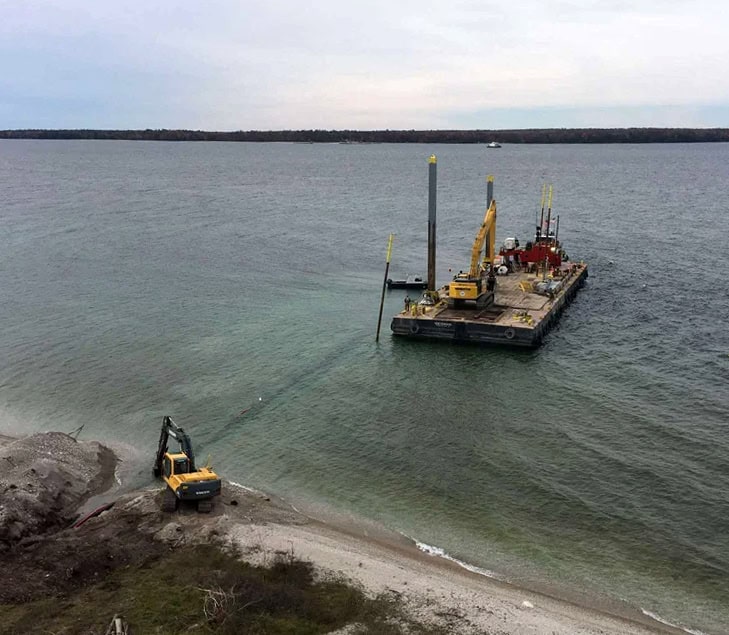
In 2018, Cornell said the co-op was forced to make “a huge investment” in its submarine cable following an unforeseen failure that required a $1 million repair.
“We were on [our] generators for 12 days because the cable that was installed in 1981 failed,” he said.
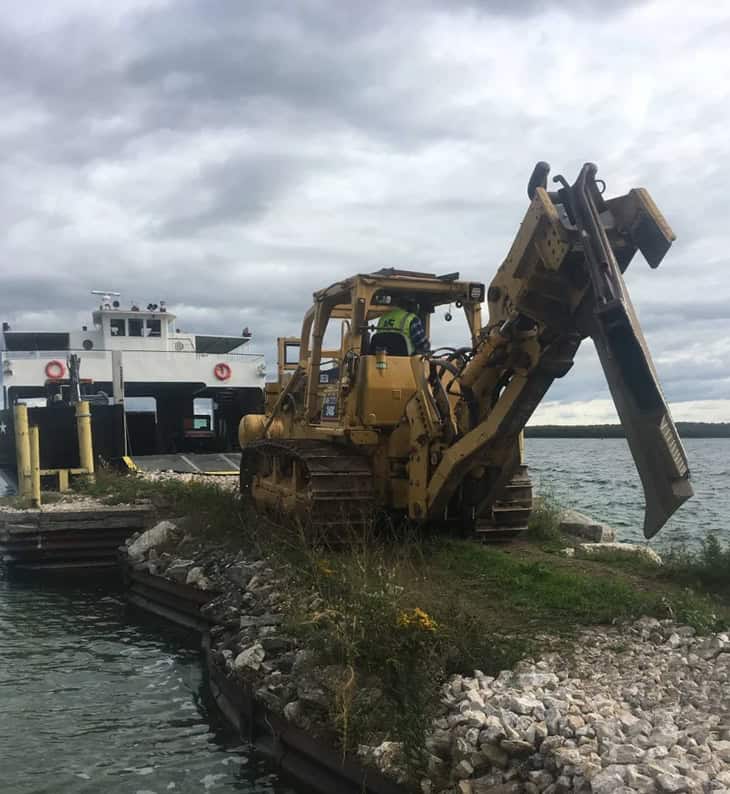
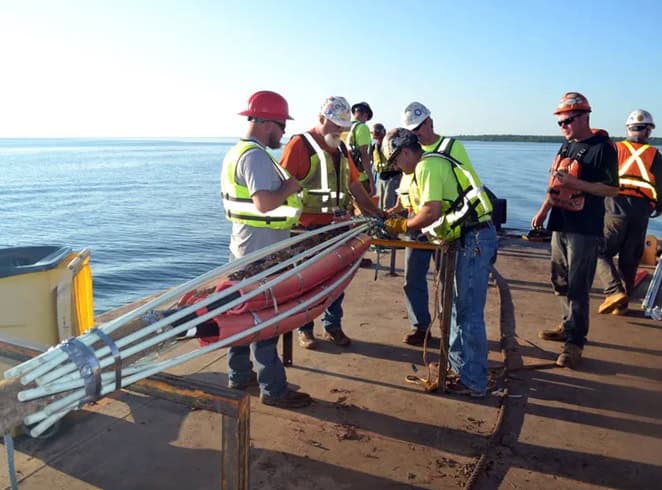
After temporarily fixing the existing cable – restoring power to the island – Cornell said the co-op worked to install a new one, deciding to include fiber optic capability “without any clear plan of what to do with it.”
“As long as we were building the cable, the cost increase to put the fiber in was negligible,” he said. “[Now], we are just wrapping up a fiber-to-the-home project, where every single home and business, essentially, [has a] meter [with] a fiber connection to it.”
At the time of his interview with The Business News, Cornell said 80% of homes and businesses connected to the fiber optic service opted in to use it.
“By the middle of August, we should be completely done with having fiber to every home,” he said. “We’re not playing the game of passing homes – we’re actually going right to the meter socket. If they want it, they can subscribe to it. If they don’t want it, they don’t have to, but we will have 100% coverage. It’s just a matter of a couple hours for somebody to connect if they decide to.”
Cornell said the co-op’s internet service offers tiered connection plans – with cost dependent on the member’s desired upload and download capacity.
“And we’re going to have multi-gig service eventually,” he said. “So, it’s a pretty reasonable service, not your typical ISP (internet service provider).”
With the addition of fiber, Cornell said the Washington Island Co-op is now enjoying two revenue streams – with both electrical and internet sales “paying the bills.”
“There’s [also] a $5 membership fee, which is, I think, fairly typical for most electric cooperatives, and then the board has to approve [new residents’] membership,” he said. “Since 1940, there has never been somebody who wasn’t approved.”
Dedication to community
Cornell said his family has called Washington Island home for more than a century – with his paternal grandfather settling in the 1850s followed by his maternal grandfather in 1919.
“I lived here basically my whole life, except for [when] I went to college and got a degree in electrical engineering,” he said. “I went to work in manufacturing for 18 years, and then came back to manage [the co-op].”
Having lived on the island for the last 25 years – “I’m living in the house my grandpa built” – Cornell said he’s experienced a shift in what the electrical co-op delivers to its members.
With a current workforce of seven employees, Cornell said three of them are brand new to the co-op following the addition of internet service.
“We’ve always needed more [staff],” he said. “Trying to find somebody who wants to live on an island is not the easiest, especially a professional person… With this fiber project, that has added some additional needs for manpower, and also justified the cost of that manpower as well.”
Though he’s found recruitment to be difficult, Cornell said once on the island, new co-op employees are taught the importance of serving the small but mighty community.
“There are seven cooperative principles and commitment to community is one of those principles,” he said.
As part of that commitment, Cornell said the Washington Island Co-op is a member of the Door County Economic Development Corporation to help connect the island with larger advancement throughout the peninsula.
To further its involvement on the mainland, Cornell said the co-op also participates in the Wisconsin Electric Cooperatives Association (WECA).
“In the State of Wisconsin, there are 24 electric cooperatives,” he said. “We’re all part of the WECA, and we all work together.”
Though one cooperative cannot provide power to another, Cornell said each of the 24 cooperative managers collaborate regularly.
“When we have a crisis, we have programs – like a mutual aid program where we work together,” he said. “As a manager of a small co-op, if I have a question about something, I can send an email to my fellow managers of the other co-ops, and I absolutely guarantee you that within four hours, I will have at least a dozen answers.”
This, Cornell said, is only one example of how the Washington Island Co-op practices its dedication to community on and off the island.
“It really is a very different way of doing business,” he said.
For more, find the Washington Island Co-op online.