 Unplug, unwind and settle into the simple life
 ‘It’s never too late to follow your dreams’


October 5, 2026
SUAMICO – Sept. 14, 2023, is a day Brenda Fritz said she will never forget.
For Fritz, that late-summer Thursday started like many others – with an early-morning bike ride.
Fritz, who graduated from Pulaski High School before playing collegiate soccer at Edgewood University in Madison, said she had just completed the Madison 70.3 IRONMAN a week before and was ready to commit to her first full IRONMAN – 2.4 miles of swimming, 112 miles of biking and 26.2 miles of running – in 2024.
“I was the eighth overall woman and second in my age group, so I did well and was happy with my result,” she said. “I had done several Half IRONMAN events in the past, so I was ready to tackle a full.”
However, her full IRONMAN goals came to a screeching halt that fateful September morning more than three years ago.
Leaving her house in the Suamico area before it was light, Fritz said the morning fog “wasn’t too bad.”
The further north she biked into the Chase area, however, she said the fog got worse.
“I was coming up on County C while riding on S. Chase Road,” she said. “Essentially, it’s a blind intersection, and it was dark and foggy. A semi-truck was coming south, and I was going east. I didn’t see the truck lights at the intersection, and I hit the truck’s back end. The driver didn’t even know [it] happened.”
Though she has no recollection of the accident, Fritz, 42, said the incident was caught on video.

As the truck drove away from the scene – again, the driver not knowing the accident had occurred – Fritz said she was catapulted into the ditch.
The only saving grace, she said, was the fact that her bike was left in the middle of the road.
“I don’t remember how far I was flown into the ditch, but it was quite a ways,” she said. “It just so happened that two pedestrians who came upon the scene saw my bike, and they found me in the ditch. They called 911 and stayed with me.”
Despite remaining conscious through the whole ordeal, Fritz said because she has no memory of that day, the stories she now tells are first-hand accounts from the pedestrians, nurses and doctors who helped save her life.
“One of the girls who found me was an ICU nurse at Aurora,” she said. “I’ve obviously met with these people, so I’ve heard their stories.”
In another stroke of good fortune, Fritz said the fog – which played a major role in the accident – actually helped save her life.
“They tried to get a helicopter to me, but it was too foggy to fly me out,” she said. “They decided to load me up in the ambulance instead. Essentially, had they flown me out from on-site, I would have died in the helicopter because I was losing so much blood. I never would have made it to Milwaukee or Madison.”
Though her injuries were severe, Fritz said she sustained no brain injury.
“I have always spent a lot of money on my helmet,” she said. “Having said that, from about T10 all the way down in my spine was shattered. I had a burst fracture of my spinal cord in two spots.”
The T10 vertebra is located in the thoracic spine, specifically in the middle of the back and situated near the lower part of the rib cage – playing a crucial role in supporting the upper body and protecting the spinal cord.
“I also had an open book pelvic fracture, so my whole pelvis was shattered,” Fritz said. “Additionally, my left femur was sticking out of my leg, and both of my hips were broken. My left arm and scapula were broken, as were some ribs. Thankfully, I had no punctured lungs.”
With “extremely bad” internal bleeding, Fritz said after being transported to Aurora, she was immediately sent to interventional radiology.
Given 40 units of blood in that one procedure, she said the hospital was “basically wiped out of its blood supply.”
“Knowing several of the people who worked on me, that made for a unique experience,” she said. “Going to Aurora made me feel comfortable with who was taking care of me.”
Fritz said her first memory after the accident came about nine or 10 days later, lying in a hospital bed at Froedtert Hospital in Milwaukee.
“I was put into a medically induced coma [to help begin the process of healing my body],” she said. “In just a couple of days, I think I had seven surgeries at Froedtert. The first few were to do whatever they could to save my life. Unfortunately, my family was in limbo that whole time.”
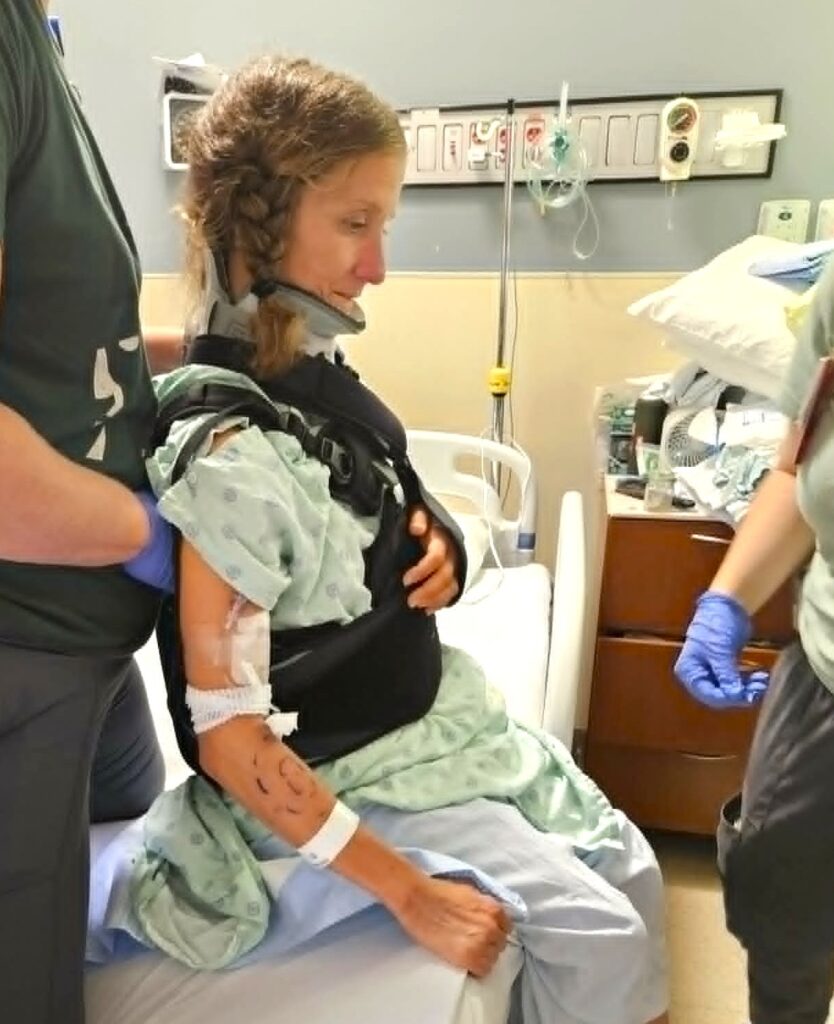
Lying in the ICU at Froedtert after she woke up, Fritz said she had a conversation with herself.
Clearly devastated and in “more pain than anyone will ever imagine,” she said as a nurse herself, she has seen patients in similar situations give up.
“If you give up, you’ll probably live a miserable rest of your life,” she said. “I chose to fight and not be miserable. I asked myself, ‘What is the fastest way to recover?’ I knew I had to cut the whole ‘pity party’ thoughts from my mind and move on. I couldn’t dwell on why this happened to me.”
The real work begins
After that conversation with herself and realizing her life had been saved, Fritz said that’s when the real work began.
At Froedtert, she said a doctor pulled her husband, Nate – who she met at Edgewood before moving to the Green Bay area about 17 years ago – aside and said he could expect his wife to remain at the hospital for three months.
Due to her hard work, determination and grit, Fritz said she defied the odds.
“Essentially, I was out of there in three and a half weeks,” she said. “I think it was because I was in such good shape before the accident. From there, it came down to either going to a nursing home or needing full-time care at home.”
Fritz said this is where she witnessed the power of family and friends.
Setting up a hospital bed in her living room, she said her mom quit her job to offer full-time care.
“The bed was equipped with everything I needed to help me recover and get stronger, including a Hoyer lift,” Fritz said. “I also used a wheelchair for about 14-16 weeks. I went to inpatient rehab in December [of 2023], and that’s basically when I first got out of my wheelchair.”
Before she took her first steps after the accident, Fritz said she was scared because she didn’t know if she’d ever walk again.
With a spinal cord injury, she said doctors also told her they didn’t know what to expect.
“Obviously, everything was assisted with crutches,” she said. “When I took my first steps, it was very promising, knowing that even if I had to use assistive devices, I wouldn’t be in a wheelchair for the rest of my life.”
In that prior conversation with herself at Froedtert, Fritz said she had also thought about her goal to complete a full IRONMAN.
As her recovery progressed, she said it became clear that she could walk again, but running was out of the question.
“I wanted to run across the finish line, but with my spinal cord injury, I realized that wasn’t going to happen,” she said. “That’s when I looked into a racing wheelchair, but they are very expensive. I applied for two grants – and received them – which helped offset some of the cost.”
Last winter, Fritz said she received her racing wheelchair.
“It’s way harder than it looks,” she laughed. “Seasoned veterans make it look so easy, but I can tell you it’s not. Some of the professionals in events like the Boston Marathon are doing three- or four-minute miles.”
With her children active in sports, Fritz said it’s still a challenge for her to walk long distances across a soccer field or two, but when it comes to biking, she feels perfectly normal.
“It’s weird because if you see me out biking, you’d think I was back to normal, but if you saw me walking, you’d ask yourself if it was the same person,” she said. “I can bike 100 miles and feel normal, but walking is another story.”
On the road again
In terms of biking, Fritz said her journey began later in 2023 when she first rode a stationary recumbent bike in her basement.
From there, she tried riding her trainer in the basement, but “that didn’t go too well.”
“I couldn’t even get on the bike,” she said. “I kept trying, and eventually, I could do it. I think I rode for maybe five minutes.”
The next step, Fritz said, was taking her mountain bike outside – with regular pedals – and utilizing the help of her husband.
“With Nate’s help, he let go of me, but I was so unsteady,” she said. “I didn’t think there was any way I could ever ride a bike again, but I didn’t give up. A couple of weeks later, we tried it again, and this time, Nate got the bike going for me, and I was able to pedal.”
Though she was able to ride her mountain bike, Fritz said there was another problem that needed solving.
“I couldn’t get off the bike by myself,” she laughed. “Nate had to help stop the bike, and then I was able to get off. We started by doing 10 miles on the Mountain Bay Trail, but when there was an intersection ahead, he had to ride up and make sure no cars were approaching. If there were, he’d have to get off his bike and stop my bike for me [while the cars passed].”
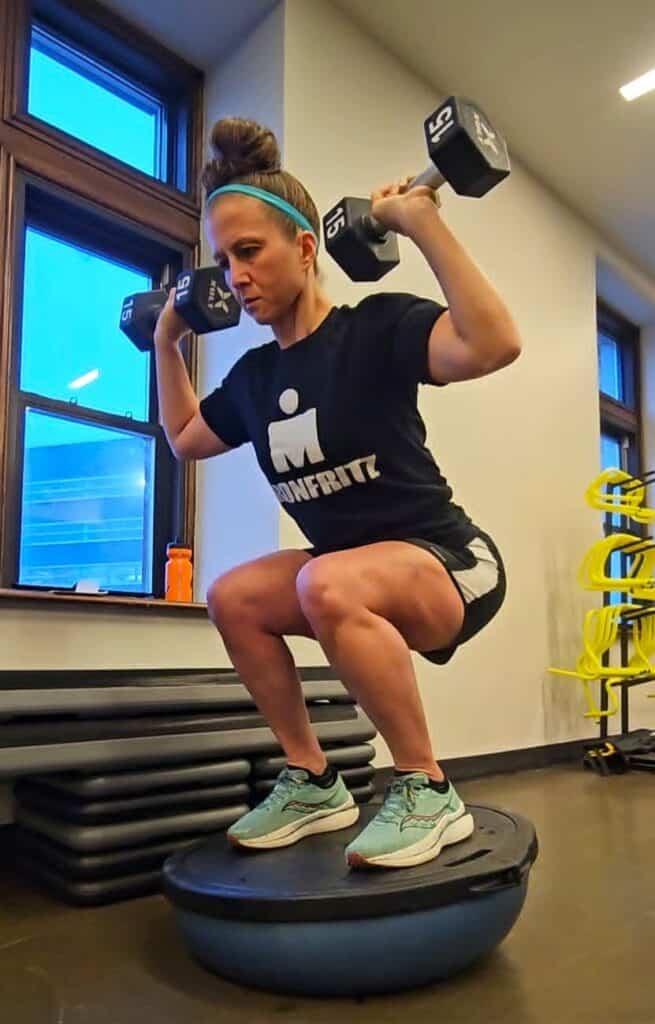
By her own admission, Fritz said she probably pushed it too much, but it also aided in her recovery.
Progressing from her mountain bike and then to her gravel bike, she said the next obstacle was her triathlon bike – a bike built for speed.
“I kept progressing and put in so much work with my physical therapist from day one – hours upon hours,” she said. “I have those special clip-in pedals on my triathlon bike and had also done that with my gravel bike, but it was still scary as heck when I first tried the triathlon bike [during the spring of 2025].”
With her triathlon bike requiring more balance and having skinnier tires, Fritz said she has to be “very mindful” out on the road.
“I haven’t had any setbacks or crashes since the accident, so I’m thankful for that,” she said. “I’m way more cautious now and don’t take as many risks. I would say there is a healthy sense of fear now.”
Revisiting her IRONMAN goal
With her life saved and her recovery going well, Fritz said she turned her attention back to her full IRONMAN goal.
With her eye on the “big prize” this fall, she said she first looked into completing the Door County Triathlon as a relay a year ago.
“I wanted to swim and bike and have someone run for me,” she said. “One of my friends suggested I look into My Team Triumph. Swimming is hard for me, so I was thinking of looking into finding a way where someone could swim with me.”
According to myteamtriumph.org, the organization invests in specialized race equipment, recruits volunteers, facilitates training and lends race day support so people of diverse abilities can come together as a team in endurance events.
“From day one, My Team Triumph has been amazing to work with,” she said. “They said, ‘Let’s get you back to racing.’ I was blown away. Yes, I have a disability, but I’m not fully in a wheelchair. I really didn’t know where I belonged. My Team Triumph took me in their little family and has helped me so much.”
After finding her place with My Team Triumph, Fritz said the nonprofit invited her to help at the Madison IRONMAN in 2025, an opportunity she didn’t pass up.
“I was so inspired by what I saw,” she said. “It was right then and there that I told myself I needed to figure out a way to do this – that’s when I really delved into getting the grants for the wheelchair. Once I got some grants, that’s when I said I needed to do a full IRONMAN in 2026.”
IRONMAN Wisconsin
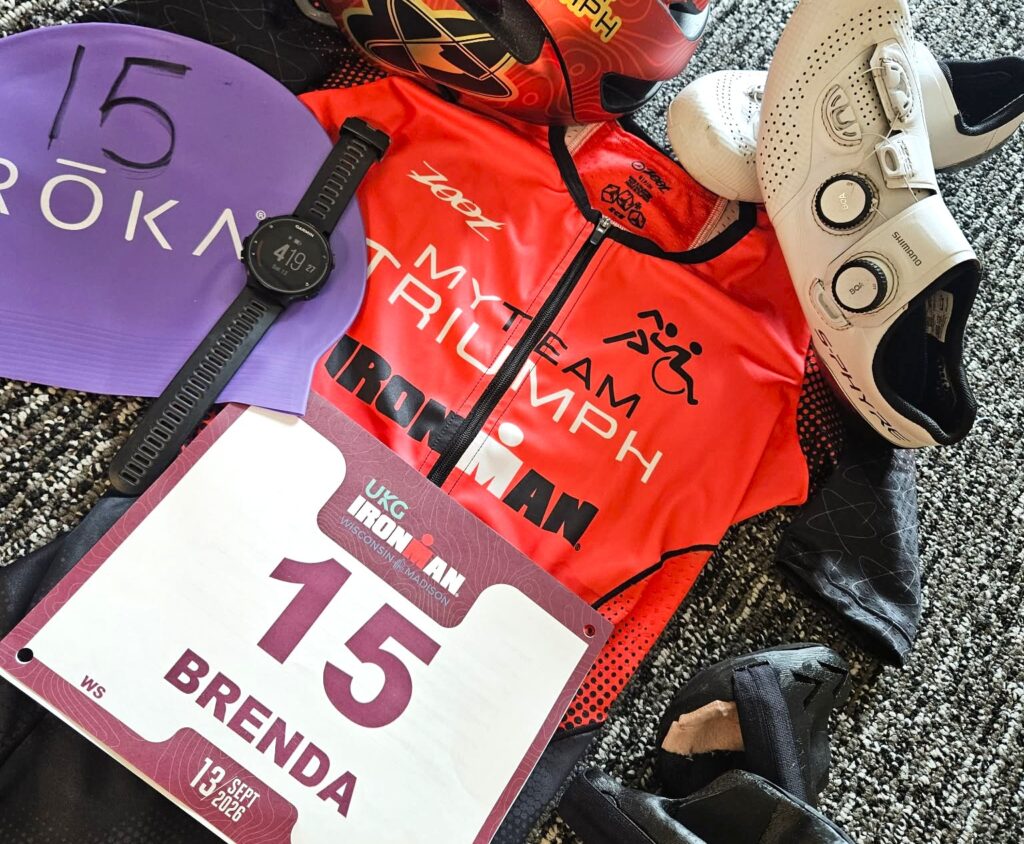
On Sept. 13, three years removed from her near-fatal bike accident, Fritz was on the starting line with more than 1,300 other participants at the IRONMAN Wisconsin event in Madison.
“My Team Triumph supported me through the entire day,” she said. “Physically, I did everything myself, but with support. I remember a lot of people telling me to just stick to smaller events or relays, but I didn’t want that – I wanted to do a full IRONMAN, by myself.”
Fritz said the grueling event – which took her 12 hours, 29 minutes and 4 seconds to complete – couldn’t have gone much better.
Thinking she would have somebody swimming with her, Fritz said IRONMAN officials didn’t allow that, but a lifeguard in a kayak paddled next to her.
“I think that was even better yet,” she laughed. “They were there just in case I needed it. It was a nice security blanket.”
With a swim time of 1:33:46, Fritz said the conditions were great, but another potential issue caused her to swim an extra 300 yards.
“Because I was in the para division, I started five minutes before the fastest swimmers,” she said. “I knew in my head that a crowd of people was coming behind me, so I was nervous about that. Because of that, I swam a wider route to stay on the outside, which essentially saved me from getting swum over. It worked out better for me.”
Ending her swim – and with the support of My Team Triumph – Fritz mounted her bike and began the 112-mile, hilly route.
Maintaining a good speed, she said the first loop went well, but she started to feel the effects of the course on lap two.
“My body started not cooperating,” she said. “With my right leg, I have a lot of neurological damage, so I couldn’t stand up on the bigger hills and push the power. There was one hill on the second loop where I felt I was going so slow that I was going to tip over. I ended up walking that hill, which was not ideal, but I didn’t let it affect me or ruin my day. I took it a little bit easier all the way in, but I was still consistent and pushed hard.”
Fritz finished the bike portion in 6:37:32 – an average of almost 17 miles per hour.
With the biking behind her, she said she was happy to transition to her racing wheelchair for the run.
“I was ready to be done with those hills,” she laughed. “I’m telling you, that Madison course is quite hilly. I was a little nervous for the run because I’ve never done a full marathon in my chair.”
The speed at which her racing chair can achieve – especially on the downhills – also made for some nervous moments, Fritz said.
“People are not expecting a wheelchair to come up behind them at the speeds I’m coming,” she said. “It was a little tricky to navigate, so I played it a little more conservatively than I wanted to. The first half went great, but the second half got tough. With the position I’m in in my chair, I’m basically kneeling.”
Fritz said her back and hip flexors tightened up and started cramping, which caused her to get out of her chair on two occasions to stretch.
She finished the run portion of the event in a little more than four hours.
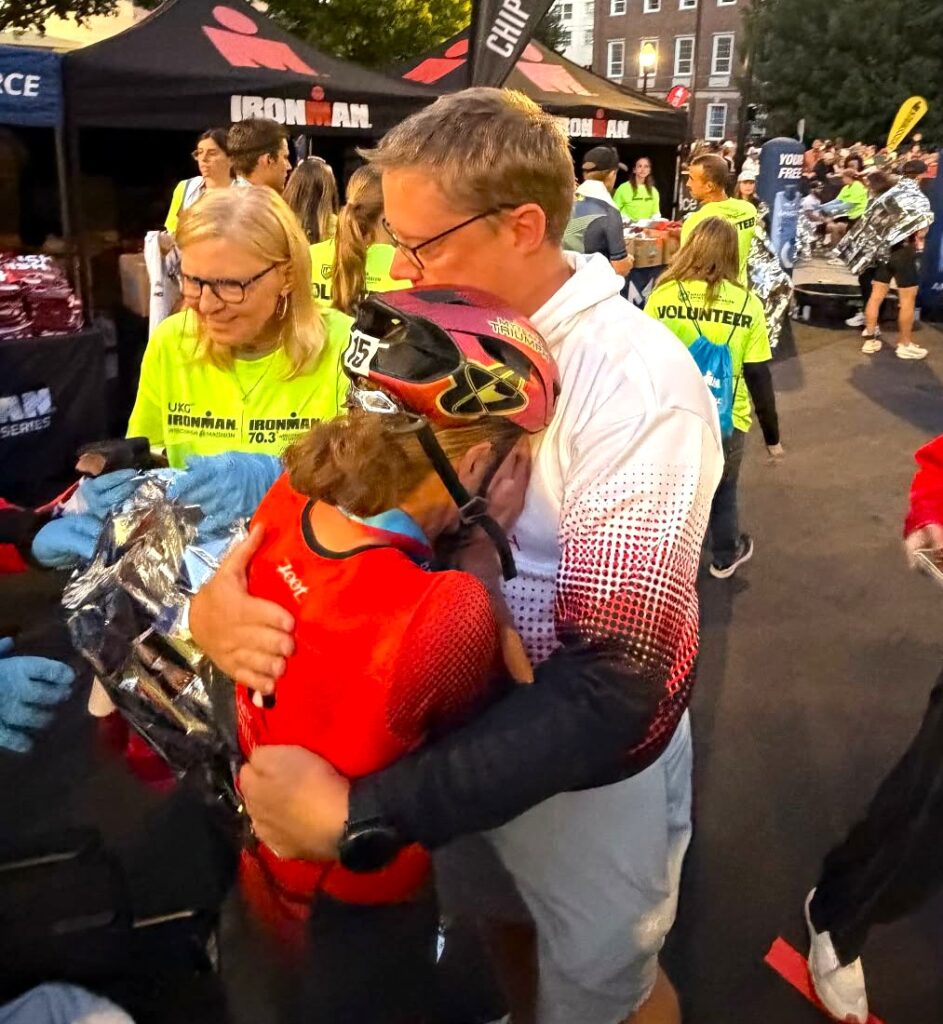
“Leading up to the race, everybody asked me how I was going to feel when I crossed the finish line,” she said. “I remember turning the corner and coming down the finish chute on the red carpet, and I ‘lost it.’ My family and My Team Triumph were there, and the announcer was blowing up my name and telling my story. That goal I set three years ago, lying in the ICU, that I would do an IRONMAN, was finally coming true.”
What’s next?
How does a person who has come back from a near-fatal bike accident and completed an IRONMAN top that?
Fritz said she’s not even sure.
“My husband was asking me that,” she laughed. “I could do the IRONMAN World Championships in Hawaii, but that’s really never been on my radar, and it’s very expensive. Logistically, it would also be very challenging.”
Based on her completing IRONMAN Wisconsin, Fritz said she qualified for the 70.3 IRONMAN World Championships in Chattanooga, Tennessee, in 2027, but is still deciding her future path.
For now, she said she doesn’t feel another full IRONMAN is in her future plans, but won’t rule it out later in life.
“I’m working with IRONMAN right now to make sure [the Tennessee course] is wheelchair-friendly,” she said. “A decision on that race hasn’t been made yet, but the opportunity might be there. I love the Half IRONMAN distance; it’s much more family-friendly with the training. Full IRONMAN training is like a full-time job.”
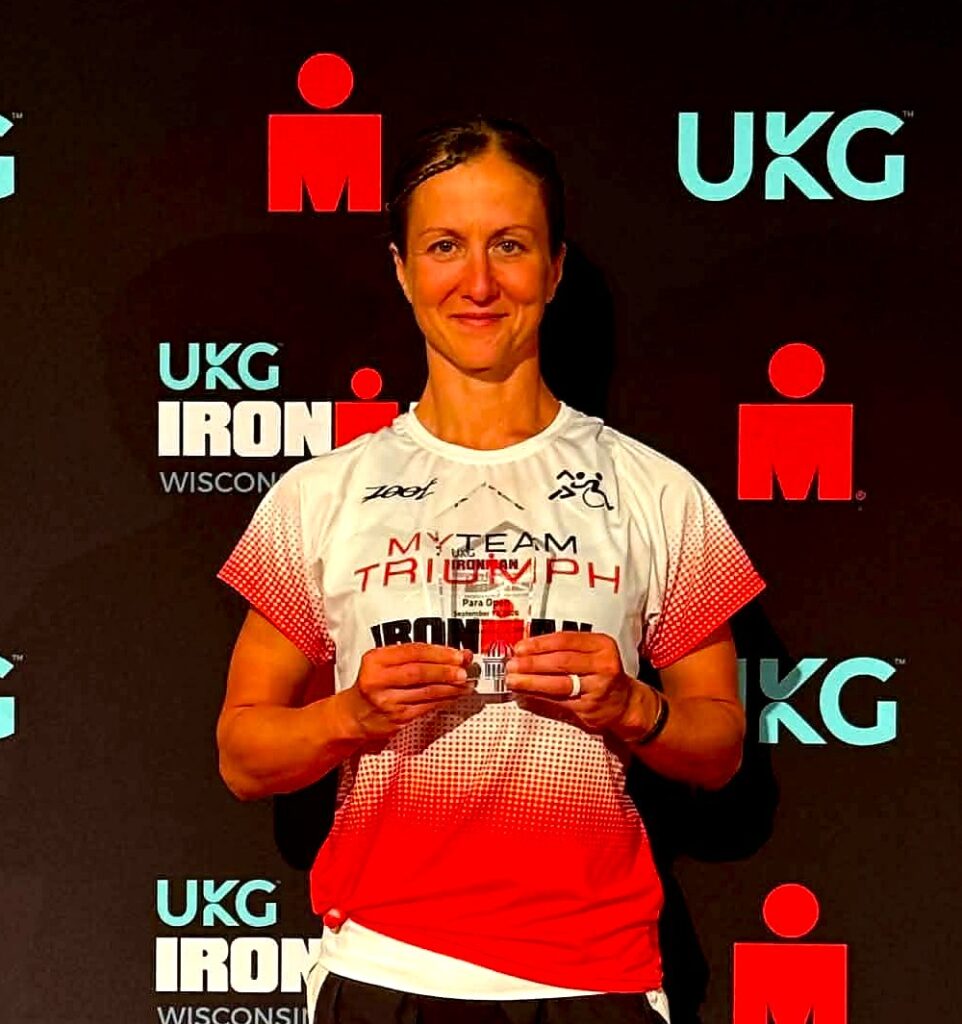
Though her example of accomplishment and determination might be hard for many people to comprehend, Fritz said the message is the same.
“You have a choice: you can choose to be happy,” she said. “I looked at what my family went through, and if I chose to give up, how would that have affected them and everybody who helped me? Life is hard, but essentially, you can make it what you want it to be. I wanted to give my story meaning, and by joining My Team Triumph and helping them raise money, I love that.”