Tomahawk motel under new ownership – but the tradition continues
 Savor a piece of history at The Pearl Ice Cream Parlor & Confectionery




October 19, 2026
PLYMOUTH – Founded more than 70 years ago, Senior Manager of Community and Workforce Development Anne Troka said Sargento Foods was built on trying new things.
“Our founder, Leonard Gentine…, was very much an innovator,” she said. “In the grocery stores at that time…, he saw in the meat section a meat slicer and he used that concept… Put cheese in it [and] out came sliced cheese.”
Though the family-owned and -operated company no longer slices its cheese by hand, Troka said Leonard’s spirit of curiosity has led the manufacturer to lead the market in natural cheese with products such as sliced and shredded cheeses, string cheese and its Balanced Breaks® on-the-go snack trays – all available in a wide variety of flavors.
However, to continue innovating, she said the company has had to heavily invest in its workforce, especially as manufacturers across Wisconsin’s Northeast region continue to compete for skilled labor.
“In 2016, Sargento created a [youth apprenticeship] opportunity… [that] was really about building those future talent pipelines,” she said, “knowing that – in manufacturing and throughout our company – we have [positions] we’re always going to need new people coming into.”
Building the talent pipeline, Troka said, is step one.
Step two, she said, is ensuring there are growth opportunities for employees once they’re established at Sargento.
“[We must] continue to grow the employees we have in their careers, and then bring new people into those opportunities,” she said. “Workforce development is very much focused on [here, because we] do have a critical business need.”
With several “pathways” available to students – such as production, maintenance technician and product logistics – Troka said regardless of why someone joins the Sargento family, the main goal is “exposure.”

“What we looked at is, ‘Where can we have students gain exposure so [they can see] the world of manufacturing has changed?’” she said. “It’s not the same type of work it was years ago, so we want students to come in, visit and see that.”
In regard to Sargento’s tenured workforce – some of whom have been with the company for 50- to 60-plus years – Troka said the workplace culture and career advancement opportunities are what keep them engaged and dedicated to the spirit of innovation the company was founded on.
“Sargento does invest in them to grow their careers with us, and then to give back,” she said. “There’s that feeling of support for one another, and when we talk about our Sargento family culture, I always like to share with our [current and] early talent [that] it’s about respect, trust, care and mutual support. When our employees feel that, they really want to give back to the organization as well. They’re growing, and they want to pay it forward.”
Building early talent
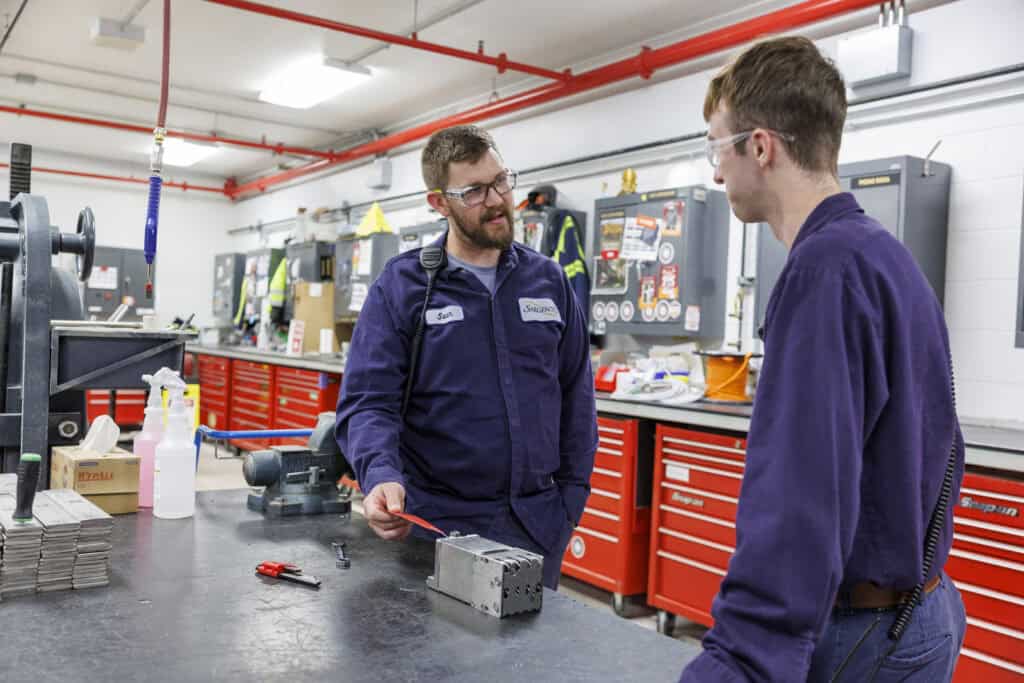
A student apprentice’s experience at Sargento begins with a tour and a brief lesson on the company’s multi-decade-long history, Troka said.
“We take them into the manufacturing facility, they go on a tour and they’re able to see all the automation and technology,” she said. “We’re no longer doing it the way we did 70 years ago, but we continue to innovate so we can meet consumer demand.”
Beyond the technology itself, Troka said the tour presents an opportunity for students to see what a career in modern manufacturing looks like.
“They can see the types of opportunities that are there for them to go into different career paths, from production to maintenance technician and all in between,” she said.
Vice President of Manufacturing Jack Lindsay said “the evolution of automation” in Sargento’s food manufacturing processes has “driven a more safety-focused” workplace throughout the company.
“It’s more focused on safe delivery of the product, so you get a more consistent product out the door safer than ever before,” he said.
On their tour of the facility, Troka said Sargento stresses to students “the most important part of food manufacturing is food safety and people safety.”
“And ergonomics as well,” she said. “I think for people working and doing anything repetitive or heavy, technology helps ease that, so people can focus on more of the electronics and the mechanical capabilities that are needed to continue manufacturing.”
Troka said Sargento has different student programs that create a natural progression through the company, given mutual interest, to help the company “start building talent from high school into production.”
At ages 16 to 17, she said students can start on the maintenance technician pathway and, if interested, grow to join the production line and experience a modern manufacturing environment first-hand.
“We created an opportunity for high school seniors when they’re 18 to come in and work a couple of days a week in production,” she said. “They work on an eight-hour shift two days a week and on weekends based on business demand, and they have an opportunity to start to understand: is this a career pathway they would be interested in?”
The benefits to this program, Troka said, are twofold: the student gets the experience, and Sargento gets the opportunity to train and recruit new, local talent right out of high school.
“Depending on performance and our business needs, we’re able to offer them full-time opportunities, or at least start out with working in the summer full-time,” she said. “Then, based on performance, they can start and grow their career with us.”
Following their student apprenticeship, Troka said interested participants can also apply for Sargento’s registered maintenance apprenticeship program.
“Our registered apprenticeship program in maintenance [provides them the opportunity to] pursue a five-year maintenance technician apprenticeship,” she said. “Or they can pursue an electromechanical associate degree through our generous tuition-assistance program and gain experience working in maintenance that way as well.”
Say, do, experience
Troka said one way Sargento’s tenured workforce “pays it forward,” as previously mentioned, is by mentoring the student apprentices who come through its workforce development pathways – passing along their well of knowledge and love of company.
“As they come in, many of our students grow in their careers and become emerging talent, and they’re learning from others who really want other people and the company to succeed,” she said. “So, it’s really building that long-term investment in our company and the long-term commitment to our employees and to our future employees, [fostering a] relationship between them that is very strong and productive.”
With the increased sophistication and expectations of food manufacturing equipment, Troka said one-on-one mentorship is increasingly important, now more than ever.
“We need to have good structure in place internally so we have support for them,” she said. “Every student who comes into our company has a mentor they work with directly. We prepare for them before they arrive, [and] within my role, I work with all the teams who are going to be managers of a student. So, we’re ready to really be a mentor and provide support and guidance.”
Troka said Sargento also ensures to follow the “skills checklists” provided by the State of Wisconsin’s Department of Workforce Development Bureau of Apprenticeship Standards.
“We follow those checklists to ensure safety for the students [and] for our company, and that there is learning and growth involved in their 11-month journey with us.”
A current example of Sargento’s mentors in action, Troka said, can be seen in the development of a student who has already completed the maintenance youth apprenticeship program as a junior.
“He did a great job, great performance, [and] the team offered him a year-two youth apprentice in maintenance,” she said. “Then, when he completed that, we created a maintenance student opportunity for him, and he earned a Sargento Advanced Manufacturing Scholarship, which was a $10,000 scholarship that paid for a significant amount of the $13,000 electromechanical associate degree.”
Troka said this student’s success, in part, is thanks to the “great mentorship” provided by the Sargento team.
“The team has really been guiding and investing in him through that mentorship,” she said. “We can’t do this without our employees serving as mentors and really supporting the students, and then the students having great work ethic as well – showing up to work with great attendance, being great team players, building their communication skills, critical thinking and problem solving and then teamwork – being great collaborators with all of us.”
Above all, however, Troka said none of this is possible without the support of Sargento’s leadership team – now headed by third-generation CEO Louie Gentine – and the family-like culture they intentionally set.
“I think that’s really important at Sargento,” she said. “We really want to make sure that experience continues on; that we say it, we do it and you experience it when you’re here with us.”
Capturing innovation
Celebrating manufacturing month – this year, in partnership with the Greater Green Bay Chamber – Lindsay said the company also recently started construction on “the largest manufacturing investment” in its history.
“We’re building a new facility in Plymouth that’ll be a state-of-the-art cheese processing facility [expected to] open January of ’28,” he said. “We’re currently in the process of building it right now, but the [cost of the] steel is going up.”
Lindsay said this is the first “full greenfield build for Sargento” since the company built its Kiel facility in the early ’90s.
“It’ll enable our growth for the future by giving us automated lines that provide a safe working environment and increase our output to meet the consumer demand,” he said. “The consumer is changing daily at this point, and building in that capacity to serve their needs is what that facility will do.”
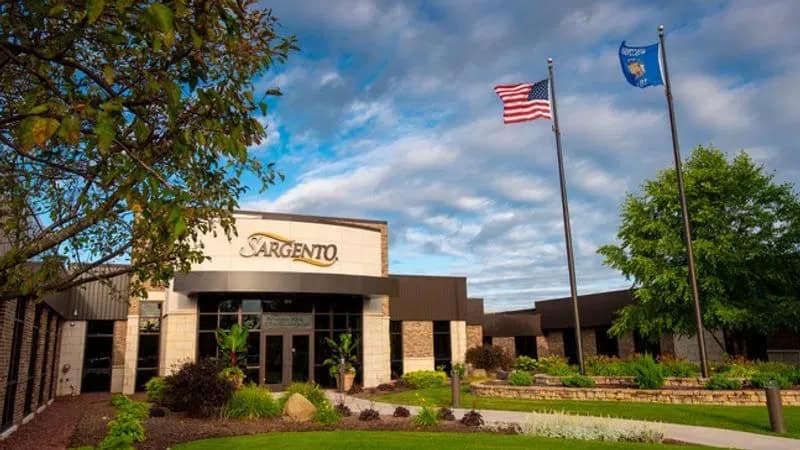
Although this new facility in Plymouth is Sargento’s first ground-up construction project in roughly 30 years, Lindsay said the company regularly invests in its existing facilities.
“We do significant investment every year to every couple of years, increasing capacity to meet the consumer demand, and that changes,” he said. “We will make the investment to capture that innovation.”
As the company continues to grow and chase the latest in natural cheese manufacturing, Troka said a steady stream of talent and internal growth opportunities remain paramount to Sargento’s success.
“We want to invest in our people, so we help them to learn and grow new skills to grow with the company,” she said. “At the same time, we realize people are going to retire, and we’re going to have to bring in new talent, so that’s where I think 10 years ago [and] even before that, the company [not only] invested in future talent, but really made that a focus.”