At a Fond du Lac County orchard, market – a ‘Little’ goes a long way
 Bellin’s Casey honored with WACEP Distinguished Service Award


July 6, 2026
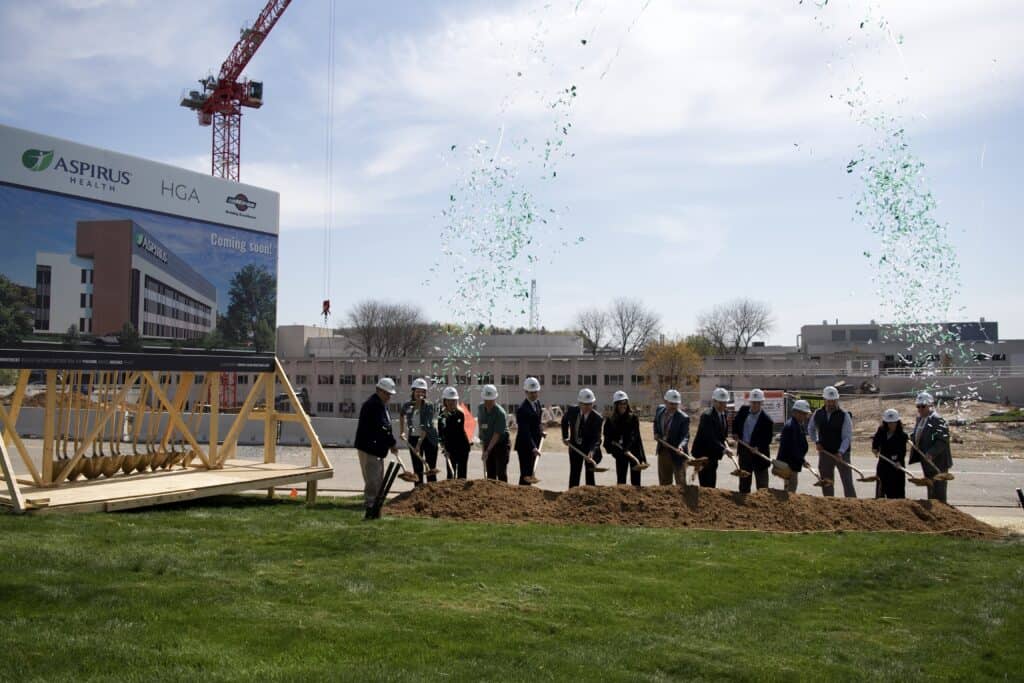
WAUSAU – Aspirus Wausau Hospital is expanding its critical care capacity through a major multi-phase project designed to meet growing patient demand and strengthen access to specialized care across the region.
Aspirus President and CEO Matt Heywood said the expansion further positions the hospital as a destination for advanced health care.
“It is a direct response to the growing needs of our patients and communities,” he said. “By increasing capacity and access to advanced technology, we are ensuring timely care and creating efficiencies that benefit everyone.”
Those growing needs, Jeff Wicklander – senior vice president and president of the Aspirus Central Region – said, are numerous.
“Our needs have grown pretty significantly in recent years,” he said. “Going into the [COVID-19] pandemic, we were a strong healthcare organization, and coming out of the pandemic, we’ve even seen more growth.”
Among the changes in the region’s healthcare landscape, Wicklander said, are hospital closures and the acquisition of a competing organization.
“During these times, we’ve seen significant demand,” he said. “The market continues to show that we have an aging population, and as such, there’s increased utilization of care by that population.”
Wicklander said the health system has also seen a sicker patient population, which he attributes in part to post-pandemic economic challenges.
As a result, he said some patients are delaying primary and preventive care and arriving at the hospital with more advanced conditions.

“Whatever the illness is, it often requires larger intervention – maybe a longer hospitalization,” he said. “Sometimes they require a larger surgery or more intense surgery that could have been a smaller surgery or maybe not even surgery at all, if they had done primary care and preventative screenings and some of that kind of thing.”
Wicklander said Aspirus is also seeing more elective procedures, along with an increase in traumatic injuries handled through its Level 2 Trauma Center and Medivac services.
Though the project centers on four major components, Wicklander said it also requires about 40 related “domino” projects that need to be completed in advance of the larger construction work.
Those early-phase projects, he said, have included relocating radiology reading rooms to accommodate a new PET/CT unit, as well as expanding pharmacy space to make room for a future bed expansion tower.
Also among the smaller projects, Wicklander said, was the relocation of services in the facility’s entry area as part of an ongoing redesign of the main entrance, including moving the security department.
The four key components of the $227 million expansion – the largest in Aspirus’ history – he said, include: increased capacity, advanced diagnostics, expanded surgical facilities and bed expansion/specialized care units.
Increased capacity
With continued shifts in federal policy, Wicklander Aspirus is treating a growing number of patients who do not qualify for inpatient admission and is focusing on centralizing care for observation patients.
“So, that will come right off of the emergency department, and that’s a really important place for us to be able to monitor these patients as they typically stay for about 24 hours or less,” he said.
Wicklander said the expansion will add 48 intermediate care beds and a 16-bed observation unit, while also allowing for future growth of intensive care services.
“Typically, observation patients are spread across the hospital,” he said. “They stay in the emergency department or they’re in various units. So, what we’re doing is centralizing that observation area because there’s really kind of defined care that we have to do for that patient population.”
Advanced diagnostics
Wicklander said the fixed PET/CT scanner is designed to enhance cancer care while limiting the need for patients to travel for advanced imaging.
“A fixed scanner will increase our capacity right away,” he said. “We have a mobile PET where we’re able to do about 1,200 scans a year. By going to this fixed PET model, we’ll be able to do about 2,400 scans a year, twice what we’re doing now.”
Wicklander said PET scans are mainly used for oncology patients, and growing demand is enabling more timely, real-time imaging capabilities.
“For those who potentially have a diagnosis of cancer, there’s nothing worse than waiting to get that imaging completed,” he said. “So, this really allows us to do that, probably within three days.”
Expanded surgical facilities
Upgraded spaces to meet rising patient demand and improve operational efficiency, Wicklander said, is a third phase of the expansion project.
“As we see changing components of inpatient versus outpatient surgeries, we’re expanding our pre- and post-operative area, as well as our PACU (Post-Anesthesia Care Unit) by 28 beds,” he said. “So, as we think about our ORs, it meets the needs of our ORs, as well as for those who are having same-day surgeries by being able to bring them in and have a smooth transition into Phase 1 or Phase 2 recovery and then discharge home.”
Wicklander said Aspirus is redesigning its pre-, post-operative and PACU areas to improve services and ensure better patient flow for surgical patients.
“We’re also redesigning the waiting room to create the best experience, obviously, for the families, as well as the patients, as they’re waiting for surgery,” he said. “So, it’s a pretty big remodel of that entire space.”
Bed expansion/specialized care units
Wicklander said the expansion will increase capacity by 88 beds, while the lower floors will be used for support services – such as pharmacy and other operational departments.
“The first floor will be 24 ICU beds, and then the second and third floors will be our telemetry step-down beds for our cardiac telemetry unit,” he said. “That’s based on the acuity of the patients we’re seeing. So, for us to be able to expand that is very important.”
Wicklander said the total number of beds across the campus will increase from 309 to 397, with the expansion primarily focused on cardiac telemetry and cardiac ICU patients.
“We will then backfill the existing beds with other step-down patients, as well as a neuro step-down unit that we will add back,” he said. “It will be a very nice addition to the campus.”
Wicklander said redesigning spaces will help better support care teams and improve patient outcomes.
“As we’re doing the bed expansion, we really look to create the patient care room of the future,” he said. “What that means is we look at how we can increase technology in the room – meaning we put TVs in all rooms, but we’ll have a Smart TV where we can actually do education for the patients based on their specific condition, right in the room, and it is supported by the staff.”
Wicklander said the expansion will integrate monitoring technologies – such as virtual care to connect patients with specialized providers as needed – while also focusing on additional technology to support staff in caring for patients in the community.
“Currently, we use different smartphones, and we’re utilizing different kinds of technology to take some of the burden off of our personnel so they can better focus on patient care,” he said.
Wicklander said the hospital has even introduced robotic floor cleaners for use in core areas outside of patient rooms.
“Obviously, that’s not freeing up staff who are performing patient care, but it’s just another example of how we’re utilizing technology to free up staff to do other tasks and improve our efficiencies overall throughout the hospital,” he said.
Expansion equals transformative care
Heywood said the roughly two-year project is more than an expansion, describing it as a transformative initiative for both Aspirus Wausau Hospital and the broader Aspirus health system.
“This expansion is designed for flexibility and foresight,” he said. “It will enhance patient flow, improve care transitions and strengthen collaboration across our specialized care teams. By providing better tools and resources, we are empowering our staff to deliver the highest level of care efficiently and effectively.”
Wicklander said expanded capabilities in Wausau will allow patients to receive care closer to home rather than traveling to Madison or Milwaukee.
“That extra time can really mean the difference between life and death or severe disability,” he said. “So, it’s really, really important that we continue to provide these services in our community. We already provide exceptional care and a meaningful experience for our patients. These expansions will allow us to do that even better.”
Wicklander said the expansion also positions Aspirus for future growth in areas such as neuroscience and cardiac care and reinforces its role in specialized health care.
Wicklander said construction will be phased to limit disruption to hospital operations, with the observation unit and PET/CT scanner slated to open in August.
“As that opens, our emergency department expands to 30 beds,” he said. “The OR part will probably be open in 2027 and then the remainder of the expansion will be open in the summer or fall of 2028.”
Wicklander said Aspirus Wausau Hospital is expected to host community tours and a ribbon-cutting once the full project is completed.