 Where swings get sharper and arms get stronger
 ThedaCare advances art of robotic surgery in NE, Central WI


September 7, 2026
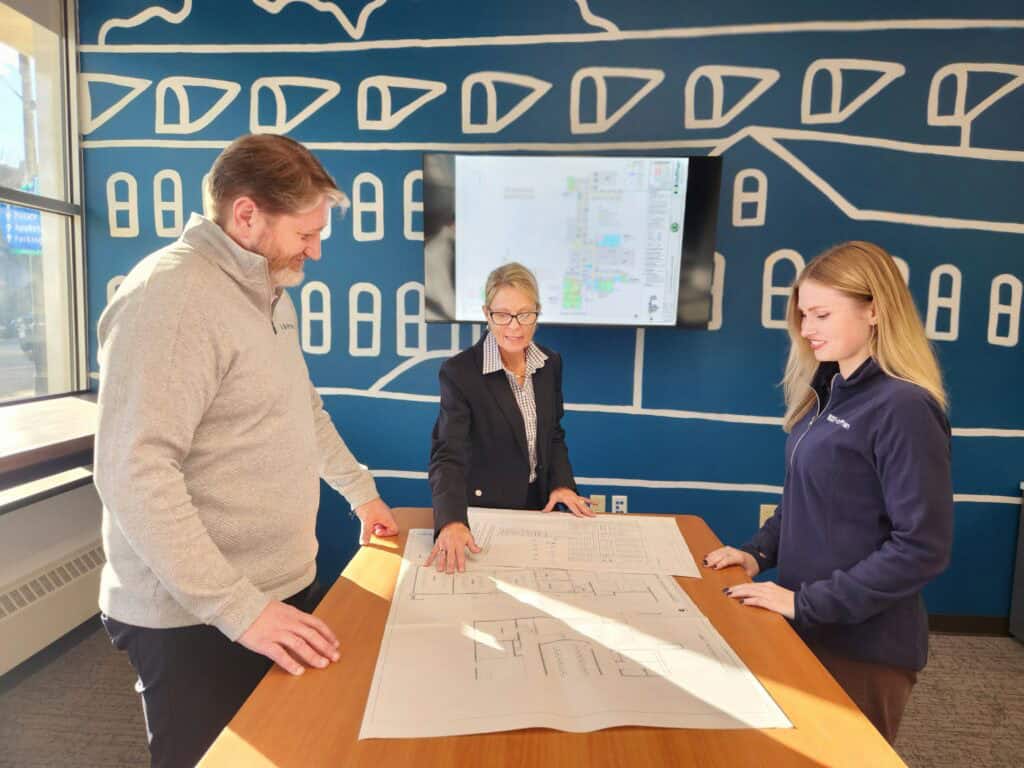
APPLETON – Hoffman Planning, Design & Construction, Inc. recently turned the design, planning and construction tables on itself, spending the better part of a year renovating its entire office area in Appleton’s City Center East at 122 E. College Ave., Suite 1G – using the same principles they use with their clients.
Executive Vice President and COO Chad Ulman said he used the same planning approach Paul Hoffman had employed years earlier when the company’s offices were located near the airport.
Ulman said Hoffman brought in University of Wisconsin-Milwaukee (UWM) students as summer interns to help develop a new office using sustainable design principles.
“The result of that was our Greenville Center building out by the airport,” he said. “We moved into that office in approximately 2000.”
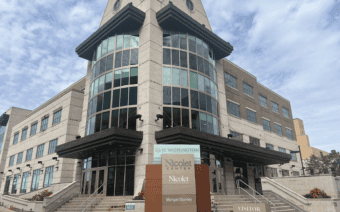
Over the years, Ulman said the company’s footprint became smaller, and in 2007 it moved to downtown Appleton, taking space on the first floor of City Center Plaza in what had previously been the Younkers department store.
“We took advantage of using existing office space and made it suitable for our own needs,” he said.
Making very few changes to the space since the move, Ulman said a refresh was definitely in order.
Following in Hoffman’s footsteps, Ulman said he brought in UWM interns three years ago to spend the summer developing ideas for a refresh of the office. The staff worked with the students throughout the process to develop the final design.
He said the concept was refined over the following two summers, with renovations beginning last summer.

Ulman said work on the 12,217-square-foot office space was done in a four-phase process, starting last summer and wrapping up substantial work this past June.
“There’s a story to why we did this refresh in a certain way,” he said. “And it was kind of cool how it all came full circle over a 20- or 25-year period, and to see what we did back in the day to how and why we did this refresh.”
Office facelift
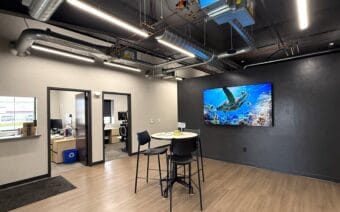
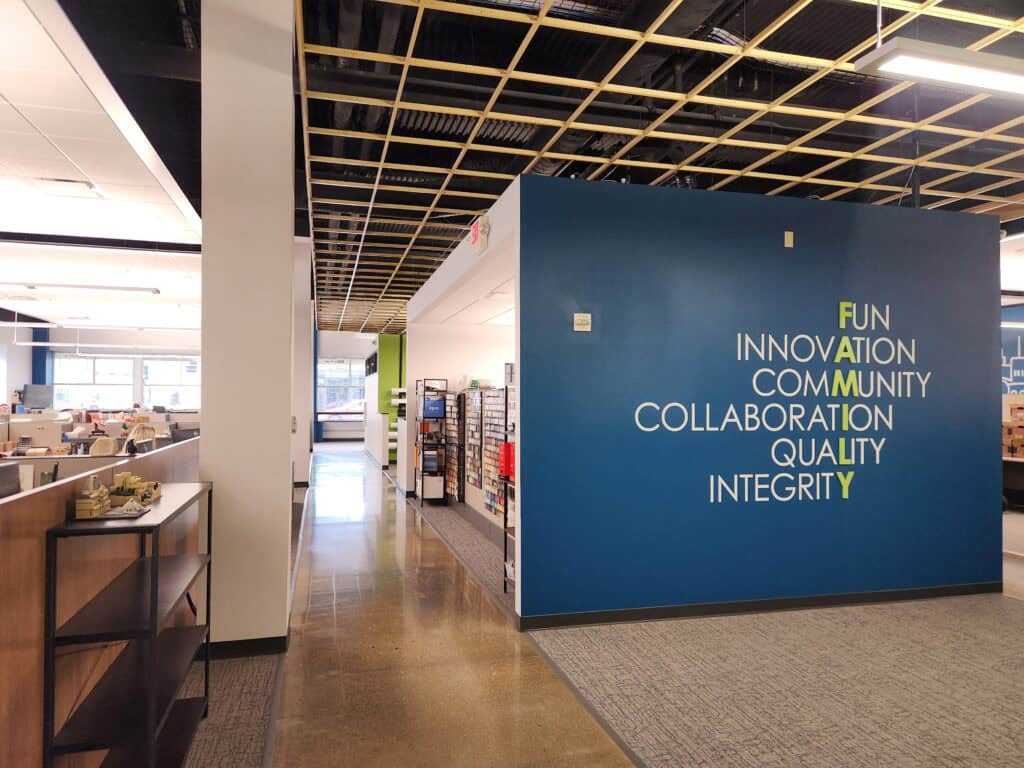
Ulman said the office was designed as an open-concept space, with no individual offices for staff.
Design staff, he said, work on one side, while construction and administrative staff are on the other, with shared spaces in the middle.
Ulman said a wing off to one side was converted from open office space into additional conference rooms.
“On the design side, the cubicles have low walls to promote informal collaboration and communication,” he said. “On the construction and administrative side, the design features higher cubicle walls for greater privacy and better acoustic treatments. And with this design, we have doubled our conference space and now have 10 conference rooms as opposed to the five conference rooms we had before.”
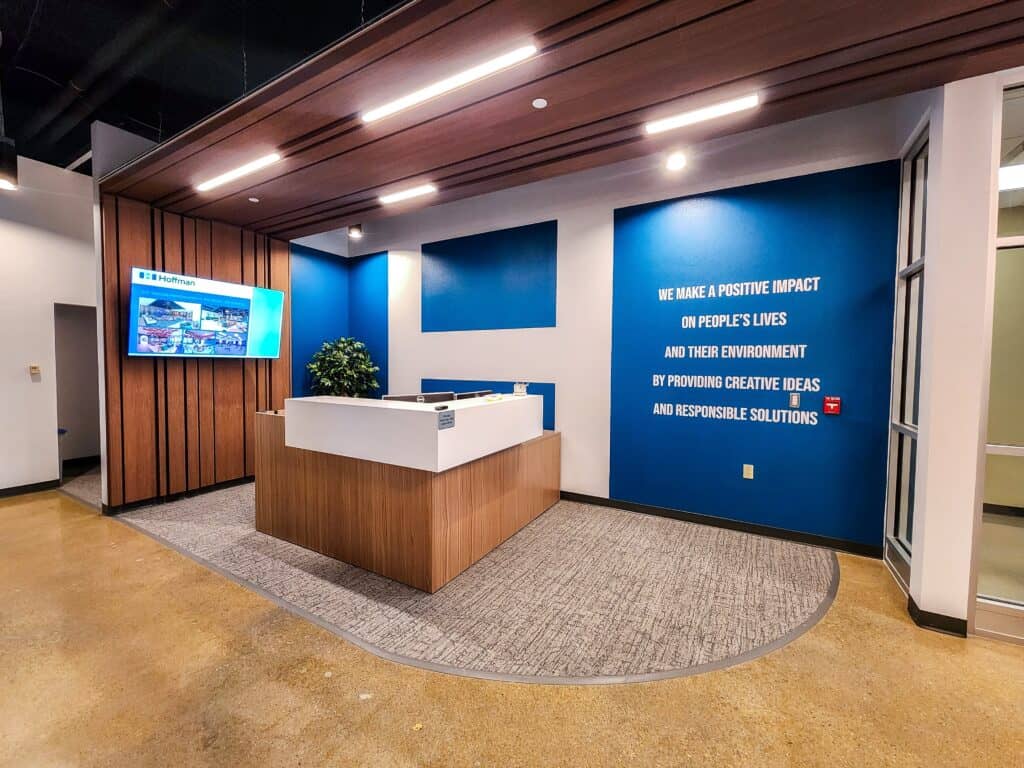
Ulman said the lobby also received a renovation.
The company, he said, is using the walls for more than artwork, incorporating panels that highlight Hoffman’s story and the company’s history.
“Our goal is to tell the history of Hoffman – who we are, what we do and how we do it, as well as the geography and the markets that we work in,” he said. “People will be able to see that as soon as they enter our office. We have the Hoffman history one done already and are starting to work on the others.”
Ulman said the company remained operational throughout the yearlong renovation, with employees either moving to another part of the office or working from home while their areas were renovated.
As each section was completed, he said new furniture was installed, and employees moved back into the space.
Sustainability is a priority for Hoffman on its client projects, and Ulman said the company carried that same approach into its own renovation.
He said Hoffman purchased used cubicles from another company, selected carpets with a high recycled content and converted all of its light fixtures to LED.
Sustainability is the name of the game with Hoffman
Ulman said Hoffman’s goal is to recycle at least 90% of the materials generated during demolition on its client projects.
“Everything we do, we try to look at it through a sustainable lens,” he said, adding that there are many more ways to be sustainable than just using green materials. “Our mission statement says we are to make a positive impact on people’s lives and their environment by providing creative ideas and responsible solutions. I think that is an epitome of sustainability. It’s all-encompassing, and it’s for the betterment of all of us, to create better spaces to live, work and play in.”
Ulman said Hoffman helps clients incorporate sustainability in a variety of ways, from installing LED lighting and using recycled-content materials to reusing existing buildings rather than constructing new ones.
“It can include looking at waste reduction and the energy being used in the client’s building; focusing on indoor air quality and occupant comfort; evaluating water efficiency, by possibly using low-flow toilets, urinals and sinks,” he said. “I encourage smart indoor and outdoor water use.”
Ulman said sustainability can extend beyond building materials and energy efficiency to include the chemicals used in offices, responsible land use and environmental protection.
“It’s all-encompassing and therefore, so much more than just using green products in a building project,” he said.
Ulman said Hoffman applied many of those same practices in its own renovation.
Though most architects and contractors are familiar with LEED (Leadership in Energy and Environmental Design) – a global green-building certification program developed by the U.S. Green Building Council – Ulman said formal certification has become less common because of its cost and administrative requirements.
However, Ulman said Hoffman continues to apply LEED principles to client projects without pursuing formal certification, which he said can come with costs that outweigh the benefits.
“We’ll do it either way, but we can give them a very sustainable building, and they can still tell their sustainable story,” he said. “They just don’t have the plaque on the wall, or the high expense of getting it.”
For more on Hoffman Planning, Design & Construction, Inc., head to hoffman.net.