 Expanding to meet the EV needs of the Fox Valley
 GRB’s United Airlines team honored with safety award


July 27, 2026
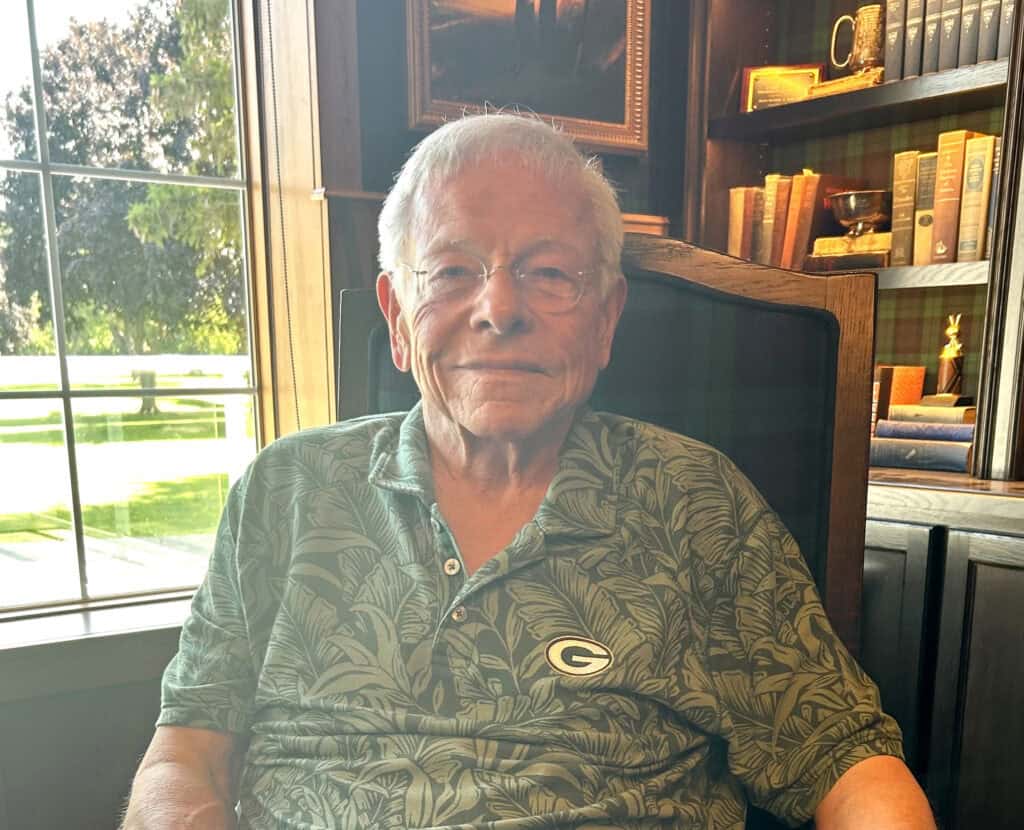
OSHKOSH – Longtime entrepreneur Thurman John “T.J.” Rodgers said for him, giving back is a way of life.
Whether through investments in local businesses, community projects or charitable initiatives, Rodgers – an Oshkosh native – said he has made it a priority to support his hometown in a variety of ways.
That commitment was evident earlier this month at the 6th Annual Oshkosh Country Club Golf Classic, where he helped raise funds for the Oshkosh Kids Foundation Tiny House Village project, which provides short-term housing and wraparound support for local children and families experiencing homelessness.
“It’s always good to be back home in Oshkosh,” Rodgers said in a sit-down interview with The Business News. “I live mostly in California, but I always enjoy my time back in Wisconsin. I get back about a dozen times per year.”
In addition to owning the country club, Rodgers, 78, said he owns several other Oshkosh area businesses, including:
- Truffle Pig
- TJ’s Destinations Oshkosh
- TJ’s Harbor Restaurant
- Ardy & Ed’s Drive In
- Kalbus RV Park
Rodgers said for him, giving back to the community is as important as investing in it.
More on the tiny house village
Several years ago, Rodgers said he was having lunch at TJ’s Harbor Restaurant when Jim Erdman, who runs Oshkosh Country Club, walked in with a woman he introduced as his fifth-grade teacher.

During the conversation, Rodgers said the woman brought up homelessness in Oshkosh – an issue he was unaware existed in his hometown.
“I left Oshkosh in 1965 and came back only for visits,” he said. “I never remember having conversations about homelessness – conversations we now have. I think the problem stems from the fact that so many people are living on the edge. If your company goes belly up or you get laid off, then you can’t make your mortgage payment. Three months later, you don’t have a house.”
As an engineer and someone who “solves problems,” Rodgers said the conversation inspired an interest in helping those experiencing homelessness in Oshkosh.
A trip to Red Granite, he said, “sealed the deal.”
“I came up with the idea to create a tiny house village,” he said. “A tiny house, by code, is less than 500 square feet. It turns out you don’t have to deal with a lot of the government [red tape when you build tiny houses], so long as they are less than 500 square feet.”
Rodgers said he commissioned the help of a carpenter in Red Granite to construct 32 tiny houses for $36,000 each – a total give of $1.152 million.
“It took them about a year to build the tiny houses, which were placed on Packer Avenue, north of town,” he said. “Wilson Jones, the former president and CEO of Oshkosh Corporation, had bought this big piece of land in town and donated it for the village, so I didn’t have to worry about that.”
Rodgers said diving into the Tiny House Village project put him in the charity business – something he quickly learned was not always easy.
“Those tiny houses were a pure expense,” he said. “The idea was that I would put in the capital and design the units – I must have gone over the blueprints 20 times. They have two bedrooms, which function as different things at different times of day. We also made them different enough that they aren’t cookie-cutter.”
In the first six months of 2026 alone, Jon Doemel – site director for the tiny house village – said the Oshkosh Kids Foundation Tiny House Village provided 14,020 nights of shelter, including 8,042 nights for children.
He said the village also launched Village University, a new program that helps residents build skills for long-term stability, including financial literacy, employment readiness, housing readiness, communication and goal setting.
So far this year, Doemel said residents have participated in more than 1,084 support services and activities, including case management meetings, counseling sessions, AODA meetings, educational programming and community engagement.
“We have been running Village University since January,” he said. “Like any new venture, we ran into some problems the first two years, but we are working on things to fix that. Village University is a good start.”
Doemel said with government funding for the program “not lasting forever,” Village University will be an important tool in demonstrating the program’s impact and securing support from outside donors.
“We are trying to find out the proper way to run the tiny houses,” he said.
Rodgers said some “tough love” for residents is involved.
“They pay a small portion of rent, do some finite time and then they graduate to the real world,” he said. “We’re trying to figure out how to make it so we can move families through there and have them be truly better off on the other side.”
With 23 families currently on the waiting list for the tiny house village, Rodgers said it’s not a matter of simply providing homeless people with housing.
“It takes much more than that,” he said. “You have to give them the resources to succeed. I don’t care what you give folks – a new house, a new car, etc. – but if you just give them free rent without stipulations, it’s not going to work. If they need housing, you have to ask them hard questions and give them resources to better themselves.”
Though only about two of the first 37 families successfully graduated out of the tiny house village, Doemel said the “buy-in” rate is slowly increasing.
“Now, about 50% of our families are buying in…,” he said. “We are looking for progress over perfection. They have plenty of chances and the ability to work on their behaviors.”
A legacy started in Oshkosh
Born in 1948, Rodgers said his father was the son of an Alabama sharecropper who enlisted in the U.S. Army weeks after the Pearl Harbor attack.
Rodgers said his mother was drafted after what he jokingly described as “foolishly” signing papers while trying to flirt with a “cute lieutenant” at a recruiting event.
He said she was soon ordered to report to Truax Air Force Base, trained in radio electronics at St. Louis University and spent the remainder of the war teaching electronics.
“After WWII, she stayed home to start a family at our house on Hickory Lane,” he said.
That home, Rodgers said, sits just 50 feet from the shore of Lake Winnebago.
“I still own that home,” he said. “I fished from our dock daily in the summer and through hand-chiseled holes in the ice in the winter.”
Rodgers said he enjoyed an “excellent education” in the Oshkosh public school system and played on back-to-back, undefeated Wisconsin state championship high school football teams.
He said one of his favorite memories was playing a game against Green Bay West High School in City Stadium – the historic venue now known as Lambeau Field.
Rodgers said his path from Oshkosh to California began with a chance meeting in a high school study hall.
“My life changed when a man with a repp stripe tie, blue button-down oxford cloth shirt, gray flannel pants, a navy-blue blazer and wing-tip shoes walked up to me in an Oshkosh High School study hall and said, ‘My name is Earl Hamilton – I’m the line coach at Dartmouth College,’ which is in Hanover, New Hampshire,” Rodgers said.
At the time, Rodgers said Dartmouth was an all-male school.
Working seven days a week while attending Dartmouth, Rodgers said he majored in chemistry and physics – skills he frequently uses daily, “kept sharp by 56 years of continuous education in California’s Silicon Valley.”
“I only played one year of football at Dartmouth because the work was so arduous,” he said. “Dartmouth eventually led to a Stanford PhD, a new career-long passion and integrated circuits.”
Today, Rodgers said he still works daily as CEO of SunPower and as a director of his five other portfolio companies.
“They make everything from advanced lithium-ion batteries to a bourbon whiskey that has won 270 awards,” he said.
Though Rodgers said he has never forgotten where he started.
Through his continued investments in local businesses and community projects, he said he remains committed to giving back to the hometown that helped shape him.