 Sargento builds its own road to CDL talent
 Chamber business survey: ‘Very positive news’ for 2025


March 23, 2026
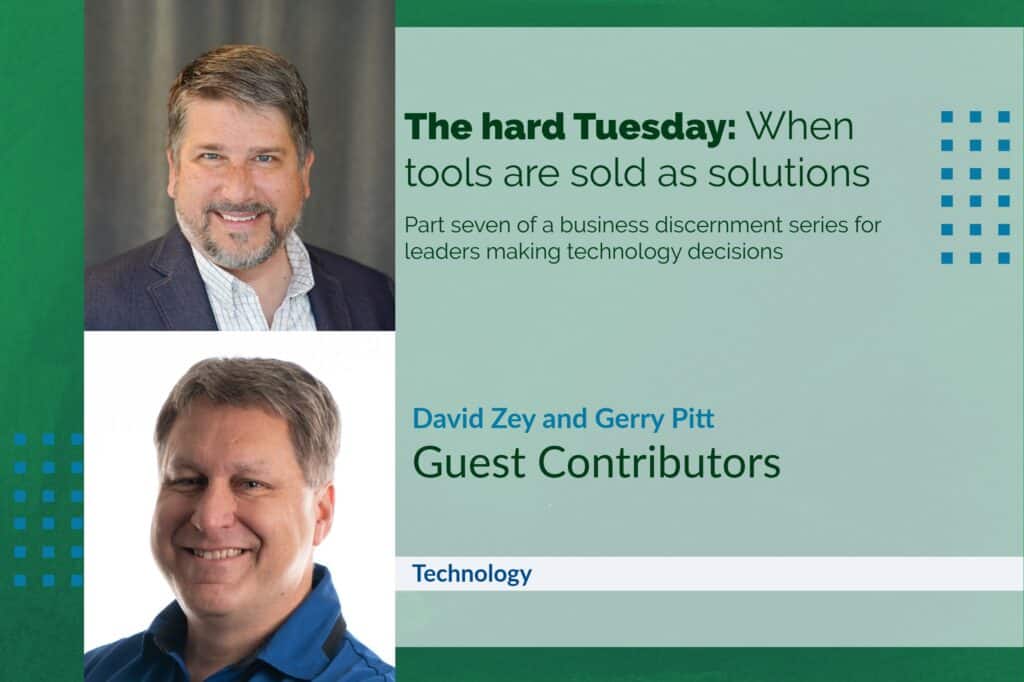
At some point, the tools stopped serving the work and instead became the work.
Most business owners cannot tell you exactly when it happened.
They just know that somewhere between the third platform and the fifth, Tuesday got heavier.
In this seventh piece in our discernment series, we return to a story we come back to again and again, because it’s the one we hear most often.
The Marcus we know
Marcus runs a 40-person professional services firm in the Fox Valley.
Good team, strong client relationships – the kind of business that earns its reputation slowly and protects it carefully.
We have sat with some version of Marcus in many Midwest companies.
He also has five platforms: a project management tool, a CRM, document automation, a communication suite and a reporting dashboard.
Each one purchased in a moment of genuine need.
Each one demonstrated by someone who understood the pain and had a real answer for it.
But somewhere along the way, the tools became the work.
Not dramatically – that’s the thing about this kind of drift.
It doesn’t arrive as a crisis – it arrives as a Tuesday.
A login here, a manual export there, a 15-minute conversation to reconcile two systems that were supposed to talk to each other but do not quite.
The effort accumulates the way mud does on a long walk.
You do not notice the weight until you try to pick up your pace and realize you can’t.
Marcus knew something was wrong.
He just could not stand far enough outside it to see what.
From inside the work, the tools did look like the solution.
They had all been purchased as solutions.
The idea that they had quietly become part of the problem was hard to discern while he was still inside it.
What we too often find
When we slow down and follow the work, before we look at the platforms, the pattern is remarkably consistent across the Marcuses we have spent time with.
It usually takes less than a week with no tools required (perhaps a pen and a notebook).
Just time inside the actual work, watching where it moves and where it does not.
What you find is:
Two or more platforms solving the same problem – one purchased before a process change that made its core function obsolete.
Nobody canceled it, because canceling it would have required a conversation about why it was bought in the first place, and that conversation was easier to keep busily avoiding.
A reporting dashboard producing data sits unread – not because the team does not care, but because the metrics it generates do not connect to any decision anyone is actually making.
A communication tool that has quietly become an elaborate email system – not what it was built for, but it fits the way the team actually moves through their day, and nobody has stepped back far enough to see the distance between the promise and the use.
The technology is not the problem – it never quite was.
What is missing is a process that was never named, and the tools have been filling that silence ever since.
Three signs the tools have become the work
When we talk with owners who are feeling this friction, three signals show up almost immediately:
- Work requires logging into multiple systems just to answer a simple operational question.
- Teams spend time reconciling data between tools instead of using that information to make decisions.
- The most important workflows still rely on someone remembering to do the next step.
None of this feels like a technology failure in isolation.
But together they point to a deeper issue: the process underneath the tools was never clearly defined.
The thing about the demo
Every one of those platforms had a good demo – that is worth saying plainly.
This is not a story about bad vendors or careless buying.
The products work, the sales teams are skilled and the ROI cases are built on real results.
What a demo cannot show you is your own ground
It shows you the ground that was prepared for it – clean, level.
The assumptions underneath, almost always unstated, are that your process is roughly similar, your integrations are straightforward and your team will move the way the demo team moved.
For a large organization, those assumptions are someone’s job to validate.
For a 40-person firm, that job falls to whoever has capacity, which usually means whoever is already carrying the most.
So, the platform gets deployed – partially.
The workarounds accumulate, the investment settles somewhere between shelfware and friction and the team keeps moving because stopping feels like one more thing they do not have time for.
Tuesday gets heavier – nobody can quite say why.
The question underneath the question
When Marcus asked what he should do, the answer was not a different platform – it was a different starting place.
Not: what tool would help us?
But: where is the work actually breaking down?
The first question puts you in a product conversation.
Features, costs, comparisons, demos – that conversation has its place, but it assumes the problem is already understood.
That the gap is a capability gap and the solution is a purchase.
The second question asks you to walk the ground before you build on it – to follow the work honestly from beginning to end, to notice the workarounds your team has developed, the quiet expertise they have built to make an imperfect process survive the day.
Those compensating behaviors are not inefficient – they are a map.
They show you exactly where the ground is soft.
A useful starting exercise is surprisingly simple: pick one workflow that happens every day – proposals, onboarding, billing or project kickoff – and follow it from beginning to end.
Write down every handoff, every login, every manual step.
The points where people pause, improvise or check another system are almost always where the real problem lives.
From that map, the technology conversation gets specific.
Not what platform manages projects, but what is causing proposals to stall at the approval stage and whether that is a visibility problem, a communication problem or a process problem that no platform will touch.
One question reaches for a product – the other reaches for the work.
They do not lead to the same place.
What changed for Marcus
Two platforms out:
- One integration connecting systems that had been siloed for three years.
- A workflow redesign that required no new software at all, just clarity about who owned what and when.
The team noticed within two weeks, not because anyone told them things were better, but because the Tuesday weight was gone.
The logins that led nowhere, the exports to reconcile, the 15-minute conversations to confirm what should have been obvious from the start were no longer bogging them down.
Marcus still has three platforms, and they are the right three.
They sit on ground that was understood before the purchase, not after.
That sequencing is the whole thing.
When the ground holds
A mirage is not a lie – the image is real and the physics are sound.
What is missing is not the vision, it is the substance that grounds it.
The leaders who find their footing with technology are not the ones with the most platforms – they are the ones who walked the ground first, who sat with the friction long enough to understand what was generating it and who asked the slower question before the faster purchase.
And when the ground holds, something shifts.
The effort that used to disappear into the overhead starts going somewhere.
The team moves.
The work moves.
What felt like a technology problem turns out to have been a foundation problem, and once the foundation is right, the tools do what they always promised they would.
That is the evolution – quiet and cumulative over time.
The kind you feel on a Wednesday morning when the work just moves, and you realize Tuesday has not been heavy in a while.