 Cedar Lake Speedway: Home of ‘old-fashioned fun’
 3 Sheeps, LeRoy Butler team up for NFL Draft celebrations



April 20, 2026
Manufacturers regularly face significant workforce challenges, such as labor shortages and a widening skills gap, that can make growth feel out of reach.
These issues strain day-to-day operations and threaten long-term growth and competitiveness.
According to recent reports from the Manufacturing Institute and Deloitte, millions of manufacturing jobs could remain unfilled in the coming years, creating significant pressure on businesses to adapt.
The key to overcoming these challenges lies in a strategic, people-first approach.
Successful manufacturers are focusing on strategies that align their workforce with long-term growth goals.
By investing in targeted upskilling programs, fostering innovation and building growth-oriented teams, manufacturers can transform their existing workforce into a powerful engine for sustainable success, even in a tight labor market.
This approach helps close the skills gap, while building resilience and enabling manufacturers to achieve meaningful growth without relying on aggressive hiring.
Manufacturing workforce challenges
Manufacturers today face a serious talent crisis.
As experienced team members retire, fewer young people pursue careers in manufacturing – while, at the same time, new technology demands updated skills.
According to a January 2026 report by AdvancedManufacturing.org, 69% of manufacturers are turning to robotics and advanced hardware to bridge the gap, while 62% of manufacturers are prioritizing employee training, retention and recruitment efforts.
Additionally, the Deloitte 2026 Manufacturing Industry Outlook highlights a growing reliance on a “build, buy, borrow” strategy, where manufacturers leverage artificial intelligence (AI) for hiring and upskilling, while adopting flexible work models to attract and retain talent.
Without enough skilled people in the right positions, it becomes harder to keep machines running and adapt quickly when new challenges arise.
These workforce challenges disrupt production, slow response to market needs and make it much tougher to achieve long-term growth goals.
When you cannot staff your production lines or specialized technical roles, the impact extends far beyond the factory floor.
Operational efficiency plummets, delivery timelines extend, customer satisfaction drops and innovation slows.
This makes it essential to maximize the potential of your current team.
Align teams with active growth goals
Achieving sustainable growth in manufacturing starts with aligning your teams around a clear and actionable vision.
Instead of lofty ideas, provide practical direction that ties company ambitions to the everyday work of each team member.
A well-defined vision connects high-level business goals to daily tasks, ensuring every team member understands how their work contributes to the company’s overall success.
For example, a passive vision like “increase operational efficiency” leaves teams unsure of priorities or progress.
An active vision – such as “reduce material waste by 10% this year to fund new automation technology” – provides clear, measurable goals and purpose.
With the clarity of an active vision, each employee knows what to aim for and how their daily efforts drive the company forward.
Another critical step to fostering alignment is breaking down silos.
When production, sales and marketing work in isolation, it leads to wasted resources and repeated efforts.
Consistent communication and cross-functional collaboration are essential for creating a unified workforce.
One way to boost teamwork and keep everyone on the same page is by having quick daily check-ins or regular meetings that include people from different departments.
For example, when a floor manager and sales director collaborate to reduce lead times, they combine knowledge of production processes with an understanding of customer needs, streamlining workflows and driving growth.
This type of teamwork helps ensure alignment and breaks down barriers to drive improvements across the company.
When teams are aligned, the results are transformative.
A shared sense of direction drives productivity by reducing inefficiencies, sparking innovation through collaborative problem-sharing and delivering measurable growth by ensuring every effort is focused on shared objectives.
By fostering alignment, manufacturers can create a workforce that is not only engaged but also empowered to achieve long-term success.
Invest in upskilling and training
You cannot always hire your way out of a skills gap, but you can train your way out of it.
Upskilling your current workforce is one of the most effective strategies for overcoming labor shortages.
When you invest in training, you equip your employees to handle new technologies or machinery and take on complex leadership roles.
Consider this example of a national manufacturer that successfully built a talent pipeline to meet aggressive expansion plans.
Instead of relying solely on external recruitment, the company developed several comprehensive internal training programs.
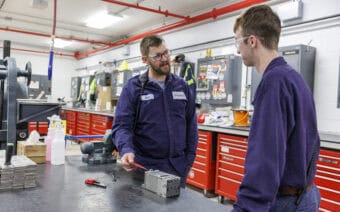
They identified high-potential employees on the production floor and provided them with the technical training necessary to transition into specialized engineering and management roles.
Continuous learning, like what is mentioned above, offers dual benefits.
For employees, it provides clear career progression, increased job satisfaction and a compelling reason to stay with the company
For employers, it builds a highly capable, adaptable workforce that can pivot alongside rapid technological changes and market demands.
Fostering a culture of innovation
Innovation is a critical tool for helping manufacturers stay competitive despite having fewer hands on deck.
When your workforce is lean, you must rely on smart ideas and efficient processes to maintain output.
Cultivating an environment where innovation thrives starts with encouraging employees at all levels to contribute ideas and solutions.
Often, the most practical efficiency improvements come from the operators who manage the equipment every day.
Create an environment that genuinely supports experimentation and collaboration.
Start by encouraging leaders to model open-mindedness, provide regular opportunities for employees to share ideas and recognize creative contributions, both big and small.
When employees feel safe sharing unconventional ideas without fear of harsh criticism, breakthrough improvements happen.
This collaborative approach to problem-solving can yield remarkable results.
By leaning into internal innovation and cross-departmental collaboration, one manufacturer successfully secured more than 50 new customers with zero outside sales hires.
They achieved this by optimizing their internal processes, utilizing data-driven marketing and empowering their existing support teams to cross-sell effectively.
This proves that a culture of innovation can directly drive revenue, even when traditional resources are limited.
Turning workforce challenges into growth opportunities
Though workforce challenges in manufacturing are real and complex, they also present an unprecedented opportunity for transformation and growth.
By boldly aligning your teams around a shared active vision, investing in skill development and building a collaborative, innovative culture, you can turn staffing constraints into a catalyst for progress.
Companies that embrace this mindset don’t just survive – they thrive, uncovering efficiencies, sparking new ideas and driving results even when resources are tight.
The organizations willing to adapt and empower their people today will be the leaders setting the pace for tomorrow’s manufacturing industry.
Don’t wait for external conditions to improve; act now to define your active vision, invest in upskilling and empower your teams to collaborate and innovate.
When you equip and motivate your people, you turn today’s workforce challenges into tomorrow’s sustainable growth and competitive advantage.
For more, visit stokerga.com.